Help us inform millions of consumers around the world about what they eat
Please give to our 2026 Fundraiser
Your donations fund the day-to-day operations of our non-profit association:
-
keeping our database open & available to all,
- technical infrastructure (website/mobile app) & a small permanent team
-
remain independent of the food industry,
-
engage a community of committed citizens,
-
support the advancement of public health research.
Wing sauce – Hooters
This product page is not complete. You can help to complete it by editing it and adding more data from the photos we have, or by taking more photos using the app for Android or iPhone/iPad. Thank you!
×
Barcode:
0733286000029(EAN / EAN-13) 733286000029 (UPC / UPC-A)
Barcode:
0733286000029(EAN / EAN-13) 733286000029 (UPC / UPC-A)
Brands: Hooters
Brand owner: Hooters Foods Inc.
Categories: Condiments, Sauces, Groceries, Wing sauce
Countries where sold: United States
Matching with your preferences
Health
Nutrition
-
Nutri-Score E
Lower nutritional quality
⚠ ️Warning: the amount of fruits, vegetables and nuts is not specified on the label, it was estimated from the list of ingredients: 0-
Discover the new Nutri-Score!
The computation of the Nutri-Score is evolving to provide better recommendations based on the latest scientific evidence.
Main improvements:
- Better score for some fatty fish and oils rich in good fats
- Better score for whole products rich in fiber
- Worse score for products containing a lot of salt or sugar
- Worse score for red meat (compared to poultry)
-
What is the Nutri-Score?
The Nutri-Score is a logo on the overall nutritional quality of products.
The score from A to E is calculated based on nutrients and foods to favor (proteins, fiber, fruits, vegetables and legumes ...) and nutrients to limit (calories, saturated fat, sugars, salt). The score is calculated from the data of the nutrition facts table and the composition data (fruits, vegetables and legumes).
Negative points: 26/55
-
Energy
4/10 points (1674kJ)
Energy intakes above energy requirements are associated with increased risks of weight gain, overweight, obesity, and consequently risk of diet-related chronic diseases.
-
Sugar
0/15 points (0g)
A high consumption of sugar can cause weight gain and tooth decay. It also augments the risk of type 2 diabetes and cardio-vascular diseases.
-
Saturated fat
10/10 points (16.67g)
A high consumption of fat, especially saturated fats, can raise cholesterol, which increases the risk of heart diseases.
-
Salt
12/20 points (2.46g)
A high consumption of salt (or sodium) can cause raised blood pressure, which can increase the risk of heart disease and stroke.
Positive points: 0/10
-
Fiber
0/5 points (0g)
Consuming foods rich in fiber (especially whole grain foods) reduces the risks of aerodigestive cancers, cardiovascular diseases, obesity and diabetes.
-
Fruits, vegetables and legumes
0/5 points (0%)
Consuming foods rich in fruits, vegetables and legumes reduces the risks of aerodigestive cancers, cardiovascular diseases, obesity and diabetes.
-
Details of the calculation of the Nutri-Score
⚠ ️Warning: the amount of fruits, vegetables and nuts is not specified on the label, it was estimated from the list of ingredients: 0This product is not considered a beverage for the calculation of the Nutri-Score.
Points for proteins are not counted because the negative points greater than or equal to 11.
Nutritional score: 26 (26 - 0)
Nutri-Score: E
-
-
Nutrient levels
-
Fat in high quantity (43.3%)
What you need to know- A high consumption of fat, especially saturated fats, can raise cholesterol, which increases the risk of heart diseases.
Recommendation: Limit the consumption of fat and saturated fat- Choose products with lower fat and saturated fat content.
-
Saturated fat in high quantity (16.7%)
What you need to know- A high consumption of fat, especially saturated fats, can raise cholesterol, which increases the risk of heart diseases.
Recommendation: Limit the consumption of fat and saturated fat- Choose products with lower fat and saturated fat content.
-
Sugars in low quantity (0%)
What you need to know- A high consumption of sugar can cause weight gain and tooth decay. It also augments the risk of type 2 diabetes and cardio-vascular diseases.
Recommendation: Limit the consumption of sugar and sugary drinks- Sugary drinks (such as sodas, fruit beverages, and fruit juices and nectars) should be limited as much as possible (no more than 1 glass a day).
- Choose products with lower sugar content and reduce the consumption of products with added sugars.
-
Salt in high quantity (2.46%)
What you need to know- A high consumption of salt (or sodium) can cause raised blood pressure, which can increase the risk of heart disease and stroke.
- Many people who have high blood pressure do not know it, as there are often no symptoms.
- Most people consume too much salt (on average 9 to 12 grams per day), around twice the recommended maximum level of intake.
Recommendation: Limit the consumption of salt and salted food- Reduce the quantity of salt used when cooking, and don't salt again at the table.
- Limit the consumption of salty snacks and choose products with lower salt content.
-
-
Nutrition facts
Nutrition facts As sold
for 100 g / 100 mlCompared to: Groceries Energy 1673 kJ
(400 kcal)815.458 kj (198 kcal) (+105%) Energy from fat 460 g
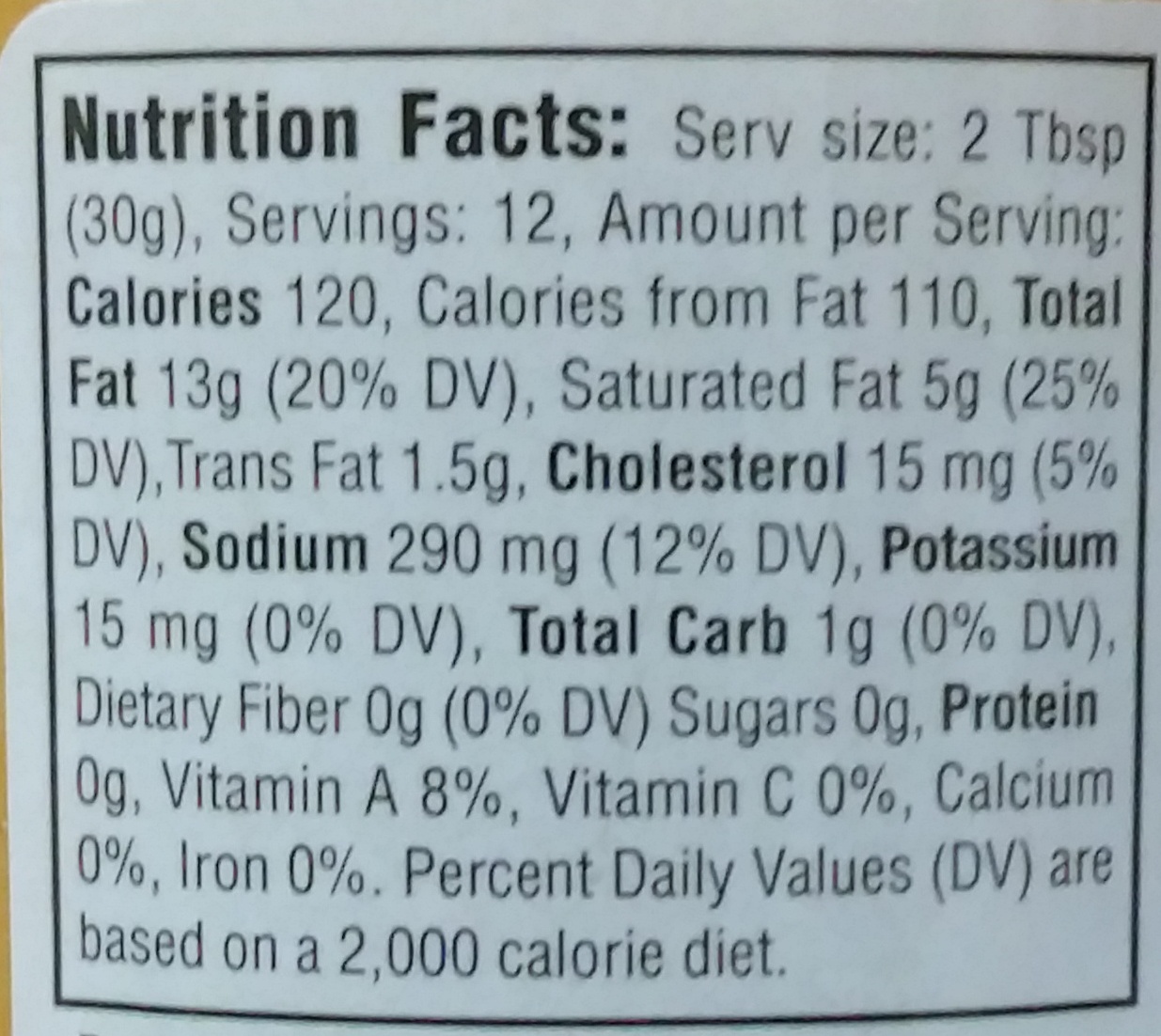
(110 kcal)407.102 kj (22539075121554 kcal) (+13%) Fat 43.33 g 13.198 g (+228%) Saturated fat 16.67 g 1.818 g (+817%) Trans fat 5 g 0 g (+1,846,241%) Cholesterol 0.05 g 6.607 mg (+657%) Carbohydrates 3.33 g 12.003 g (-72%) Sugars 0 g 6.694 g (-100%) Fiber 0 g 1.753 g (-100%) Proteins 0 g 2.677 g (-100%) Salt 2.4562 g 2.413 g (+2%) Sodium 0.98248 g 0.964 g (+2%) Vitamin A 0.0003999 g 5.1 µg (+7,741%) Vitamin C (ascorbic acid) 0 g 6.911 mg (-100%) Potassium 0.05 g 230.184 mg (-78%) Calcium 0 g 43.003 mg (-100%) Iron 0 g 1.167 mg (-100%) Fruits‚ vegetables‚ legumes ? 27.432 % -
Nutrition facts (Detailed data)
Nutrition facts As sold
for 100 g / 100 mlAs sold for 100 g (packaging) Energy 1673 kJ
(400 kcal)? kcal
(400 kcal)Energy from fat 460 g
(110 kcal)460 g
(110 kcal)Fat 43.33 g 43.33 g Saturated fat 16.67 g 16.67 g Trans fat 5 g 5 g Cholesterol 0.05 g 0.05 g Carbohydrates 3.33 g 3.33 g Sugars 0 g 0 g Fiber 0 g 0 g Proteins 0 g 0 g Salt 2.4562 g 2.4562 g Sodium 0.98248 g 0.98248 g Vitamin A 0.0003999 g 0.0003999 g Vitamin C (ascorbic acid) 0 g 0 g Potassium 0.05 g 0.05 g Calcium 0 g 0 g Iron 0 g 0 g Fruits‚ vegetables‚ legumes ? ?
-
Ingredients
-
36 ingredients
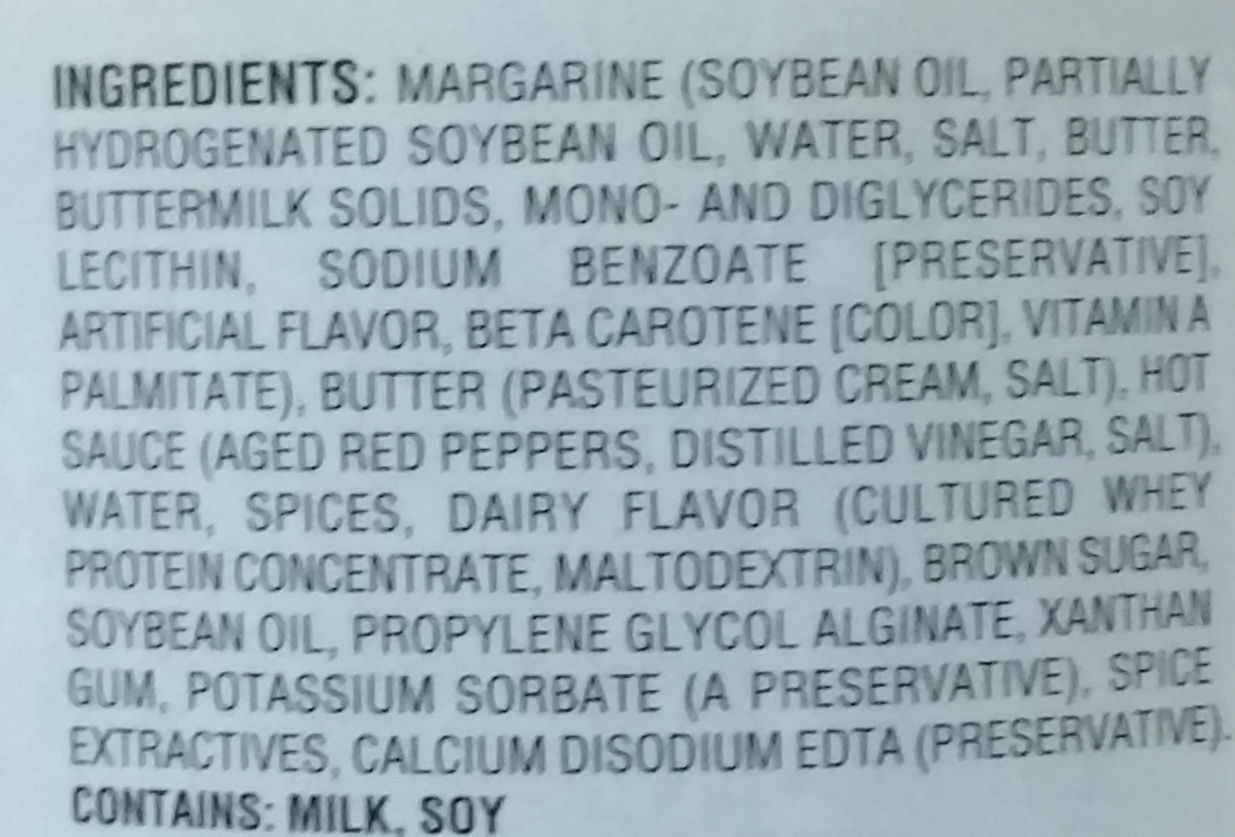
Margarine (soybean oil, partially hydrogenated soybean oil, water, salt, butter, buttermilk solids, mono - and diglycerides, soy lecithin, sodium benzoate [preservative], artificial flavor, beta carotene [color], vitamin a palmitate), butter (pasteurized cream, salt), hot sauce (aged red peppers, distilled vinegar, salt), water, spices, dairy flavor (cultured whey protein concentrate, maltodextrin), brown sugar, soybean oil, propylene glycol alginate, xanthan gum, potassium sorbate (a preservative), spice extractives, calcium disodium edta (preservative).Allergens: Milk, Soybeans-
Ingredient information
-
Margarine: 50.0% (estimate)
-
— Soya oil: 25.0% (estimate)
-
— Partially hydrogenated soybean oil: 12.5% (estimate)
-
— Water: 6.2% (estimate)
-
— Salt: 3.1% (estimate)
-
— Butter: < 2% (estimate)
-
— Buttermilk solids: < 2% (estimate)
-
— E471: < 2% (estimate)
-
— Soya lecithin: < 2% (estimate)
-
— E211: < 2% (estimate)
-
—— Preservative: < 2% (estimate)
-
— Artificial flavouring: < 2% (estimate)
-
— E160ai: < 2% (estimate)
-
—— Colour: < 2% (estimate)
-
— Retinyl palmitate: < 2% (estimate)
-
Butter: 25.0% (estimate)
-
— Cream: 12.5% (estimate)
-
— Salt: 12.5% (estimate)
-
Hot sauce: 12.5% (estimate)
-
— Aged-red-peppers: 6.2% (estimate)
-
— Distilled vinegar: 3.1% (estimate)
-
— Salt: 3.1% (estimate)
-
Water: 6.2% (estimate)
-
Spice: 3.1% (estimate)
-
Dairy-flavor: < 2% (estimate)
-
— Cultured-whey-protein-concentrate: < 2% (estimate)
-
— Maltodextrin: < 2% (estimate)
-
Brown sugar: < 2% (estimate)
-
Soya oil: < 2% (estimate)
-
E405: < 2% (estimate)
-
E415: < 2% (estimate)
-
E202: < 2% (estimate)
-
— Preservative: < 2% (estimate)
-
Spice: < 2% (estimate)
-
E385: < 2% (estimate)
-
— Preservative: < 2% (estimate)
-
-
-
Contains added sugars (~ 0%)
Added sugars: Brown sugar
Estimated quantity of added sugars in ingredients: 0%Search for products in the same category without added sugars: SaucesWhat you need to know- A high consumption of sugar can cause weight gain and tooth decay. It also augments the risk of type 2 diabetes and cardio-vascular diseases.
Recommendation: Limit the consumption of sugar and sugary drinks- Sugary drinks (such as sodas, fruit beverages, and fruit juices and nectars) should be limited as much as possible (no more than 1 glass a day).
- Choose products with lower sugar content and reduce the consumption of products with added sugars.
Food processing
-
Ultra-processed foods
8 ultra-processing markers
-
Limit ultra-processed foods
Limiting ultra-processed foods reduces the risk of noncommunicable chronic diseases
Several studies have found that a lower consumption of ultra-processed foods is associated with a reduced risk of noncommunicable chronic diseases, such as obesity, hypertension and diabetes.
Source: Ultra-processed foods increase noncommunicable chronic disease risk
Elements that indicate the product is in the 4 - Ultra processed food and drink products group:
- Additive: E160a - Carotene
- Additive: E322 - Lecithins
- Additive: E405 - Propane-1‚2-diol alginate
- Additive: E415 - Xanthan gum
- Additive: E471 - Mono- and diglycerides of fatty acids
- Ingredient: Colour
- Ingredient: Flavouring
- Ingredient: Maltodextrin
Food products are classified into 4 groups according to their degree of processing:
- Unprocessed or minimally processed foods
- Processed culinary ingredients
- Processed foods
- Ultra-processed foods
The determination of the group is based on the category of the product and on the ingredients it contains.
-
Additives
-
E160a - Carotene
Carotene: The term carotene -also carotin, from the Latin carota, "carrot"- is used for many related unsaturated hydrocarbon substances having the formula C40Hx, which are synthesized by plants but in general cannot be made by animals -with the exception of some aphids and spider mites which acquired the synthesizing genes from fungi-. Carotenes are photosynthetic pigments important for photosynthesis. Carotenes contain no oxygen atoms. They absorb ultraviolet, violet, and blue light and scatter orange or red light, and -in low concentrations- yellow light. Carotenes are responsible for the orange colour of the carrot, for which this class of chemicals is named, and for the colours of many other fruits, vegetables and fungi -for example, sweet potatoes, chanterelle and orange cantaloupe melon-. Carotenes are also responsible for the orange -but not all of the yellow- colours in dry foliage. They also -in lower concentrations- impart the yellow coloration to milk-fat and butter. Omnivorous animal species which are relatively poor converters of coloured dietary carotenoids to colourless retinoids have yellowed-coloured body fat, as a result of the carotenoid retention from the vegetable portion of their diet. The typical yellow-coloured fat of humans and chickens is a result of fat storage of carotenes from their diets. Carotenes contribute to photosynthesis by transmitting the light energy they absorb to chlorophyll. They also protect plant tissues by helping to absorb the energy from singlet oxygen, an excited form of the oxygen molecule O2 which is formed during photosynthesis. β-Carotene is composed of two retinyl groups, and is broken down in the mucosa of the human small intestine by β-carotene 15‚15'-monooxygenase to retinal, a form of vitamin A. β-Carotene can be stored in the liver and body fat and converted to retinal as needed, thus making it a form of vitamin A for humans and some other mammals. The carotenes α-carotene and γ-carotene, due to their single retinyl group -β-ionone ring-, also have some vitamin A activity -though less than β-carotene-, as does the xanthophyll carotenoid β-cryptoxanthin. All other carotenoids, including lycopene, have no beta-ring and thus no vitamin A activity -although they may have antioxidant activity and thus biological activity in other ways-. Animal species differ greatly in their ability to convert retinyl -beta-ionone- containing carotenoids to retinals. Carnivores in general are poor converters of dietary ionone-containing carotenoids. Pure carnivores such as ferrets lack β-carotene 15‚15'-monooxygenase and cannot convert any carotenoids to retinals at all -resulting in carotenes not being a form of vitamin A for this species-; while cats can convert a trace of β-carotene to retinol, although the amount is totally insufficient for meeting their daily retinol needs.Source: Wikipedia
-
E160ai - Beta-carotene
Beta-Carotene: β-Carotene is an organic, strongly colored red-orange pigment abundant in plants and fruits. It is a member of the carotenes, which are terpenoids -isoprenoids-, synthesized biochemically from eight isoprene units and thus having 40 carbons. Among the carotenes, β-carotene is distinguished by having beta-rings at both ends of the molecule. β-Carotene is biosynthesized from geranylgeranyl pyrophosphate.β-Carotene is the most common form of carotene in plants. When used as a food coloring, it has the E number E160a. The structure was deduced by Karrer et al. in 1930. In nature, β-carotene is a precursor -inactive form- to vitamin A via the action of beta-carotene 15‚15'-monooxygenase.Isolation of β-carotene from fruits abundant in carotenoids is commonly done using column chromatography. It can also be extracted from the beta-carotene rich algae, Dunaliella salina. The separation of β-carotene from the mixture of other carotenoids is based on the polarity of a compound. β-Carotene is a non-polar compound, so it is separated with a non-polar solvent such as hexane. Being highly conjugated, it is deeply colored, and as a hydrocarbon lacking functional groups, it is very lipophilic.Source: Wikipedia
-
E202 - Potassium sorbate
Potassium sorbate (E202) is a synthetic food preservative commonly used to extend the shelf life of various food products.
It works by inhibiting the growth of molds, yeast, and some bacteria, preventing spoilage. When added to foods, it helps maintain their freshness and quality.
Some studies have shown that when combined with nitrites, potassium sorbate have genotoxic activity in vitro. However, potassium sorbate is generally recognized as safe (GRAS) by regulatory authorities.
-
E211 - Sodium benzoate
Sodium benzoate: Sodium benzoate is a substance which has the chemical formula NaC7H5O2. It is a widely used food preservative, with an E number of E211. It is the sodium salt of benzoic acid and exists in this form when dissolved in water. It can be produced by reacting sodium hydroxide with benzoic acid.Source: Wikipedia
-
E322 - Lecithins
Lecithins are natural compounds commonly used in the food industry as emulsifiers and stabilizers.
Extracted from sources like soybeans and eggs, lecithins consist of phospholipids that enhance the mixing of oil and water, ensuring smooth textures in various products like chocolates, dressings, and baked goods.
They do not present any known health risks.
-
E322i - Lecithin
Lecithins are natural compounds commonly used in the food industry as emulsifiers and stabilizers.
Extracted from sources like soybeans and eggs, lecithins consist of phospholipids that enhance the mixing of oil and water, ensuring smooth textures in various products like chocolates, dressings, and baked goods.
They do not present any known health risks.
-
E385 - Calcium disodium ethylenediaminetetraacetate
-
E405 - Propane-1‚2-diol alginate
Propylene glycol alginate: Propylene glycol alginate -PGA- is an emulsifier, stabilizer, and thickener used in food products. It is a food additive with E number E405. Chemically, propylene glycol alginate is an ester of alginic acid, which is derived from kelp. Some of the carboxyl groups are esterified with propylene glycol, some are neutralized with an appropriate alkali, and some remain free.Source: Wikipedia
-
E415 - Xanthan gum
Xanthan gum (E415) is a natural polysaccharide derived from fermented sugars, often used in the food industry as a thickening and stabilizing agent.
This versatile food additive enhances texture and prevents ingredient separation in a wide range of products, including salad dressings, sauces, and gluten-free baked goods.
It is considered safe for consumption even at high intake amounts.
-
E471 - Mono- and diglycerides of fatty acids
Mono- and diglycerides of fatty acids (E471), are food additives commonly used as emulsifiers in various processed foods.
These compounds consist of glycerol molecules linked to one or two fatty acid chains, which help stabilize and blend water and oil-based ingredients. E471 enhances the texture and shelf life of products like margarine, baked goods, and ice cream, ensuring a smooth and consistent texture.
It is generally considered safe for consumption within established regulatory limits.
Ingredients analysis
-
May contain palm oil
Ingredients that may contain palm oil: E471
-
Non-vegan
Non-vegan ingredients: Butter, Buttermilk solids, Butter, CreamSome ingredients could not be recognized.
We need your help!
You can help us recognize more ingredients and better analyze the list of ingredients for this product and others:
- Edit this product page to correct spelling mistakes in the ingredients list, and/or to remove ingredients in other languages and sentences that are not related to the ingredients.
- Add new entries, synonyms or translations to our multilingual lists of ingredients, ingredient processing methods, and labels.
If you would like to help, join the #ingredients channel on our Slack discussion space and/or learn about ingredients analysis on our wiki. Thank you!
-
Vegetarian status unknown
Unrecognized ingredients: Margarine, Aged-red-peppers, Dairy-flavor, Cultured-whey-protein-concentrateSome ingredients could not be recognized.
We need your help!
You can help us recognize more ingredients and better analyze the list of ingredients for this product and others:
- Edit this product page to correct spelling mistakes in the ingredients list, and/or to remove ingredients in other languages and sentences that are not related to the ingredients.
- Add new entries, synonyms or translations to our multilingual lists of ingredients, ingredient processing methods, and labels.
If you would like to help, join the #ingredients channel on our Slack discussion space and/or learn about ingredients analysis on our wiki. Thank you!
-
Details of the analysis of the ingredients
We need your help!
Some ingredients could not be recognized.
We need your help!
You can help us recognize more ingredients and better analyze the list of ingredients for this product and others:
- Edit this product page to correct spelling mistakes in the ingredients list, and/or to remove ingredients in other languages and sentences that are not related to the ingredients.
- Add new entries, synonyms or translations to our multilingual lists of ingredients, ingredient processing methods, and labels.
If you would like to help, join the #ingredients channel on our Slack discussion space and/or learn about ingredients analysis on our wiki. Thank you!
en: Margarine (soybean oil, partially hydrogenated soybean oil, water, salt, butter, buttermilk solids, mono- and diglycerides, soy lecithin, sodium benzoate (preservative), artificial flavor, beta carotene (color), vitamin a palmitate), butter (cream, salt), hot sauce (aged red peppers, distilled vinegar, salt), water, spices, dairy flavor (cultured whey protein concentrate, maltodextrin), brown sugar, soybean oil, propylene glycol alginate, xanthan gum, potassium sorbate (a preservative), spice, calcium disodium edta (preservative)- Margarine -> en:margarine – percent_estimate: 50
- soybean oil -> en:soya-oil – vegan: yes – vegetarian: yes – from_palm_oil: no – ciqual_food_code: 17420 – percent_estimate: 25
- partially hydrogenated soybean oil -> en:partially-hydrogenated-soybean-oil – vegan: yes – vegetarian: yes – from_palm_oil: no – ciqual_food_code: 17420 – percent_estimate: 12.5
- water -> en:water – vegan: yes – vegetarian: yes – ciqual_food_code: 18066 – percent_estimate: 6.25
- salt -> en:salt – vegan: yes – vegetarian: yes – ciqual_food_code: 11058 – percent_estimate: 3.125
- butter -> en:butter – vegan: no – vegetarian: yes – ciqual_proxy_food_code: 16400 – percent_estimate: 1.5625
- buttermilk solids -> en:buttermilk-solids – vegan: no – vegetarian: yes – ciqual_food_code: 19801 – percent_estimate: 0.78125
- mono- and diglycerides -> en:e471 – vegan: maybe – vegetarian: maybe – from_palm_oil: maybe – percent_estimate: 0.390625
- soy lecithin -> en:soya-lecithin – vegan: yes – vegetarian: yes – ciqual_food_code: 42200 – percent_estimate: 0.1953125
- sodium benzoate -> en:e211 – vegan: yes – vegetarian: yes – percent_estimate: 0.09765625
- preservative -> en:preservative – percent_estimate: 0.09765625
- artificial flavor -> en:artificial-flavouring – vegan: maybe – vegetarian: maybe – percent_estimate: 0.048828125
- beta carotene -> en:e160ai – vegan: maybe – vegetarian: maybe – from_palm_oil: maybe – percent_estimate: 0.0244140625
- color -> en:colour – percent_estimate: 0.0244140625
- vitamin a palmitate -> en:retinyl-palmitate – vegan: yes – vegetarian: yes – percent_estimate: 0.0244140625
- butter -> en:butter – vegan: no – vegetarian: yes – ciqual_proxy_food_code: 16400 – percent_estimate: 25
- cream -> en:cream – vegan: no – vegetarian: yes – ciqual_food_code: 19402 – percent_estimate: 12.5
- salt -> en:salt – vegan: yes – vegetarian: yes – ciqual_food_code: 11058 – percent_estimate: 12.5
- hot sauce -> en:hot-sauce – vegan: maybe – vegetarian: maybe – percent_estimate: 12.5
- aged red peppers -> en:aged-red-peppers – percent_estimate: 6.25
- distilled vinegar -> en:distilled-vinegar – vegan: yes – vegetarian: yes – ciqual_food_code: 11018 – percent_estimate: 3.125
- salt -> en:salt – vegan: yes – vegetarian: yes – ciqual_food_code: 11058 – percent_estimate: 3.125
- water -> en:water – vegan: yes – vegetarian: yes – ciqual_food_code: 18066 – percent_estimate: 6.25
- spices -> en:spice – vegan: yes – vegetarian: yes – percent_estimate: 3.125
- dairy flavor -> en:dairy-flavor – percent_estimate: 1.5625
- cultured whey protein concentrate -> en:cultured-whey-protein-concentrate – percent_estimate: 0.78125
- maltodextrin -> en:maltodextrin – vegan: yes – vegetarian: yes – percent_estimate: 0.78125
- brown sugar -> en:brown-sugar – vegan: yes – vegetarian: yes – ciqual_food_code: 31017 – percent_estimate: 0.78125
- soybean oil -> en:soya-oil – vegan: yes – vegetarian: yes – from_palm_oil: no – ciqual_food_code: 17420 – percent_estimate: 0.390625
- propylene glycol alginate -> en:e405 – vegan: yes – vegetarian: yes – percent_estimate: 0.1953125
- xanthan gum -> en:e415 – vegan: yes – vegetarian: yes – percent_estimate: 0.09765625
- potassium sorbate -> en:e202 – vegan: yes – vegetarian: yes – percent_estimate: 0.048828125
- a preservative -> en:preservative – percent_estimate: 0.048828125
- spice -> en:spice – vegan: yes – vegetarian: yes – percent_estimate: 0.0244140625
- calcium disodium edta -> en:e385 – vegan: yes – vegetarian: yes – percent_estimate: 0.0244140625
- preservative -> en:preservative – percent_estimate: 0.0244140625
Environment
-
Green-Score not computed
Missing a precise category
We could not compute the Green-Score of this product as it is missing some data, could you help complete it?The category we have for this product is not precise enough to compute the Green-Score. Could you add a more precise product category?
Packaging
-
Missing packaging information for this product
⚠ ️ The information about the packaging of this product is not filled in.Take a photo of the recycling information
Transportation
-
Origins of ingredients
Missing origins of ingredients information
⚠ ️ The origins of the ingredients of this product are not indicated.
If they are indicated on the packaging, you can modify the product sheet and add them.
If you are the manufacturer of this product, you can send us the information with our free platform for producers.Add the origins of ingredients for this product

Report a problem
-
Incomplete or incorrect information?
Category, labels, ingredients, allergens, nutritional information, photos etc.
If the information does not match the information on the packaging, you can complete or correct it. Thank you! Open Food Facts is a collaborative database, and every contribution is useful for all.If you want to report vandalism, inappropriate content or erroneous data you can't fix yourself, report it to our moderators team.
Data sources
Product added on by stephane
Last edit of product page on by kiliweb.
Product page also edited by aaronasachimp, boudeffa, org-database-usda, tacite, teolemon, yuka.sY2b0xO6T85zoF3NwEKvlhJ3WtuP-gPaFQTix1GO9PDVf5L0bvxAz6PQNas.