Focus on Research & Community
Open Food Facts Days 2026 

Fri 13th – Sat 14th November
Paris, France


Oaties – Belmont Biscuits – 300 g
This product page is not complete. You can help to complete it by editing it and adding more data from the photos we have, or by taking more photos using the mobile app for Android or iPhone/iPad. Thank you!
×
Barcode:
4088600108612(EAN / EAN-13)
Barcode:
4088600108612(EAN / EAN-13)
Quantity: 300 g
Brands: Belmont Biscuits
Categories: Snacks, Sweet snacks, Biscuits and cakes, Biscuits and crackers, Biscuits, Chocolate biscuits
Labels, certifications, awards: Vegetarian
Stores: Aldi
Countries where sold: France, Ireland, United Kingdom
Matching with your preferences
Health
Nutrition
-

Nutri-Score E
Lower nutritional quality
⚠ ️Warning: the amount of fruits, vegetables and nuts is not specified on the label, it was estimated from the list of ingredients: 0-

Discover the new Nutri-Score!
The computation of the Nutri-Score is evolving to provide better recommendations based on the latest scientific evidence.
Main improvements:
- Better score for some fatty fish and oils rich in good fats
- Better score for whole products rich in fiber
- Worse score for products containing a lot of salt or sugar
- Worse score for red meat (compared to poultry)
-
What is the Nutri-Score?
The Nutri-Score is a logo on the overall nutritional quality of products.
The score from A to E is calculated based on nutrients and foods to favor (proteins, fiber, fruits, vegetables and legumes ...) and nutrients to limit (calories, saturated fat, sugars, salt). The score is calculated from the data of the nutrition facts table and the composition data (fruits, vegetables and legumes).

Negative points: 27/55
-

Energy
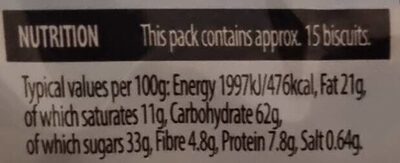
5/10 points (2002kJ)
Energy intakes above energy requirements are associated with increased risks of weight gain, overweight, obesity, and consequently risk of diet-related chronic diseases.
-

Sugar
9/15 points (33g)
A high consumption of sugar can cause weight gain and tooth decay. It also augments the risk of type 2 diabetes and cardio-vascular diseases.
-

Saturated fat
10/10 points (11g)
A high consumption of fat, especially saturated fats, can raise cholesterol, which increases the risk of heart diseases.
-

Salt
3/20 points (0.64g)
A high consumption of salt (or sodium) can cause raised blood pressure, which can increase the risk of heart disease and stroke.

Positive points: 2/10
-

Fiber
2/5 points (4.8g)
Consuming foods rich in fiber (especially whole grain foods) reduces the risks of aerodigestive cancers, cardiovascular diseases, obesity and diabetes.
-

Fruits, vegetables and legumes
0/5 points (0%)
Consuming foods rich in fruits, vegetables and legumes reduces the risks of aerodigestive cancers, cardiovascular diseases, obesity and diabetes.
-
Details of the calculation of the Nutri-Score
⚠ ️Warning: the amount of fruits, vegetables and nuts is not specified on the label, it was estimated from the list of ingredients: 0This product is not considered a beverage for the calculation of the Nutri-Score.
Points for proteins are not counted because the negative points greater than or equal to 11.
Nutritional score: 25 (27 - 2)
Nutri-Score: E
-
-

Nutrient levels
-

Fat in high quantity (21%)
What you need to know- A high consumption of fat, especially saturated fats, can raise cholesterol, which increases the risk of heart diseases.
Recommendation: Limit the consumption of fat and saturated fat- Choose products with lower fat and saturated fat content.
-
Saturated fat in high quantity (11%)
What you need to know- A high consumption of fat, especially saturated fats, can raise cholesterol, which increases the risk of heart diseases.
Recommendation: Limit the consumption of fat and saturated fat- Choose products with lower fat and saturated fat content.
-
Sugars in high quantity (33%)
What you need to know- A high consumption of sugar can cause weight gain and tooth decay. It also augments the risk of type 2 diabetes and cardio-vascular diseases.
Recommendation: Limit the consumption of sugar and sugary drinks- Sugary drinks (such as sodas, fruit beverages, and fruit juices and nectars) should be limited as much as possible (no more than 1 glass a day).
- Choose products with lower sugar content and reduce the consumption of products with added sugars.
-

Salt in moderate quantity (0.64%)
What you need to know- A high consumption of salt (or sodium) can cause raised blood pressure, which can increase the risk of heart disease and stroke.
- Many people who have high blood pressure do not know it, as there are often no symptoms.
- Most people consume too much salt (on average 9 to 12 grams per day), around twice the recommended maximum level of intake.
Recommendation: Limit the consumption of salt and salted food- Reduce the quantity of salt used when cooking, and don't salt again at the table.
- Limit the consumption of salty snacks and choose products with lower salt content.
-


Ingredients

-

Contains added sugars (11%)
Added sugars: sugar, invert sugar syrup
Quantity of added sugars: 11%Search for products in the same category without added sugars: Chocolate biscuitsWhat you need to know- A high consumption of sugar can cause weight gain and tooth decay. It also augments the risk of type 2 diabetes and cardio-vascular diseases.
Recommendation: Limit the consumption of sugar and sugary drinks- Sugary drinks (such as sodas, fruit beverages, and fruit juices and nectars) should be limited as much as possible (no more than 1 glass a day).
- Choose products with lower sugar content and reduce the consumption of products with added sugars.


Food processing
-

Ultra-processed foods
5 ultra-processing markers
-

Limit ultra-processed foods
Limiting ultra-processed foods reduces the risk of noncommunicable chronic diseases
Several studies have found that a lower consumption of ultra-processed foods is associated with a reduced risk of noncommunicable chronic diseases, such as obesity, hypertension and diabetes.
Source: Ultra-processed foods increase noncommunicable chronic disease risk
Elements that indicate the product is in the 4 - Ultra processed food and drink products group:
- Additive: E322 - Lecithins
- Additive: E476 - Polyglycerol polyricinoleate
- Ingredient: flavouring
- Ingredient: invert sugar
- Ingredient: whey
Food products are classified into 4 groups according to their degree of processing:
- Unprocessed or minimally processed foods
- Processed culinary ingredients
- Processed foods
- Ultra-processed foods
The determination of the group is based on the category of the product and on the ingredients it contains.
-
Additives
Ingredients analysis
-

Palm oil
Ingredients that contain palm oil: palm fat, palm oil
-

Non-vegan
Non-vegan ingredients: milk chocolate, skimmed milk powder, whey powder, milkfatSome ingredients could not be recognized.
We need your help!
You can help us recognize more ingredients and better analyze the list of ingredients for this product and others:
- Edit this product page to correct spelling mistakes in the ingredients list, and/or to remove ingredients in other languages and sentences that are not related to the ingredients.
- Add new entries, synonyms or translations to our multilingual lists of ingredients, ingredient processing methods, and labels.
If you would like to help, join the #ingredients channel on our Slack discussion space and/or learn about ingredients analysis on our wiki. Thank you!
-

Vegetarian
No non-vegetarian ingredients detected
Unrecognized ingredients: DAT FLAKES, Rainforest Alliance Certified A better future for people and natureSome ingredients could not be recognized.
We need your help!
You can help us recognize more ingredients and better analyze the list of ingredients for this product and others:
- Edit this product page to correct spelling mistakes in the ingredients list, and/or to remove ingredients in other languages and sentences that are not related to the ingredients.
- Add new entries, synonyms or translations to our multilingual lists of ingredients, ingredient processing methods, and labels.
If you would like to help, join the #ingredients channel on our Slack discussion space and/or learn about ingredients analysis on our wiki. Thank you!
-

Details of the analysis of the ingredients
We need your help!
Some ingredients could not be recognized.
We need your help!
You can help us recognize more ingredients and better analyze the list of ingredients for this product and others:
- Edit this product page to correct spelling mistakes in the ingredients list, and/or to remove ingredients in other languages and sentences that are not related to the ingredients.
- Add new entries, synonyms or translations to our multilingual lists of ingredients, ingredient processing methods, and labels.
If you would like to help, join the #ingredients channel on our Slack discussion space and/or learn about ingredients analysis on our wiki. Thank you!
en: DAT FLAKES 30%, MILK CHOCOLATE 25%, Sugar, Cocoa Butter", Cocoa Mass, Skimmed Milk Powder, Whey Powder, Milk Fat, Vegetable Fats (Sal Fat, Palm Fat, Shea Fat), Flavouring, Lecithins, Polyglycerol Polyricinoleate, Sugar, Wheat Flour, Palm Oil, Inverted Sugar Syrup, Sodium Carbonates, Ammonium Carbonates, Salt, Rainforest Alliance Certified A better future for people and natureingredient taxonomy_id vegan vegetarian palm_oil ciqual ciqual_proxy percent min max origin labels DAT FLAKES en:DAT FLAKES 30.0 MILK CHOCOLATE en:milk-chocolate no yes 31004 25.0 Sugar en:sugar maybe yes 31016 31016 9.0 Cocoa Butter" en:cocoa-butter yes yes no 16030 5.8 Cocoa Mass en:cocoa-paste yes yes 16030 16030 4.2 Skimmed Milk Powder en:skimmed-milk-powder no yes 19054 3.3 Whey Powder en:whey-powder no maybe 2.8 Milk Fat en:milkfat no yes no 2.7 Vegetable Fats en:vegetable-fat yes yes maybe 2.7 Sal Fat en:sal-fat yes yes no 1.3 Palm Fat en:palm-fat yes yes yes 16129 16129 0.7 Shea Fat en:shea-butter yes yes no 16110 0.6 Flavouring en:flavouring maybe maybe 1.9 Lecithins en:e322 maybe maybe 1.7 Polyglycerol Polyricinoleate en:e476 yes yes 1.6 Sugar en:sugar maybe yes 31016 31016 1.5 Wheat Flour en:wheat-flour yes yes 9410 9410 1.4 en:whole-grain Palm Oil en:palm-oil yes yes yes 16129 1.3 Inverted Sugar Syrup en:invert-sugar-syrup yes yes 31016 31016 1.3 Sodium Carbonates en:e500 yes yes 1.2 Ammonium Carbonates en:e503 yes yes 1.2 Salt en:salt yes yes 11058 0.6 Rainforest Alliance Certified A better future for people and nature en:Rainforest Alliance Certified A better future for people and nature 0.6
Environment
-

Green-Score E
Very high environmental impact
⚠ ️Select a country in order to include the full impact of transportation.The Green-Score is an experimental score that summarizes the environmental impacts of food products.→ The Green-Score was initially developed for France and it is being extended to other European countries. The Green-Score formula is subject to change as it is regularly improved to make it more precise and better suited to each country.Life cycle analysis
-

Average impact of products of the same category: C (Score: 53/100)
Category: Biscuit (cookie), with chocolate, prepacked
Category: Biscuit (cookie), with chocolate, prepacked
- PEF environmental score: 0.50 (the lower the score, the lower the impact)
- including impact on climate change: 6.67 kg CO2 eq/kg of product
Stage Impact  Agriculture
75.7 %
 Processing
7.8 %
 Packaging
11.4 %
 Transportation
4.1 %
 Distribution
1.1 %
 Consumption
0.0 %
Bonuses and maluses
-

Missing origins of ingredients information
Malus: -5
⚠ ️ The origins of the ingredients of this product are not indicated.
If they are indicated on the packaging, you can modify the product sheet and add them.
If you are the manufacturer of this product, you can send us the information with our free platform for producers.
-

Ingredients that threatens species
Malus: -10
Contains palm oil
Tropical forests in Asia, Africa and Latin America are destroyed to create and expand oil palm tree plantations. The deforestation contributes to climate change, and it endangers species such as the orangutan, the pigmy elephant and the Sumatran rhino.
-
Missing packaging information for this product
Malus: -15
⚠ ️ The information about the packaging of this product is not filled in.⚠ ️ For a more precise calculation of the Green-Score, you can edit the product page and add them.
If you are the manufacturer of this product, you can send us the information with our free platform for producers.
Green-Score for this product
-
Impact for this product: E (Score: 23/100)
Product: Oaties – Belmont Biscuits – 300 g
Life cycle analysis score: 53
Sum of bonuses and maluses: -30
Final score: 23/100
-
Carbon footprint
-

Equal to driving 3.5 km in a petrol car
667 g CO₂e per 100g of product
The carbon emission figure comes from ADEME's Agribalyse database, for the category: Biscuit (cookie), with chocolate, prepacked (Source: ADEME Agribalyse Database)
Stage Impact
Agriculture
79.6 %
Processing
3.1 %
Packaging
13.2 %
Transportation
3.8 %
Distribution
0.4 %
Consumption
0.0 %
Packaging
-
Missing packaging information for this product
⚠ ️ The information about the packaging of this product is not filled in.Take a photo of the recycling information


Transportation
-
Origins of ingredients
Missing origins of ingredients information
⚠ ️ The origins of the ingredients of this product are not indicated.
If they are indicated on the packaging, you can modify the product sheet and add them.
If you are the manufacturer of this product, you can send us the information with our free platform for producers.Add the origins of ingredients for this product
Threatened species
-
Contains palm oil
Drives deforestation and threatens species such as the orangutan
Tropical forests in Asia, Africa and Latin America are destroyed to create and expand oil palm tree plantations. The deforestation contributes to climate change, and it endangers species such as the orangutan, the pigmy elephant and the Sumatran rhino.
-

Medium risk of deforestation
Presence of one or more ingredients at risk of deforestation, with moderate risk given their quantity, origin and/or labels.
Forest Footprint
The Forest Footprint is a methodology developed by the association Envol Vert to estimate the risk of deforestation related to our consumption. → More information on the methodology
Forest Footprint grade: C
Presence of one or more ingredients at risk of deforestation, with moderate risk given their quantity, origin and/or labels.
Total Forest Footprint: 0.105 m² per kg of food
Cocoa
Primary ingredient grade: C
Primary ingredient: 0.104 m² per kg of food
Cocoa production, concentrated mainly in West Africa, contributes significantly to deforestation. For example, Côte d'Ivoire, the leading cocoa-producing country, has lost 90% of its forests since the 1960s.
Ingredient % in product Primary ingredient Processing factor Origin of the product and/or its ingredients Forest Footprint for the origin Label Deforestation risk Forest Footprint
(m² per kg of food)chocolate 25.00 % cocoa 1.00 Unknown 0.296 - 100 % 0.074 cocoa butter 5.84 % cocoa 1.00 Unknown 0.296 - 100 % 0.017 cocoa paste 4.25 % cocoa 1.00 Unknown 0.296 - 100 % 0.013 Palm oil
Primary ingredient grade: B
Primary ingredient: 0.001 m² per kg of food
Palm oil production, concentrated mainly in Indonesia and Malaysia, contributes significantly to deforestation. Borneo has lost more than half of its forests since the 1970s.
Ingredient % in product Primary ingredient Processing factor Origin of the product and/or its ingredients Forest Footprint for the origin Label Deforestation risk Forest Footprint
(m² per kg of food)palm oil and fat 0.74 % palm oil 1.00 Unknown 0.055 - 100 % 0.000 palm oil and fat 1.34 % palm oil 1.00 Unknown 0.055 - 100 % 0.001 Other risky ingredients
These ingredients are not yet assessed for deforestation risk:
- skimmed milk powder
- whey powder
- milkfat
Labels
The presence of certain labels can greatly help reduce the risk of deforestation, through the presence of environmental criteria and/or through better remuneration of producers.

Data sources
Product added on by kiliweb
Last edit of product page on by macrofactor.
Product page also edited by ecoscore-impact-estimator, inf, naruyoko, roboto-app, scanbot, scrypt, segundo, yuka.Rm81YkQ3VS85NlU2by9FVTFCelNxdnhieUtlWUFuN3FJY2hNSUE9PQ, yuka.sY2b0xO6T85zoF3NwEKvlhFBCfzjhG6fZxnis0KGw_DWf6HVXdd0_Y3rbKs, yuka.sY2b0xO6T85zoF3NwEKvlndjfuuAiW75bRfui2yTns-ADKb1OfhvvpX-GKo.