Help us inform millions of consumers around the world about what they eat

group photo donation 2024
open food facts logo

Please give to our 2025 Fundraiser

Your donations fund the day-to-day operations of our non-profit association:

  • keeping our database open & available to all,
    • technical infrastructure (website/mobile app) & a small permanent team
  • remain independent of the food industry,

  • engage a community of committed citizens,

  • support the advancement of public health research.

Each donation counts! We appreciate your support in bringing further food transparency in the world.

arrow_upward

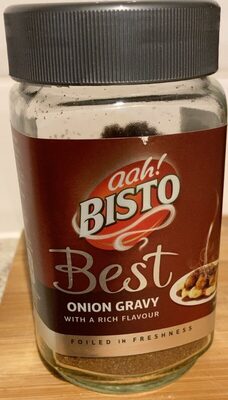
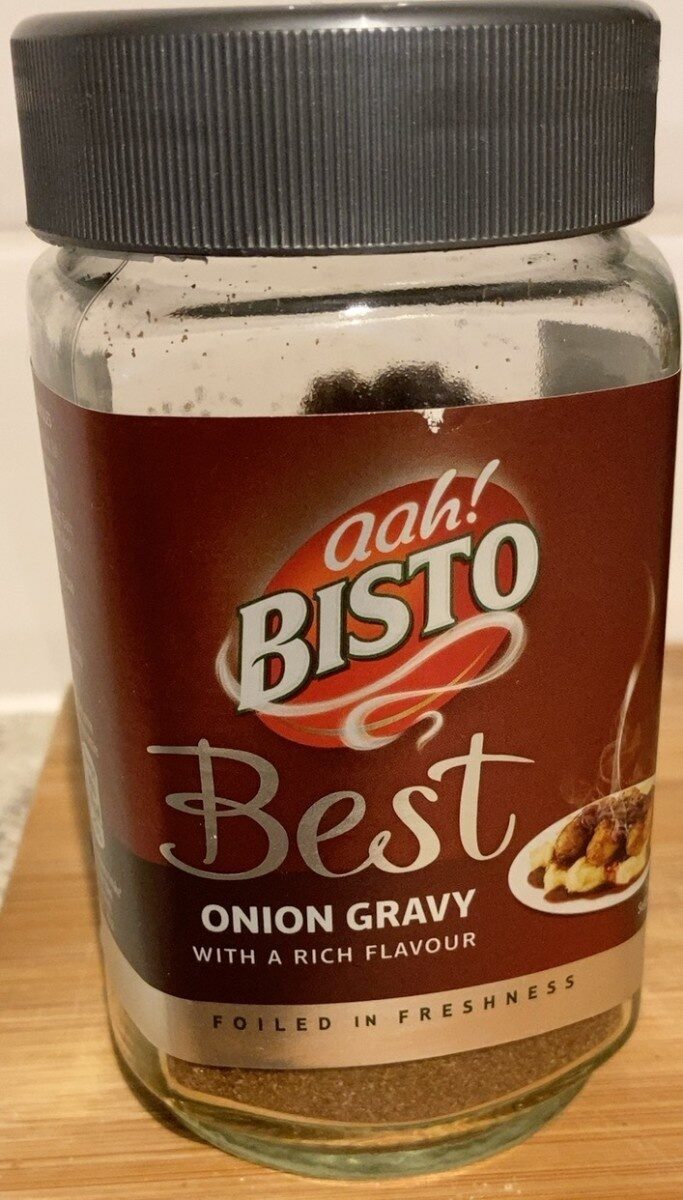
Best Onion Gravy – Bisto

Best Onion Gravy – Bisto

This product page is not complete. You can help to complete it by editing it and adding more data from the photos we have, or by taking more photos using the app for Android or iPhone/iPad. Thank you! ×

Barcode:
5000354915604(EAN / EAN-13)

Packaging: Lid, Glass-jar

Brands: Bisto

Categories: Condiments, Dried products, Dried products to be rehydrated, Sauces, Dehydrated sauces, Groceries

Countries where sold: United Kingdom

Matching with your preferences

Health

Nutrition

  • icon

    Nutrition facts


    Nutrition facts As sold
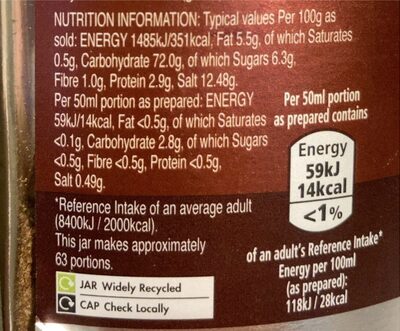
    for 100 g / 100 ml
    Compared to: Dehydrated sauces
    Energy 1,469 kj
    (351 kcal)
    +60%
    Fat 5.5 g +24%
    Saturated fat 0.5 g -60%
    Carbohydrates 72 g +105%
    Sugars 6.3 g +18%
    Fiber ?
    Proteins 2.9 g -39%
    Salt 12.48 g +76%
    Fruits‚ vegetables‚ nuts and rapeseed‚ walnut and olive oils (estimate from ingredients list analysis) 6.54 %

Ingredients

  • icon

    21 ingredients


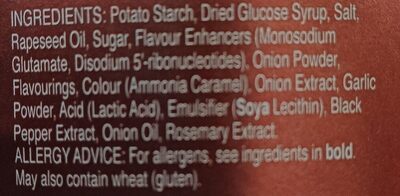
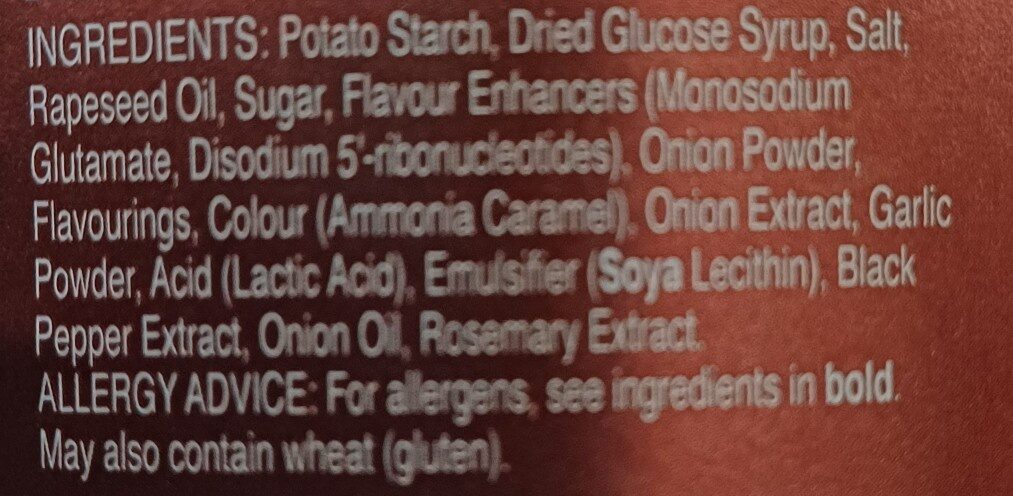
    potato starch, dried glucose syrup, salt, rapeseed oil, sugar, flavour enhancers (monosodium glutamate, disodium 5'-ribonucleotides), onion powder, flavourings, colour (ammonia caramel). onion extract, garlic powder, acid (lactic acid), emulsifier (soya lecithin), black pepper extract, onion oil, rosemary extract. allergy advice: for allergens, see ingredients in bold. may also contain wheat (gluten).
    Allergens: Gluten, Soybeans
    Traces: Gluten
    • Ingredient information


      • Potato starch: 53.1% (estimate)


      • Dehydrated glucose syrup: 23.4% (estimate)


      • Salt: 6.2% (estimate)


      • Rapeseed oil: 6.2% (estimate)


      • Sugar: 3.2% (estimate)


      • Flavour enhancer: 3.2% (estimate)


      • — E621: < 2% (estimate)


        Monosodium glutamate: Monosodium glutamate -MSG, also known as sodium glutamate- is the sodium salt of glutamic acid, one of the most abundant naturally occurring non-essential amino acids. Glutamic acid is found naturally in tomatoes, grapes, cheese, mushrooms and other foods.MSG is used in the food industry as a flavor enhancer with an umami taste that intensifies the meaty, savory flavor of food, as naturally occurring glutamate does in foods such as stews and meat soups. It was first prepared in 1908 by Japanese biochemist Kikunae Ikeda, who was trying to isolate and duplicate the savory taste of kombu, an edible seaweed used as a base for many Japanese soups. MSG as a flavor enhancer balances, blends, and rounds the perception of other tastes.The U.S. Food and Drug Administration has given MSG its generally recognized as safe -GRAS- designation. A popular belief is that large doses of MSG can cause headaches and other feelings of discomfort, known as "Chinese restaurant syndrome," but double-blind tests fail to find evidence of such a reaction. The European Union classifies it as a food additive permitted in certain foods and subject to quantitative limits. MSG has the HS code 29224220 and the E number E621.
        Source: Wikipedia
      • — E635: < 2% (estimate)


      • Onion: 2.3% (estimate)


      • Flavouring: < 2% (estimate)


      • Colour: < 2% (estimate)


      • — E150a: < 2% (estimate)


      • Onion Extract: < 2% (estimate)


      • Garlic: < 2% (estimate)


      • Acid: < 2% (estimate)


      • — E270: < 2% (estimate)


      • Emulsifier: < 2% (estimate)


      • — Soya lecithin: < 2% (estimate)


      • Black pepper extract: < 2% (estimate)


      • Onion oil: < 2% (estimate)


      • E392: < 2% (estimate)


  • icon

    Contains added sugars (~ 26%)

    Added sugars: Dehydrated glucose syrup, Sugar
    Estimated quantity of added sugars in ingredients: 26%
    Search for products in the same category without added sugars: Dehydrated sauces
    What you need to know
    • A high consumption of sugar can cause weight gain and tooth decay. It also augments the risk of type 2 diabetes and cardio-vascular diseases.

    Recommendation: Limit the consumption of sugar and sugary drinks
    • Sugary drinks (such as sodas, fruit beverages, and fruit juices and nectars) should be limited as much as possible (no more than 1 glass a day).
    • Choose products with lower sugar content and reduce the consumption of products with added sugars.

Food processing

Additives

  • E150c - Ammonia caramel


  • E270 - Lactic acid


    Lactic acid: Lactic acid is an organic compound with the formula CH3CH-OH-COOH. In its solid state, it is white and water-soluble. In its liquid state, it is colorless. It is produced both naturally and synthetically. With a hydroxyl group adjacent to the carboxyl group, lactic acid is classified as an alpha-hydroxy acid -AHA-. In the form of its conjugate base called lactate, it plays a role in several biochemical processes. In solution, it can ionize a proton from the carboxyl group, producing the lactate ion CH3CH-OH-CO−2. Compared to acetic acid, its pKa is 1 unit less, meaning lactic acid deprotonates ten times more easily than acetic acid does. This higher acidity is the consequence of the intramolecular hydrogen bonding between the α-hydroxyl and the carboxylate group. Lactic acid is chiral, consisting of two optical isomers. One is known as L--+--lactic acid or -S--lactic acid and the other, its mirror image, is D--−--lactic acid or -R--lactic acid. A mixture of the two in equal amounts is called DL-lactic acid, or racemic lactic acid. Lactic acid is hygroscopic. DL-lactic acid is miscible with water and with ethanol above its melting point which is around 17 or 18 °C. D-lactic acid and L-lactic acid have a higher melting point. In animals, L-lactate is constantly produced from pyruvate via the enzyme lactate dehydrogenase -LDH- in a process of fermentation during normal metabolism and exercise. It does not increase in concentration until the rate of lactate production exceeds the rate of lactate removal, which is governed by a number of factors, including monocarboxylate transporters, concentration and isoform of LDH, and oxidative capacity of tissues. The concentration of blood lactate is usually 1–2 mM at rest, but can rise to over 20 mM during intense exertion and as high as 25 mM afterward. In addition to other biological roles, L-lactic acid is the primary endogenous agonist of hydroxycarboxylic acid receptor 1 -HCA1-, which is a Gi/o-coupled G protein-coupled receptor -GPCR-.In industry, lactic acid fermentation is performed by lactic acid bacteria, which convert simple carbohydrates such as glucose, sucrose, or galactose to lactic acid. These bacteria can also grow in the mouth; the acid they produce is responsible for the tooth decay known as caries. In medicine, lactate is one of the main components of lactated Ringer's solution and Hartmann's solution. These intravenous fluids consist of sodium and potassium cations along with lactate and chloride anions in solution with distilled water, generally in concentrations isotonic with human blood. It is most commonly used for fluid resuscitation after blood loss due to trauma, surgery, or burns.
    Source: Wikipedia
  • E322 - Lecithins


    Lecithins are natural compounds commonly used in the food industry as emulsifiers and stabilizers.

    Extracted from sources like soybeans and eggs, lecithins consist of phospholipids that enhance the mixing of oil and water, ensuring smooth textures in various products like chocolates, dressings, and baked goods.

    They do not present any known health risks.

  • E322i - Lecithin


    Lecithins are natural compounds commonly used in the food industry as emulsifiers and stabilizers.

    Extracted from sources like soybeans and eggs, lecithins consist of phospholipids that enhance the mixing of oil and water, ensuring smooth textures in various products like chocolates, dressings, and baked goods.

    They do not present any known health risks.

  • E392 - Extracts of rosemary


  • E621 - Monosodium glutamate


    Monosodium glutamate (MSG), or E621, is the sodium salt of glutamic acid, an amino acid found naturally in many foods.

    It is widely used as a flavor enhancer to provide an "umami" or savory taste to a variety of processed foods, including soups, snack chips, and frozen meals.

    MSG is generally recognized as safe (GRAS) by food authorities. However, some people report sensitivity to MSG, experiencing short-term symptoms like headaches and flushing, though scientific studies have not shown a consistent link.

  • E635 - Disodium 5'-ribonucleotide


Ingredients analysis

  • icon

    Maybe vegan


    Ingredients that may not be vegan: E635, Flavouring, Onion oil
The analysis is based solely on the ingredients listed and does not take into account processing methods.
  • icon

    Details of the analysis of the ingredients


    en: potato starch, dried glucose syrup, salt, rapeseed oil, sugar, flavour enhancers (monosodium glutamate, disodium 5'-ribonucleotides), onion, flavourings, colour (ammonia caramel), onion extract, garlic, acid (lactic acid), emulsifier (soya lecithin), black pepper extract, onion oil, rosemary extract
    1. potato starch -> en:potato-starch – vegan: yes – vegetarian: yes – ciqual_proxy_food_code: 9510 – percent_min: 6.25 – percent_max: 100
    2. dried glucose syrup -> en:dehydrated-glucose-syrup – vegan: yes – vegetarian: yes – ciqual_proxy_food_code: 31016 – percent_min: 0 – percent_max: 50
    3. salt -> en:salt – vegan: yes – vegetarian: yes – ciqual_food_code: 11058 – percent_min: 0 – percent_max: 12.4799995
    4. rapeseed oil -> en:rapeseed-oil – vegan: yes – vegetarian: yes – from_palm_oil: no – percent_min: 0 – percent_max: 12.4799995
    5. sugar -> en:sugar – vegan: yes – vegetarian: yes – ciqual_proxy_food_code: 31016 – percent_min: 0 – percent_max: 6.3000001907349
    6. flavour enhancers -> en:flavour-enhancer – percent_min: 0 – percent_max: 6.3000001907349
      1. monosodium glutamate -> en:e621 – vegan: yes – vegetarian: yes – percent_min: 0 – percent_max: 6.3000001907349
      2. disodium 5'-ribonucleotides -> en:e635 – vegan: maybe – vegetarian: maybe – percent_min: 0 – percent_max: 3.15000009536745
    7. onion -> en:onion – vegan: yes – vegetarian: yes – ciqual_food_code: 20034 – percent_min: 0 – percent_max: 6.3000001907349
    8. flavourings -> en:flavouring – vegan: maybe – vegetarian: maybe – percent_min: 0 – percent_max: 5
    9. colour -> en:colour – percent_min: 0 – percent_max: 5
      1. ammonia caramel -> en:e150a – vegan: yes – vegetarian: yes – percent_min: 0 – percent_max: 5
    10. onion extract -> en:onion-extract – vegan: yes – vegetarian: yes – ciqual_food_code: 20034 – percent_min: 0 – percent_max: 5
    11. garlic -> en:garlic – vegan: yes – vegetarian: yes – ciqual_food_code: 11000 – percent_min: 0 – percent_max: 5
    12. acid -> en:acid – percent_min: 0 – percent_max: 5
      1. lactic acid -> en:e270 – vegan: yes – vegetarian: yes – percent_min: 0 – percent_max: 5
    13. emulsifier -> en:emulsifier – percent_min: 0 – percent_max: 5
      1. soya lecithin -> en:soya-lecithin – vegan: yes – vegetarian: yes – ciqual_food_code: 42200 – percent_min: 0 – percent_max: 5
    14. black pepper extract -> en:black-pepper-extract – vegan: yes – vegetarian: yes – ciqual_food_code: 11015 – percent_min: 0 – percent_max: 5
    15. onion oil -> en:onion-oil – vegan: maybe – vegetarian: maybe – from_palm_oil: maybe – ciqual_food_code: 20034 – percent_min: 0 – percent_max: 5
    16. rosemary extract -> en:e392 – vegan: yes – vegetarian: yes – percent_min: 0 – percent_max: 5

Environment

Packaging

Transportation

Report a problem

Data sources

Product added on by kiliweb
Last edit of product page on by luckyorchid.
Product page also edited by charlesnepote, inf, openfoodfacts-contributors, packbot, swipe-studio, teolemon, yuka.sY2b0xO6T85zoF3NwEKvlmJuVMTlh2nKbSbTvWaAy_GQDJ3STotjuaH0aKo.

If the data is incomplete or incorrect, you can complete or correct it by editing this page.