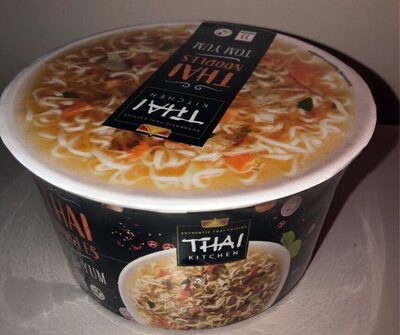
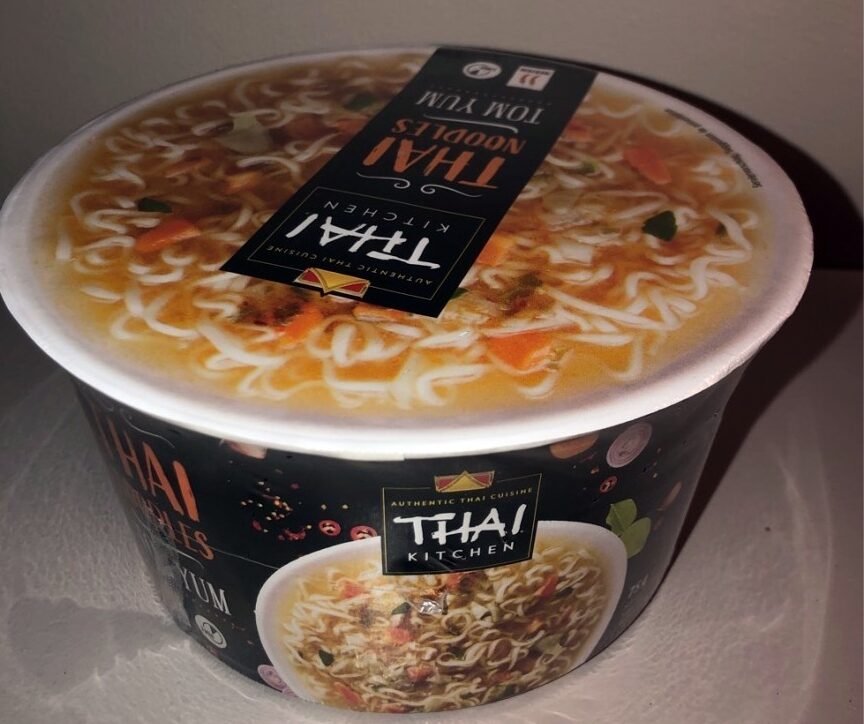
Nouilles Thaï - Thai Kitchen - 75 g
This product page is not complete. You can help to complete it by editing it and adding more data from the photos we have, or by taking more photos using the app for Android or iPhone/iPad. Thank you!
×
Barcode: 5021047000070 (EAN / EAN-13)
Common name: Soupe aux nouilles
Quantity: 75 g
Brands: Thai Kitchen
Categories: Plant-based foods and beverages, Plant-based foods, Cereals and potatoes, Cereals and their products, Dried products, Pastas, Dried products to be rehydrated, Noodles, Instant noodles
Countries where sold: France
Matching with your preferences
Health
Ingredients


Food processing
-

Ultra processed foods
Elements that indicate the product is in the 4 - Ultra processed food and drink products group:
- Additive: E160c - Paprika extract
- Additive: E451 - Triphosphates
- Additive: E466 - Sodium carboxy methyl cellulose
- Additive: E621 - Monosodium glutamate
- Additive: E635 - Disodium 5'-ribonucleotide
- Ingredient: Colour
- Ingredient: Flavour enhancer
- Ingredient: Flavouring
- Ingredient: Glucose
- Ingredient: Glucose syrup
- Ingredient: Hydrogenated oil
- Ingredient: Thickener
Food products are classified into 4 groups according to their degree of processing:
- Unprocessed or minimally processed foods
- Processed culinary ingredients
- Processed foods
- Ultra processed foods
The determination of the group is based on the category of the product and on the ingredients it contains.
Additives
Ingredients analysis
-

Palm oil
Ingredients that contain palm oil: Palm oil, Hydrogenated palm oil, Palm oil
-

Non-vegan
Non-vegan ingredients: Cream, Sodium caseinate, Shrimp, Fish sauce, FishSome ingredients could not be recognized.
We need your help!
You can help us recognize more ingredients and better analyze the list of ingredients for this product and others:
- Edit this product page to correct spelling mistakes in the ingredients list, and/or to remove ingredients in other languages and sentences that are not related to the ingredients.
- Add new entries, synonyms or translations to our multilingual lists of ingredients, ingredient processing methods, and labels.
If you would like to help, join the #ingredients channel on our Slack discussion space and/or learn about ingredients analysis on our wiki. Thank you!
-

Non-vegetarian
Non-vegetarian ingredients: Shrimp, Fish sauce, FishSome ingredients could not be recognized.
We need your help!
You can help us recognize more ingredients and better analyze the list of ingredients for this product and others:
- Edit this product page to correct spelling mistakes in the ingredients list, and/or to remove ingredients in other languages and sentences that are not related to the ingredients.
- Add new entries, synonyms or translations to our multilingual lists of ingredients, ingredient processing methods, and labels.
If you would like to help, join the #ingredients channel on our Slack discussion space and/or learn about ingredients analysis on our wiki. Thank you!
-

Details of the analysis of the ingredients
We need your help!
Some ingredients could not be recognized.
We need your help!
You can help us recognize more ingredients and better analyze the list of ingredients for this product and others:
- Edit this product page to correct spelling mistakes in the ingredients list, and/or to remove ingredients in other languages and sentences that are not related to the ingredients.
- Add new entries, synonyms or translations to our multilingual lists of ingredients, ingredient processing methods, and labels.
If you would like to help, join the #ingredients channel on our Slack discussion space and/or learn about ingredients analysis on our wiki. Thank you!
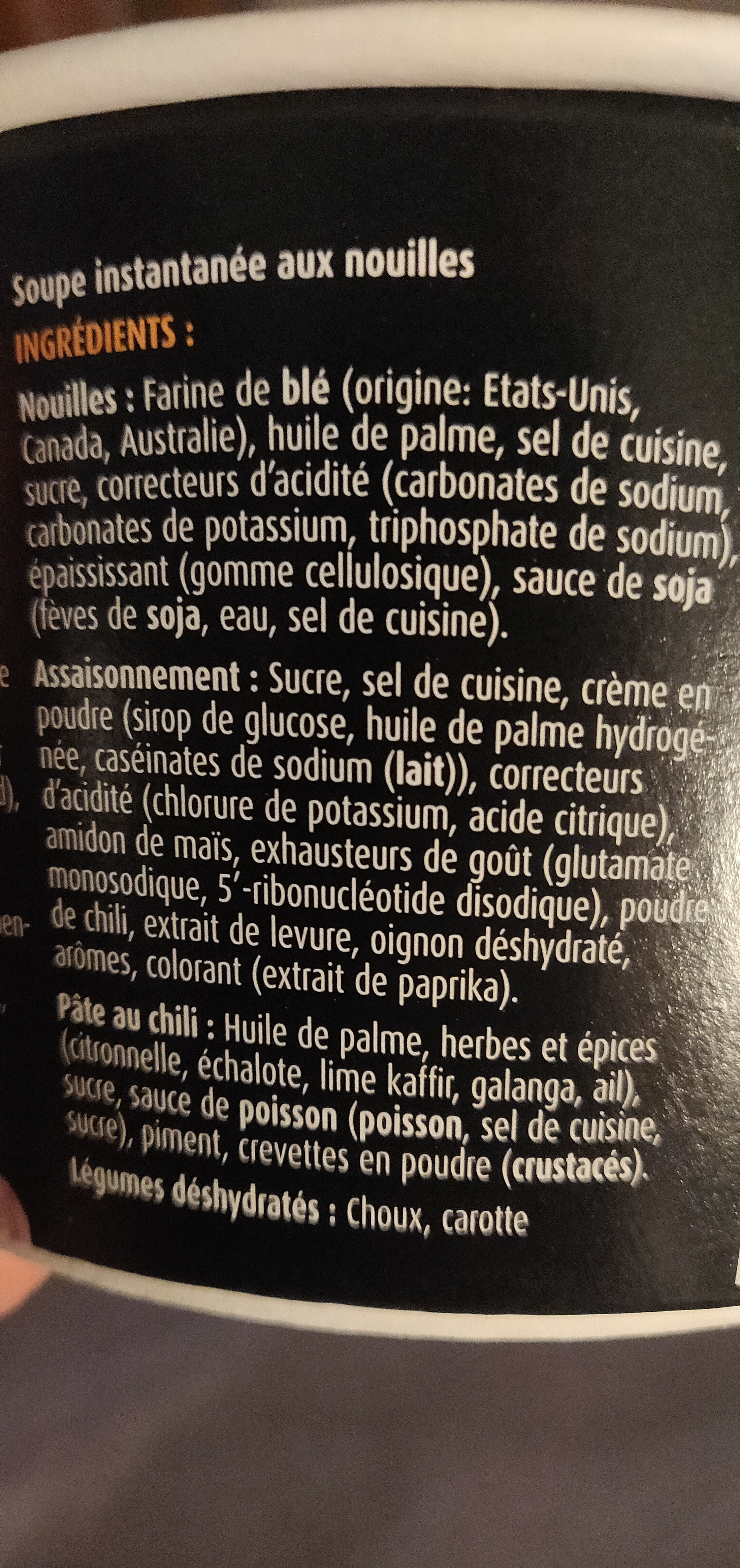
: Nouilles (Farine de blé, huile de palme, sel de cuisine, Sucre, correcteurs d'acidité (carbonates de sodium, carbonates de potassium, triphosphate de sodium), épaississant (gomme cellulosique), sauce de soja (fèves de soja, eau, sel de cuisine)), Assaisonnement, Sucre, sel de cuisine, crème (sirop de glucose, huile de palme hydrogénée, caséinates de sodium), correcteurs d'acidité (chlorure de potassium, acide citrique), amidon de maïs, exhausteurs de goût (glutamate monosodique, 5´-ribonucléotide disodique), poudre, extrait de levure, oignon déshydraté, en-arômes, colorant (extrait de paprika), Pâte au chili (Huile de palme, herbes et épices (citronnelle, échalote, lime kaffir, galanga, ail), Sucre), piment, crevettes, Sucre, sauce de poisson (poisson, sel de cuisine, légumes déshydratés (Choux), carotte)- Nouilles -> en:noodle - vegan: maybe - vegetarian: maybe - percent_min: 5.55555555555556 - percent_max: 100
- Farine de blé -> en:wheat-flour - vegan: yes - vegetarian: yes - ciqual_proxy_food_code: 9410 - percent_min: 0.793650793650794 - percent_max: 100
- huile de palme -> en:palm-oil - vegan: yes - vegetarian: yes - from_palm_oil: yes - ciqual_food_code: 16129 - percent_min: 0 - percent_max: 50
- sel de cuisine -> en:salt - vegan: yes - vegetarian: yes - ciqual_food_code: 11058 - percent_min: 0 - percent_max: 8.9
- Sucre -> en:sugar - vegan: yes - vegetarian: yes - ciqual_proxy_food_code: 31016 - percent_min: 0 - percent_max: 8.9
- correcteurs d'acidité -> en:acidity-regulator - percent_min: 0 - percent_max: 8.9
- carbonates de sodium -> en:e500 - vegan: yes - vegetarian: yes - percent_min: 0 - percent_max: 8.9
- carbonates de potassium -> en:e501 - vegan: yes - vegetarian: yes - percent_min: 0 - percent_max: 4.45
- triphosphate de sodium -> fr:triphosphate-de-sodium - percent_min: 0 - percent_max: 2.96666666666667
- épaississant -> en:thickener - percent_min: 0 - percent_max: 8.9
- gomme cellulosique -> en:e466 - vegan: yes - vegetarian: yes - percent_min: 0 - percent_max: 8.9
- sauce de soja -> en:soy-sauce - vegan: maybe - vegetarian: maybe - ciqual_food_code: 11104 - percent_min: 0 - percent_max: 8.9
- fèves de soja -> en:soya-bean - vegan: yes - vegetarian: yes - ciqual_food_code: 20901 - percent_min: 0 - percent_max: 8.9
- eau -> en:water - vegan: yes - vegetarian: yes - ciqual_food_code: 18066 - percent_min: 0 - percent_max: 4.45
- sel de cuisine -> en:salt - vegan: yes - vegetarian: yes - ciqual_food_code: 11058 - percent_min: 0 - percent_max: 2.96666666666667
- Assaisonnement -> en:condiment - vegan: maybe - vegetarian: maybe - percent_min: 0 - percent_max: 50
- Sucre -> en:sugar - vegan: yes - vegetarian: yes - ciqual_proxy_food_code: 31016 - percent_min: 0 - percent_max: 14
- sel de cuisine -> en:salt - vegan: yes - vegetarian: yes - ciqual_food_code: 11058 - percent_min: 0 - percent_max: 8.9
- crème -> en:cream - vegan: no - vegetarian: yes - ciqual_food_code: 19402 - percent_min: 0 - percent_max: 8.9
- sirop de glucose -> en:glucose-syrup - vegan: yes - vegetarian: yes - ciqual_proxy_food_code: 31016 - percent_min: 0 - percent_max: 8.9
- huile de palme hydrogénée -> en:hydrogenated-palm-oil - vegan: yes - vegetarian: yes - from_palm_oil: yes - ciqual_food_code: 16129 - percent_min: 0 - percent_max: 4.45
- caséinates de sodium -> en:sodium-caseinate - vegan: no - vegetarian: yes - percent_min: 0 - percent_max: 2.96666666666667
- correcteurs d'acidité -> en:acidity-regulator - percent_min: 0 - percent_max: 8.9
- chlorure de potassium -> en:e508 - vegan: yes - vegetarian: yes - percent_min: 0 - percent_max: 8.9
- acide citrique -> en:e330 - vegan: yes - vegetarian: yes - percent_min: 0 - percent_max: 4.45
- amidon de maïs -> en:corn-starch - vegan: yes - vegetarian: yes - ciqual_food_code: 9510 - percent_min: 0 - percent_max: 8.9
- exhausteurs de goût -> en:flavour-enhancer - percent_min: 0 - percent_max: 8.9
- glutamate monosodique -> en:e621 - vegan: yes - vegetarian: yes - percent_min: 0 - percent_max: 8.9
- 5´-ribonucléotide disodique -> en:e635 - vegan: maybe - vegetarian: maybe - percent_min: 0 - percent_max: 4.45
- poudre -> fr:poudre - percent_min: 0 - percent_max: 8.9
- extrait de levure -> en:yeast-extract - vegan: yes - vegetarian: yes - percent_min: 0 - percent_max: 8.9
- oignon déshydraté -> en:dehydrated-onion - vegan: yes - vegetarian: yes - ciqual_food_code: 20180 - percent_min: 0 - percent_max: 8.9
- en-arômes -> en:flavouring - vegan: maybe - vegetarian: maybe - percent_min: 0 - percent_max: 5
- colorant -> en:colour - percent_min: 0 - percent_max: 5
- extrait de paprika -> en:e160c - vegan: yes - vegetarian: yes - percent_min: 0 - percent_max: 5
- Pâte au chili -> fr:pate-au-chili - percent_min: 0 - percent_max: 5
- Huile de palme -> en:palm-oil - vegan: yes - vegetarian: yes - from_palm_oil: yes - ciqual_food_code: 16129 - percent_min: 0 - percent_max: 5
- herbes et épices -> en:herbs-and-spices - vegan: yes - vegetarian: yes - percent_min: 0 - percent_max: 2.5
- citronnelle -> en:lemongrass - vegan: yes - vegetarian: yes - percent_min: 0 - percent_max: 2.5
- échalote -> en:shallot - vegan: yes - vegetarian: yes - ciqual_food_code: 20097 - percent_min: 0 - percent_max: 1.25
- lime kaffir -> en:kaffir-lime - vegan: yes - vegetarian: yes - percent_min: 0 - percent_max: 0.833333333333333
- galanga -> en:galangal - vegan: yes - vegetarian: yes - percent_min: 0 - percent_max: 0.625
- ail -> en:garlic - vegan: yes - vegetarian: yes - ciqual_food_code: 11000 - percent_min: 0 - percent_max: 0.5
- Sucre -> en:sugar - vegan: yes - vegetarian: yes - ciqual_proxy_food_code: 31016 - percent_min: 0 - percent_max: 1.66666666666667
- piment -> en:chili-pepper - vegan: yes - vegetarian: yes - ciqual_food_code: 20151 - percent_min: 0 - percent_max: 5
- crevettes -> en:shrimp - vegan: no - vegetarian: no - ciqual_food_code: 10021 - percent_min: 0 - percent_max: 5
- Sucre -> en:sugar - vegan: yes - vegetarian: yes - ciqual_proxy_food_code: 31016 - percent_min: 0 - percent_max: 5
- sauce de poisson -> en:fish-sauce - vegan: no - vegetarian: no - percent_min: 0 - percent_max: 5
- poisson -> en:fish - vegan: no - vegetarian: no - ciqual_proxy_food_code: 26140 - percent_min: 0 - percent_max: 5
- sel de cuisine -> en:salt - vegan: yes - vegetarian: yes - ciqual_food_code: 11058 - percent_min: 0 - percent_max: 2.5
- légumes déshydratés -> fr:legume-deshydrate - vegan: yes - vegetarian: yes - percent_min: 0 - percent_max: 1.66666666666667
- Choux -> en:cabbage - vegan: yes - vegetarian: yes - percent_min: 0 - percent_max: 1.66666666666667
- carotte -> en:carrot - vegan: yes - vegetarian: yes - ciqual_food_code: 20009 - percent_min: 0 - percent_max: 1.25



Environment
-

Eco-Score C - Moderate environmental impact
⚠ ️Select a country in order to include the full impact of transportation.The Eco-Score is an experimental score that summarizes the environmental impacts of food products.→ The Eco-Score was initially developped for France and it is being extended to other European countries. The Eco-Score formula is subject to change as it is regularly improved to make it more precise and better suited to each country.Life cycle analysis
-

Average impact of products of the same category: A (Score: 82/100)
Category: Asian noodles, flavoured, dehydrated
Category: Asian noodles, flavoured, dehydrated
- PEF environmental score: 0.26 (the lower the score, the lower the impact)
- including impact on climate change: 1.67 kg CO2 eq/kg of product
Stage Impact  Agriculture
65.5 %
Agriculture
65.5 % Processing
20.6 %
Processing
20.6 % Packaging
8.7 %
Packaging
8.7 % Transportation
3.5 %
Transportation
3.5 % Distribution
1.8 %
Distribution
1.8 % Consumption
0.0 %
Consumption
0.0 %
Bonuses and maluses
-

Origins of ingredients with a high impact
Malus: -5
Environmental policy: -5
Transportation: 0
Origin of the product and/or its ingredients % of ingredients Impact Unknown 100 %High Chile 0 %High
-

Ingredients that threatens species
Malus: -10
Contains palm oil
Tropical forests in Asia, Africa and Latin America are destroyed to create and expand oil palm tree plantations. The deforestation contributes to climate change, and it endangers species such as the orangutan, the pigmy elephant and the Sumatran rhino.
-
Packaging with a medium impact
Malus: -11
Shape Material Recycling Impact Unknown Plastic High Unknown Cardboard Low ⚠ ️ The information about the packaging of this product is not sufficiently precise (exact shapes and materials of all components of the packaging).⚠ ️ For a more precise calculation of the Eco-Score, you can modify the product page and add them.
If you are the manufacturer of this product, you can send us the information with our free platform for producers.
Eco-Score for this product
-
Impact for this product: C (Score: 56/100)
Product: Nouilles Thaï - Thai Kitchen - 75 g
Life cycle analysis score: 82
Sum of bonuses and maluses: -26
Final score: 56/100
-
Carbon footprint
-

Equal to driving 0.9 km in a petrol car
167 g CO² per 100g of product
The carbon emission figure comes from ADEME's Agribalyse database, for the category: Asian noodles, flavoured, dehydrated (Source: ADEME Agribalyse Database)
Stage Impact
Agriculture
61.0 %
Processing
14.9 %
Packaging
16.3 %
Transportation
6.8 %
Distribution
1.0 %
Consumption
0.0 %
Packaging
-
Packaging with a medium impact
-
Packaging parts
 (Plastic)
(Cardboard)
-
Transportation
-
Origins of ingredients
Origins of ingredients with a high impact
Origin of the product and/or its ingredients % of ingredients Impact Unknown 100 %High Chile 0 %High
Threatened species
-
Contains palm oil
Drives deforestation and threatens species such as the orangutan
Tropical forests in Asia, Africa and Latin America are destroyed to create and expand oil palm tree plantations. The deforestation contributes to climate change, and it endangers species such as the orangutan, the pigmy elephant and the Sumatran rhino.

Data sources
Product added on by kiliweb
Last edit of product page on by packbot.
Product page also edited by openfoodfacts-contributors, quentinbrd, sophiecool62, yuka.YkljS0xxUTVoc2M0b3ZRYTNBTGYzODFsMXBheGVWNjBOYllRSVE9PQ.