

Galletas BioArtesanas con Manzana - El Granero Integral - 250 g
This product page is not complete. You can help to complete it by editing it and adding more data from the photos we have, or by taking more photos using the app for Android or iPhone/iPad. Thank you!
×
Barcode: 8422584030471 (EAN / EAN-13)
Common name: Galletas ecológicas
Quantity: 250 g
Packaging: es:Bolsa de plástico, es:Caja de cartón
Brands: El Granero Integral
Categories: Snacks, Sweet snacks, Biscuits and cakes, Biscuits
Labels, certifications, awards:
Organic, Vegetarian, EU Organic, Vegan, PT-BIO-04
Origin of ingredients: European Union
Manufacturing or processing places: Portugal
Traceability code: PORTUGAL - N° REG. SAN.: 621/2000 PT, FABRICANTE Y ENVASADOR:, DESCONOCIDO, DISTRIBUIDOR:, BIOGRÁN S.L.
Link to the product page on the official site of the producer: http://granerointegral.com
Stores: Carrefour
Countries where sold: Spain
Matching with your preferences
Health
Ingredients

Food processing
-

Processed foods
Elements that indicate the product is in the 3 - Processed foods group:
- Ingredient: Salt
- Ingredient: Vegetable oil
- Category: Sweet snacks
Food products are classified into 4 groups according to their degree of processing:
- Unprocessed or minimally processed foods
- Processed culinary ingredients
- Processed foods
- Ultra processed foods
The determination of the group is based on the category of the product and on the ingredients it contains.
Additives
Ingredients analysis
-

Palm oil free
No ingredients containing palm oil detected
-

Vegan
No non-vegan ingredients
-

Vegetarian
No non-vegetarian ingredients detected
-

Details of the analysis of the ingredients
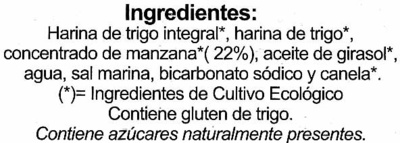
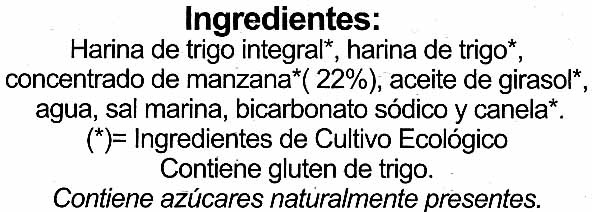
es: Harina de _trigo_ integral, harina de _trigo_, de manzana 22%, aceite de girasol, agua, sal marina, bicarbonato sôdico (e500ii), canela- Harina de _trigo_ integral -> en:whole-wheat-flour - labels: en:organic - vegan: yes - vegetarian: yes - ciqual_proxy_food_code: 9410 - percent_min: 22 - percent_max: 56
- harina de _trigo_ -> en:wheat-flour - labels: en:organic - vegan: yes - vegetarian: yes - ciqual_proxy_food_code: 9410 - percent_min: 22 - percent_max: 39
- de manzana -> en:apple - labels: en:organic - vegan: yes - vegetarian: yes - ciqual_food_code: 13050 - percent_min: 22 - percent: 22 - percent_max: 22
- aceite de girasol -> en:sunflower-oil - labels: en:organic - vegan: yes - vegetarian: yes - from_palm_oil: no - ciqual_food_code: 17440 - percent_min: 0 - percent_max: 22
- agua -> en:water - vegan: yes - vegetarian: yes - ciqual_food_code: 18066 - percent_min: 0 - percent_max: 18.6666666666667
- sal marina -> en:sea-salt - vegan: yes - vegetarian: yes - ciqual_food_code: 11082 - percent_min: 0 - percent_max: 1.2
- bicarbonato sôdico -> en:e500ii - vegan: yes - vegetarian: yes - percent_min: 0 - percent_max: 1.2
- e500ii -> en:e500ii - vegan: yes - vegetarian: yes - percent_min: 0 - percent_max: 1.2
- canela -> en:cinnamon - vegan: yes - vegetarian: yes - percent_min: 0 - percent_max: 1.2
Nutrition
-

Poor nutritional quality
⚠ ️Warning: the amount of fiber is not specified, their possible positive contribution to the grade could not be taken into account.⚠ ️Warning: the amount of fruits, vegetables and nuts is not specified on the label, it was estimated from the list of ingredients: 22This product is not considered a beverage for the calculation of the Nutri-Score.
Positive points: 0
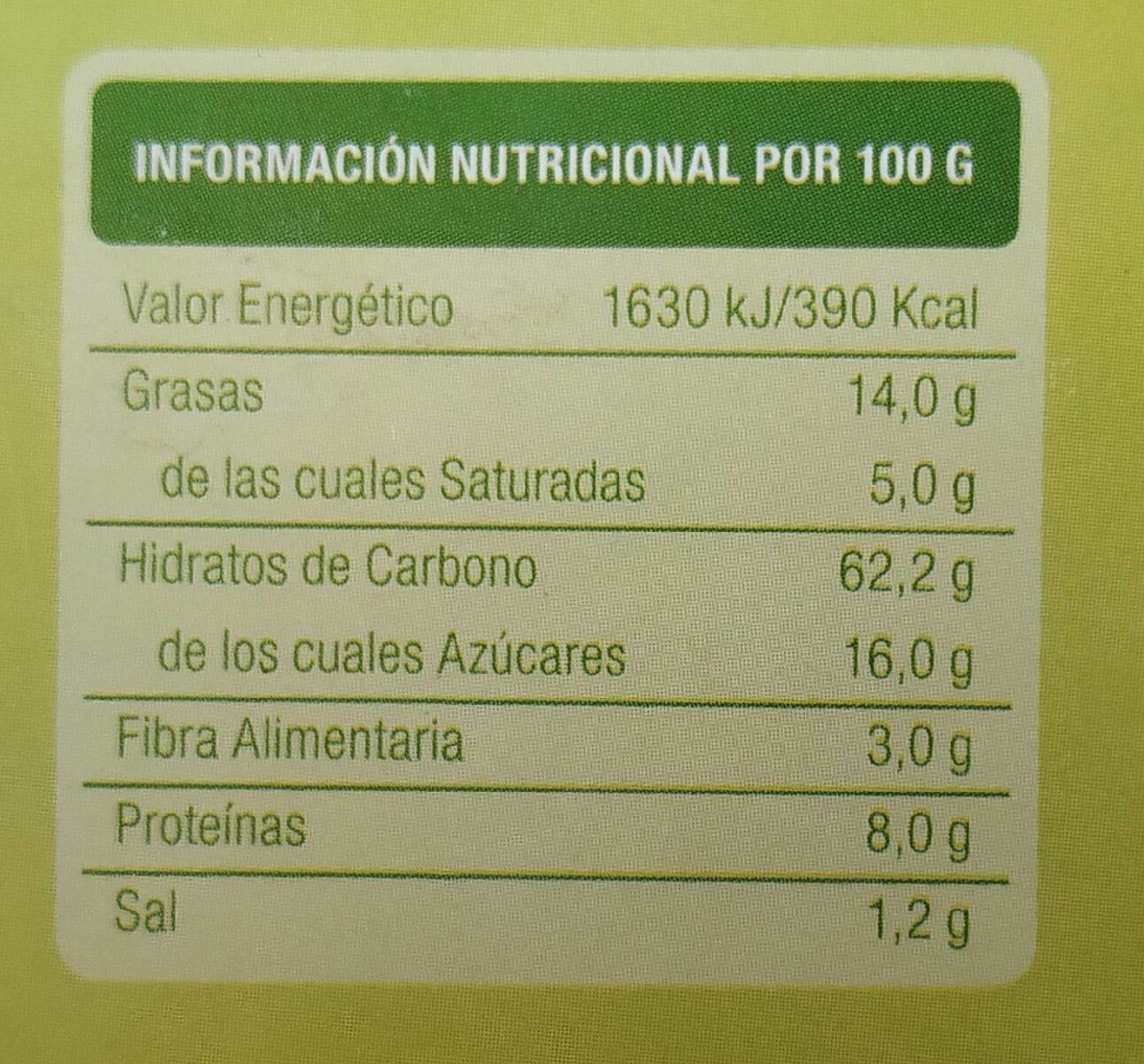
- Proteins: 4 / 5 (value: 8, rounded value: 8)
- Fiber: 0 / 5 (value: 0, rounded value: 0)
- Fruits, vegetables, nuts, and colza/walnut/olive oils: 0 / 5 (value: 22, rounded value: 22)
Negative points: 16
- Energy: 4 / 10 (value: 1632, rounded value: 1632)
- Sugars: 3 / 10 (value: 16, rounded value: 16)
- Saturated fat: 4 / 10 (value: 5, rounded value: 5)
- Sodium: 5 / 10 (value: 480, rounded value: 480)
The points for proteins are not counted because the negative points are greater or equal to 11.
Nutritional score: (16 - 0)
Nutri-Score:
-

Nutrient levels
-

Fat in moderate quantity (14%)
What you need to know- A high consumption of fat, especially saturated fats, can raise cholesterol, which increases the risk of heart diseases.
Recommendation: Limit the consumption of fat and saturated fat- Choose products with lower fat and saturated fat content.
-
Saturated fat in moderate quantity (5%)
What you need to know- A high consumption of fat, especially saturated fats, can raise cholesterol, which increases the risk of heart diseases.
Recommendation: Limit the consumption of fat and saturated fat- Choose products with lower fat and saturated fat content.
-

Sugars in high quantity (16%)
What you need to know- A high consumption of sugar can cause weight gain and tooth decay. It also augments the risk of type 2 diabetes and cardio-vascular diseases.
Recommendation: Limit the consumption of sugar and sugary drinks- Sugary drinks (such as sodas, fruit beverages, and fruit juices and nectars) should be limited as much as possible (no more than 1 glass a day).
- Choose products with lower sugar content and reduce the consumption of products with added sugars.
-
Salt in moderate quantity (1.2%)
What you need to know- A high consumption of salt (or sodium) can cause raised blood pressure, which can increase the risk of heart disease and stroke.
- Many people who have high blood pressure do not know it, as there are often no symptoms.
- Most people consume too much salt (on average 9 to 12 grams per day), around twice the recommended maximum level of intake.
Recommendation: Limit the consumption of salt and salted food- Reduce the quantity of salt used when cooking, and don't salt again at the table.
- Limit the consumption of salty snacks and choose products with lower salt content.
-


Environment
-

Eco-Score B - Low environmental impact
⚠ ️Select a country in order to include the full impact of transportation.The Eco-Score is an experimental score that summarizes the environmental impacts of food products.→ The Eco-Score was initially developped for France and it is being extended to other European countries. The Eco-Score formula is subject to change as it is regularly improved to make it more precise and better suited to each country.Life cycle analysis
-

Average impact of products of the same category: B (Score: 70/100)
Category: Biscuit (cookie)
Category: Biscuit (cookie)
- PEF environmental score: 0.34 (the lower the score, the lower the impact)
- including impact on climate change: 2.86 kg CO2 eq/kg of product
Stage Impact  Agriculture
80.2 %
Agriculture
80.2 % Processing
12.0 %
Processing
12.0 % Packaging
3.2 %
Packaging
3.2 % Transportation
3.2 %
Transportation
3.2 % Distribution
1.4 %
Distribution
1.4 % Consumption
0.0 %
Consumption
0.0 %
Bonuses and maluses
-
Labels with high environmental benefits
Bonus: +15
-
EU Organic
Organic agriculture contributes to preserve biodiversity, climate, water quality and soil fertility.
Organic food is food produced by methods complying with the standards of organic farming and features practices that cycle resources, promote ecological balance, and conserve biodiversity.
-
-

Origins of ingredients with a high impact
Malus: -5
Environmental policy: -5
Transportation: 0
Origin of the product and/or its ingredients % of ingredients Impact European Union 100 %High
-
Packaging with a high impact
Malus: -15
Shape Material Recycling Impact Bag Plastic High Box Unknown High ⚠ ️ The information about the packaging of this product is not sufficiently precise (exact shapes and materials of all components of the packaging).⚠ ️ For a more precise calculation of the Eco-Score, you can modify the product page and add them.
If you are the manufacturer of this product, you can send us the information with our free platform for producers.
Eco-Score for this product
-
Impact for this product: B (Score: 65/100)
Product: Galletas BioArtesanas con Manzana - El Granero Integral - 250 g
Life cycle analysis score: 70
Sum of bonuses and maluses: -5
Final score: 65/100
-

Carbon footprint
-

Equal to driving 1.5 km in a petrol car
286 g CO² per 100g of product
The carbon emission figure comes from ADEME's Agribalyse database, for the category: Biscuit (cookie) (Source: ADEME Agribalyse Database)
Stage Impact
Agriculture
82.7 %
Processing
8.0 %
Packaging
3.8 %
Transportation
4.7 %
Distribution
0.7 %
Consumption
0.0 %
Packaging
-
Packaging with a high impact
-
Packaging parts
 Bag (Plastic)
Box
-
Transportation
-
Origins of ingredients
Origins of ingredients with a high impact
Origin of the product and/or its ingredients % of ingredients Impact European Union 100 %High
Labels
-
EU Organic
Organic agriculture contributes to preserve biodiversity, climate, water quality and soil fertility.
Organic food is food produced by methods complying with the standards of organic farming and features practices that cycle resources, promote ecological balance, and conserve biodiversity.

Data sources
Product added on by javichu
Last edit of product page on by thaialagata.
Product page also edited by fix-ingredientes-bot, kiliweb, musarana, packbot, yuka.WjZvOEN2OGcrL1FTdGRzZit4am4xZmRTbmNPTVVXYUhOZnBPSUE9PQ, yuka.sY2b0xO6T85zoF3NwEKvln5Db-PToRXoMjjmtxfa5_a1Fp32Ou5c-5HHLas.