Help us inform millions of consumers around the world about what they eat

group photo donation 2024
Open Food Facts logo

Please give to our 2026 Fundraiser

Your donations fund the day-to-day operations of our non-profit association:

  • keeping our database open & available to all,
    • technical infrastructure (website/mobile app) & a small permanent team
  • remain independent of the food industry,

  • engage a community of committed citizens,

  • support the advancement of public health research.

Each donation counts! We appreciate your support in bringing further food transparency in the world.

arrow_upward

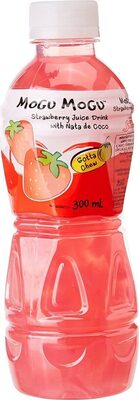
Mogu Mogu Strawberry Juice – Sappe Public Company Limited – 320ml

Mogu Mogu Strawberry Juice – Sappe Public Company Limited – 320ml

This product page is not complete. You can help to complete it by editing it and adding more data from the photos we have, or by taking more photos using the app for Android or iPhone/iPad. Thank you! ×

Barcode:
8850389100691(EAN / EAN-13)

Quantity: 320ml

Brands: Sappe Public Company Limited

Categories: Beverages and beverages preparations, Beverages, Sweetened beverages

Origin of ingredients: Philippines

Countries where sold: France, India

Matching with your preferences

Health

Nutrition

  • icon

    Nutri-Score E

    Lower nutritional quality
    ⚠ ️Warning: the amount of fruits, vegetables and nuts is not specified on the label, it was estimated from the list of ingredients: 51
    • icon

      Discover the new Nutri-Score!


      The computation of the Nutri-Score is evolving to provide better recommendations based on the latest scientific evidence.

      Main improvements:

      • Better score for some fatty fish and oils rich in good fats
      • Better score for whole products rich in fiber
      • Worse score for products containing a lot of salt or sugar
      • Worse score for red meat (compared to poultry)
    • icon

      What is the Nutri-Score?


      The Nutri-Score is a logo on the overall nutritional quality of products.

      The score from A to E is calculated based on nutrients and foods to favor (proteins, fiber, fruits, vegetables and legumes ...) and nutrients to limit (calories, saturated fat, sugars, salt). The score is calculated from the data of the nutrition facts table and the composition data (fruits, vegetables and legumes).

    icon

    Negative points: 14/54

    • icon

      Energy

      4/10 points (236.25kJ)

      Energy intakes above energy requirements are associated with increased risks of weight gain, overweight, obesity, and consequently risk of diet-related chronic diseases.

    • icon

      Sugar

      10/10 points (13.44g)

      A high consumption of sugar can cause weight gain and tooth decay. It also augments the risk of type 2 diabetes and cardio-vascular diseases.

    • icon

      Salt

      0/20 points (0.12g)

      A high consumption of salt (or sodium) can cause raised blood pressure, which can increase the risk of heart disease and stroke.

    • icon

      Non-nutritive sweeteners

      0/4 points (0 sweetener)

      Non-nutritive sweeteners may not confer any long-term benefit in reducing body fat in adults or children. There may be potential undesirable effects from long-term use of non-nutritive sweeteners, such as an increased risk of type 2 diabetes and cardiovascular diseases in adults.

    icon

    Positive points: 2/18

    • icon

      Proteins

      0/7 points (0g)

      Foods that are rich in proteins are usually rich in calcium or iron which are essential minerals with numerous health benefits.

    • icon

      Fiber

      0/5 points (0.31g)

      Consuming foods rich in fiber (especially whole grain foods) reduces the risks of aerodigestive cancers, cardiovascular diseases, obesity and diabetes.

    • icon

      Details of the calculation of the Nutri-Score


      ⚠ ️Warning: the amount of fruits, vegetables and nuts is not specified on the label, it was estimated from the list of ingredients: 51

      This product is considered a beverage for the calculation of the Nutri-Score.

      Points for proteins are counted because the product is considered to be a beverage.

      Nutritional score: 12 (14 - 2)

      Nutri-Score: E

  • icon

    Nutrient levels


    • icon

      Sugars in high quantity (13.4%)


      What you need to know
      • A high consumption of sugar can cause weight gain and tooth decay. It also augments the risk of type 2 diabetes and cardio-vascular diseases.

      Recommendation: Limit the consumption of sugar and sugary drinks
      • Sugary drinks (such as sodas, fruit beverages, and fruit juices and nectars) should be limited as much as possible (no more than 1 glass a day).
      • Choose products with lower sugar content and reduce the consumption of products with added sugars.
    • icon

      Salt in low quantity (0.125%)


      What you need to know
      • A high consumption of salt (or sodium) can cause raised blood pressure, which can increase the risk of heart disease and stroke.
      • Many people who have high blood pressure do not know it, as there are often no symptoms.
      • Most people consume too much salt (on average 9 to 12 grams per day), around twice the recommended maximum level of intake.

      Recommendation: Limit the consumption of salt and salted food
      • Reduce the quantity of salt used when cooking, and don't salt again at the table.
      • Limit the consumption of salty snacks and choose products with lower salt content.

  • icon

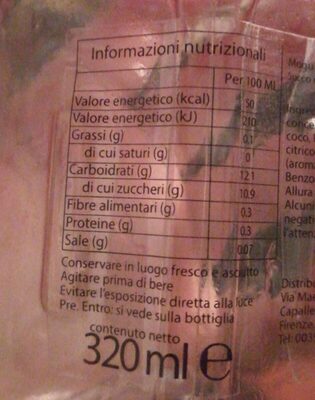
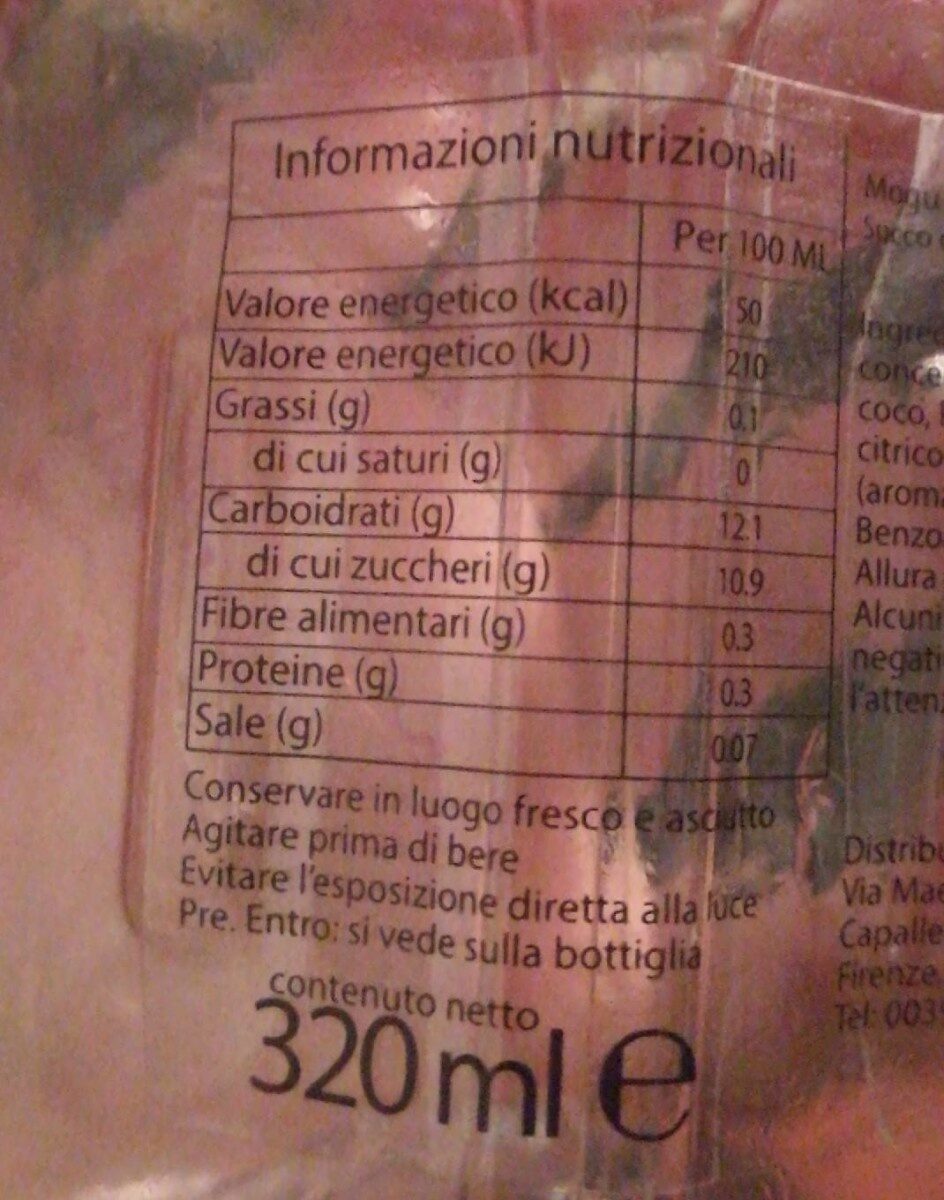
    Nutrition facts


    Nutrition facts As sold
    for 100 g / 100 ml
    Compared to: Sweetened beverages
    Energy ~ 236.25 kJ
    (56 kcal)
    253.687 kj (60 kcal) (-7%)
    Fat 0 g 0.228 g (-100%)
    Saturated fat ? 0.095 g
    Carbohydrates 13.75 g 13.299 g (+3%)
    Sugars 13.4375 g 12.304 g (+9%)
    Added sugars 13.125 g 11.559 g (+14%)
    Fiber 0.3125 g 0.174 g (+80%)
    Proteins 0 g 0.359 g (-100%)
    Salt 0.125 g 0.034 g (+265%)
    Sodium 0.05 g 0.014 g (+264%)
    Calcium 0.015625 g 36.118 mg (-57%)
    Fruits‚ vegetables‚ legumes ~ 51.95 % 5.719 % (+808%)
    • Nutrition facts (Detailed data)


      Nutrition facts As sold
      for 100 g / 100 ml
      As sold per serving (320 ml) (packaging) As sold for 100 g (estimate)
      Energy ~ 236.25 kJ
      (56 kcal)
      ? kcal
      (180 kcal)
      ?
      Fat 0 g 0 g ?
      Saturated fat ? ? ?
      Carbohydrates 13.75 g 44 g ?
      Sugars 13.4375 g 43 g ?
      Added sugars 13.125 g 42 g ~ 6.6625 g
      Fiber 0.3125 g 1 g ?
      Proteins 0 g 0 g ?
      Salt 0.125 g 0.4 g ?
      Sodium 0.05 g 0.16 g ?
      Calcium 0.015625 g 0.05 g ?
      Fruits‚ vegetables‚ legumes ~ 51.95 % ? ~ 51.95 %
Serving size: 1 bottle (320 ml)

Ingredients

  • icon

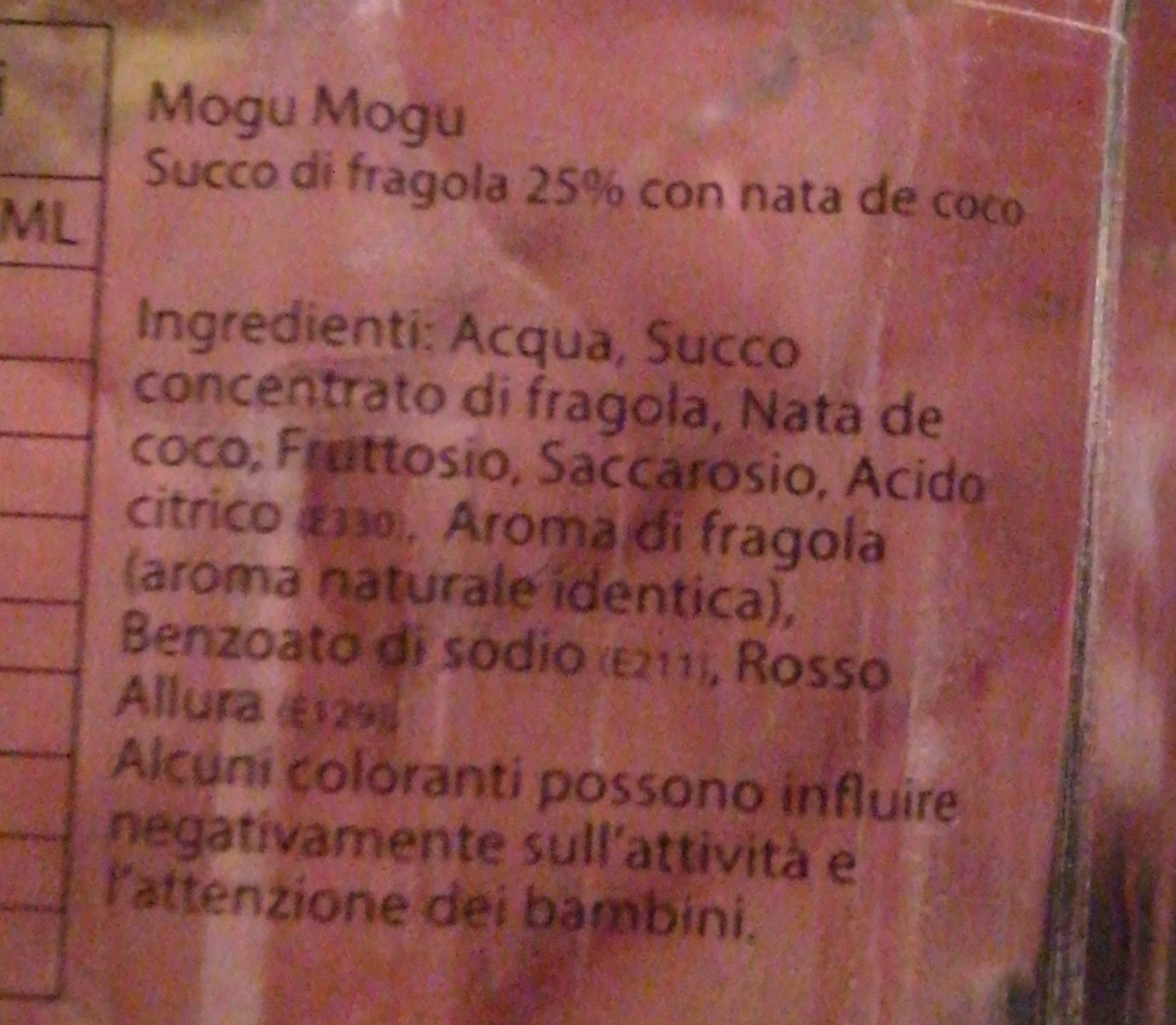
    23 ingredients


    water, strawberry juice from concentrate (25%), nata de coco (25%) (coconut water (97,8%), sugar, acidity regulator (ins 260)), sugar, nature identical flavour (strawberry), acidity regulators (ins 330, ins 327), preservatives (ins 202, ins 211), stabilizer (ins 418), artificial colours (ins 122, ins 124, ins 102), pete
    • Ingredient information


      • Water: 37.5% (estimate)


      • Strawberry juice from concentrate: 25.0%


      • Nata-de-coco: 25.0%


      • — Coconut water: 24.4%


      • — Sugar: < 2% (estimate)


      • — Acidity regulator: < 2% (estimate)


      • —— E260: < 2% (estimate)


      • Sugar: 6.2% (estimate)


      • Nature identical flavouring: 2.5% (estimate)


      • — Strawberry: 2.5% (estimate)


      • Acidity regulator: < 2% (estimate)


      • — E330: < 2% (estimate)


      • — E327: < 2% (estimate)


      • Preservative: < 2% (estimate)


      • — E202: < 2% (estimate)


      • — E211: < 2% (estimate)


      • Stabiliser: < 2% (estimate)


      • — E418: < 2% (estimate)


      • Colour: < 2% (estimate)


      • — E122: < 2% (estimate)


      • — E124: < 2% (estimate)


      • — E102: < 2% (estimate)


      • Pete: < 2% (estimate)


  • icon

    Contains added sugars (13%)

    Added sugars: Sugar
    Quantity of added sugars: 13%
    Search for products in the same category without added sugars: Sweetened beverages
    What you need to know
    • A high consumption of sugar can cause weight gain and tooth decay. It also augments the risk of type 2 diabetes and cardio-vascular diseases.

    Recommendation: Limit the consumption of sugar and sugary drinks
    • Sugary drinks (such as sodas, fruit beverages, and fruit juices and nectars) should be limited as much as possible (no more than 1 glass a day).
    • Choose products with lower sugar content and reduce the consumption of products with added sugars.

Food processing

Additives

  • E102 - Tartrazine


    Tartrazine (E102) is a synthetic lemon-yellow azo dye used as a food coloring.

    It is found in a wide range of products such as soft drinks, desserts, candies, and snack foods to give them a vibrant yellow appearance.

    While approved by many regulatory agencies, tartrazine has been linked to allergic reactions, such as hives, in a small portion of the population. Some studies have also suggested a link to increased hyperactivity in children, particularly when consumed with other additives like benzoates.

  • E122 - Azorubine


    Azorubine: Azorubine is an azo dye produced as a disodium salt. In its dry form, the product appears red to maroon. It is mainly used in foods which are heat-treated after fermentation. It has E number E122.
    Source: Wikipedia
  • E124 - Ponceau 4r


    Ponceau 4R: Ponceau 4R -known by more than 100 synonyms, including as C.I. 16255, Cochineal Red A, C.I. Acid Red 18, Brilliant Scarlet 3R, Brilliant Scarlet 4R, New Coccine, is a synthetic colourant that may be used as a food colouring. It is denoted by E Number E124. Its chemical name is 1--4-sulpho-1-napthylazo-- 2-napthol- 6‚8-disulphonic acid, trisodium salt. Ponceau -17th century French for "poppy-coloured"- is the generic name for a family of azo dyes. Ponceau 4R is a strawberry red azo dye which can be used in a variety of food products, and is usually synthesized from aromatic hydrocarbons; it is stable to light, heat, and acid but fades in the presence of ascorbic acid.It is used in Europe, Asia and Australia, but has not been approved by the US FDA.
    Source: Wikipedia
  • E202 - Potassium sorbate


    Potassium sorbate (E202) is a synthetic food preservative commonly used to extend the shelf life of various food products.

    It works by inhibiting the growth of molds, yeast, and some bacteria, preventing spoilage. When added to foods, it helps maintain their freshness and quality.

    Some studies have shown that when combined with nitrites, potassium sorbate have genotoxic activity in vitro. However, potassium sorbate is generally recognized as safe (GRAS) by regulatory authorities.

  • E211 - Sodium benzoate


    Sodium benzoate: Sodium benzoate is a substance which has the chemical formula NaC7H5O2. It is a widely used food preservative, with an E number of E211. It is the sodium salt of benzoic acid and exists in this form when dissolved in water. It can be produced by reacting sodium hydroxide with benzoic acid.
    Source: Wikipedia
  • E260 - Acetic acid


    Acetic acid: Acetic acid , systematically named ethanoic acid , is a colorless liquid organic compound with the chemical formula CH3COOH -also written as CH3CO2H or C2H4O2-. When undiluted, it is sometimes called glacial acetic acid. Vinegar is no less than 4% acetic acid by volume, making acetic acid the main component of vinegar apart from water. Acetic acid has a distinctive sour taste and pungent smell. In addition to household vinegar, it is mainly produced as a precursor to polyvinyl acetate and cellulose acetate. It is classified as a weak acid since it only partially dissociates in solution, but concentrated acetic acid is corrosive and can attack the skin. Acetic acid is the second simplest carboxylic acid -after formic acid-. It consists of a methyl group attached to a carboxyl group. It is an important chemical reagent and industrial chemical, used primarily in the production of cellulose acetate for photographic film, polyvinyl acetate for wood glue, and synthetic fibres and fabrics. In households, diluted acetic acid is often used in descaling agents. In the food industry, acetic acid is controlled by the food additive code E260 as an acidity regulator and as a condiment. In biochemistry, the acetyl group, derived from acetic acid, is fundamental to all forms of life. When bound to coenzyme A, it is central to the metabolism of carbohydrates and fats. The global demand for acetic acid is about 6.5 million metric tons per year -Mt/a-, of which approximately 1.5 Mt/a is met by recycling; the remainder is manufactured from methanol. Vinegar is mostly dilute acetic acid, often produced by fermentation and subsequent oxidation of ethanol.
    Source: Wikipedia
  • E327 - Calcium lactate


    Calcium lactate: Calcium lactate is a white crystalline salt with formula C6H10CaO6, consisting of two lactate anions H3C-CHOH-CO−2 for each calcium cation Ca2+. It forms several hydrates, the most common being the pentahydrate C6H10CaO6·5H2O. Calcium lactate is used in medicine, mainly to treat calcium deficiencies; and as a food additive with E number of E327. Some cheese crystals consist of calcium lactate.
    Source: Wikipedia
  • E330 - Citric acid


    Citric acid is a natural organic acid found in citrus fruits such as lemons, oranges, and limes.

    It is widely used in the food industry as a flavor enhancer, acidulant, and preservative due to its tart and refreshing taste.

    Citric acid is safe for consumption when used in moderation and is considered a generally recognized as safe (GRAS) food additive by regulatory agencies worldwide.

  • E418 - Gellan gum


    Gellan gum: Gellan gum is a water-soluble anionic polysaccharide produced by the bacterium Sphingomonas elodea -formerly Pseudomonas elodea based on the taxonomic classification at the time of its discovery-. Its taxonomic classification has been subsequently changed to Sphingomonas elodea based on current classification system. The gellan-producing bacterium was discovered and isolated by the former Kelco Division of Merck & Company, Inc. in 1978 from the lily plant tissue from a natural pond in Pennsylvania, USA. It was initially identified as a substitute gelling agent at significantly lower use level to replace agar in solid culture media for the growth of various microorganisms Its initial commercial product with the trademark as "GELRITE" gellan gum, was subsequently identified as a suitable agar substitute as gelling agent in various clinical bacteriological media.
    Source: Wikipedia

Ingredients analysis

  • icon

    Vegan status unknown


    Unrecognized ingredients: Pete

    Some ingredients could not be recognized.

    We need your help!

    You can help us recognize more ingredients and better analyze the list of ingredients for this product and others:

    • Edit this product page to correct spelling mistakes in the ingredients list, and/or to remove ingredients in other languages and sentences that are not related to the ingredients.
    • Add new entries, synonyms or translations to our multilingual lists of ingredients, ingredient processing methods, and labels.

    If you would like to help, join the #ingredients channel on our Slack discussion space and/or learn about ingredients analysis on our wiki. Thank you!

  • icon

    Vegetarian status unknown


    Unrecognized ingredients: Pete

    Some ingredients could not be recognized.

    We need your help!

    You can help us recognize more ingredients and better analyze the list of ingredients for this product and others:

    • Edit this product page to correct spelling mistakes in the ingredients list, and/or to remove ingredients in other languages and sentences that are not related to the ingredients.
    • Add new entries, synonyms or translations to our multilingual lists of ingredients, ingredient processing methods, and labels.

    If you would like to help, join the #ingredients channel on our Slack discussion space and/or learn about ingredients analysis on our wiki. Thank you!

The analysis is based solely on the ingredients listed and does not take into account processing methods.
  • icon

    Details of the analysis of the ingredients

    We need your help!

    Some ingredients could not be recognized.

    We need your help!

    You can help us recognize more ingredients and better analyze the list of ingredients for this product and others:

    • Edit this product page to correct spelling mistakes in the ingredients list, and/or to remove ingredients in other languages and sentences that are not related to the ingredients.
    • Add new entries, synonyms or translations to our multilingual lists of ingredients, ingredient processing methods, and labels.

    If you would like to help, join the #ingredients channel on our Slack discussion space and/or learn about ingredients analysis on our wiki. Thank you!

    en: water, strawberry juice from concentrate 25%, nata de coco 25% (coconut water 24.45%, sugar, acidity regulator (e260)), sugar, nature identical flavour (strawberry), acidity regulators (e330, e327), preservatives (e202, e211), stabilizer (e418), artificial colours (e122, e124, e102), pete
    1. water -> en:water – vegan: yes – vegetarian: yes – ciqual_food_code: 18066 – percent_min: 25 – percent_estimate: 37.5 – percent_max: 50
    2. strawberry juice from concentrate -> en:strawberry-juice-from-concentrate – vegan: maybe – vegetarian: maybe – ciqual_food_code: 13014 – percent_min: 25 – percent: 25 – percent_max: 25
    3. nata de coco -> en:nata-de-coco – percent_min: 25 – percent: 25 – percent_max: 25
      1. coconut water -> en:coconut-water – vegan: yes – vegetarian: yes – ciqual_food_code: 18011 – percent_min: 24.45 – percent: 24.45 – percent_max: 24.45
      2. sugar -> en:sugar – vegan: maybe – vegetarian: yes – ciqual_proxy_food_code: 31016 – percent_min: 0.275 – percent_estimate: 0.412500000000001 – percent_max: 0.550000000000001
      3. acidity regulator -> en:acidity-regulator – percent_min: 0 – percent_estimate: 0.137499999999999 – percent_max: 0.274999999999999
        1. e260 -> en:e260 – vegan: yes – vegetarian: yes – percent_min: 0 – percent_estimate: 0.137499999999999 – percent_max: 0.274999999999999
    4. sugar -> en:sugar – vegan: maybe – vegetarian: yes – ciqual_proxy_food_code: 31016 – percent_min: 0 – percent_estimate: 6.25 – percent_max: 25
    5. nature identical flavour -> en:nature-identical-flavouring – vegan: maybe – vegetarian: maybe – percent_min: 0 – percent_estimate: 2.5 – percent_max: 5
      1. strawberry -> en:strawberry – vegan: yes – vegetarian: yes – ciqual_food_code: 13014 – percent_min: 0 – percent_estimate: 2.5 – percent_max: 5
    6. acidity regulators -> en:acidity-regulator – percent_min: 0 – percent_estimate: 1.875 – percent_max: 5
      1. e330 -> en:e330 – vegan: yes – vegetarian: yes – percent_min: 0 – percent_estimate: 0.9375 – percent_max: 5
      2. e327 -> en:e327 – vegan: yes – vegetarian: yes – percent_min: 0 – percent_estimate: 0.9375 – percent_max: 2.5
    7. preservatives -> en:preservative – percent_min: 0 – percent_estimate: 0.9375 – percent_max: 5
      1. e202 -> en:e202 – vegan: yes – vegetarian: yes – percent_min: 0 – percent_estimate: 0.46875 – percent_max: 5
      2. e211 -> en:e211 – vegan: yes – vegetarian: yes – percent_min: 0 – percent_estimate: 0.46875 – percent_max: 2.5
    8. stabilizer -> en:stabiliser – percent_min: 0 – percent_estimate: 0.46875 – percent_max: 5
      1. e418 -> en:e418 – vegan: yes – vegetarian: yes – percent_min: 0 – percent_estimate: 0.46875 – percent_max: 5
    9. artificial colours -> en:colour – percent_min: 0 – percent_estimate: 0.234375 – percent_max: 5
      1. e122 -> en:e122 – vegan: yes – vegetarian: yes – percent_min: 0 – percent_estimate: 0.1171875 – percent_max: 5
      2. e124 -> en:e124 – vegan: yes – vegetarian: yes – percent_min: 0 – percent_estimate: 0.05859375 – percent_max: 2.5
      3. e102 -> en:e102 – vegan: yes – vegetarian: yes – percent_min: 0 – percent_estimate: 0.05859375 – percent_max: 1.66666666666667
    10. pete -> en:pete – percent_min: 0 – percent_estimate: 0.234375 – percent_max: 5

Environment

Packaging

Transportation

Report a problem

Data sources

Product added on by deogracia
Last edit of product page on by new-nutrition-bot.
Product page also edited by aaruswartz, foodless, inf, kiliweb, macrofactor, openfoodfacts-contributors, roboto-app, scanbot, shahani, yuka.VDVwZk5QaFpuOEExdk5zN3hRdlcwUGRKekptRVIwV2FDdXNVSWc9PQ, yuka.sY2b0xO6T85zoF3NwEKvllZaaeXcnRfUFD3TkGqi482VKaS0SvBv66PeM6g.

If the data is incomplete or incorrect, you can complete or correct it by editing this page.