Help us inform millions of consumers around the world about what they eat
Please give to our 2026 Fundraiser
Your donations fund the day-to-day operations of our non-profit association:
-
keeping our database open & available to all,
- technical infrastructure (website/mobile app) & a small permanent team
-
remain independent of the food industry,
-
engage a community of committed citizens,
-
support the advancement of public health research.
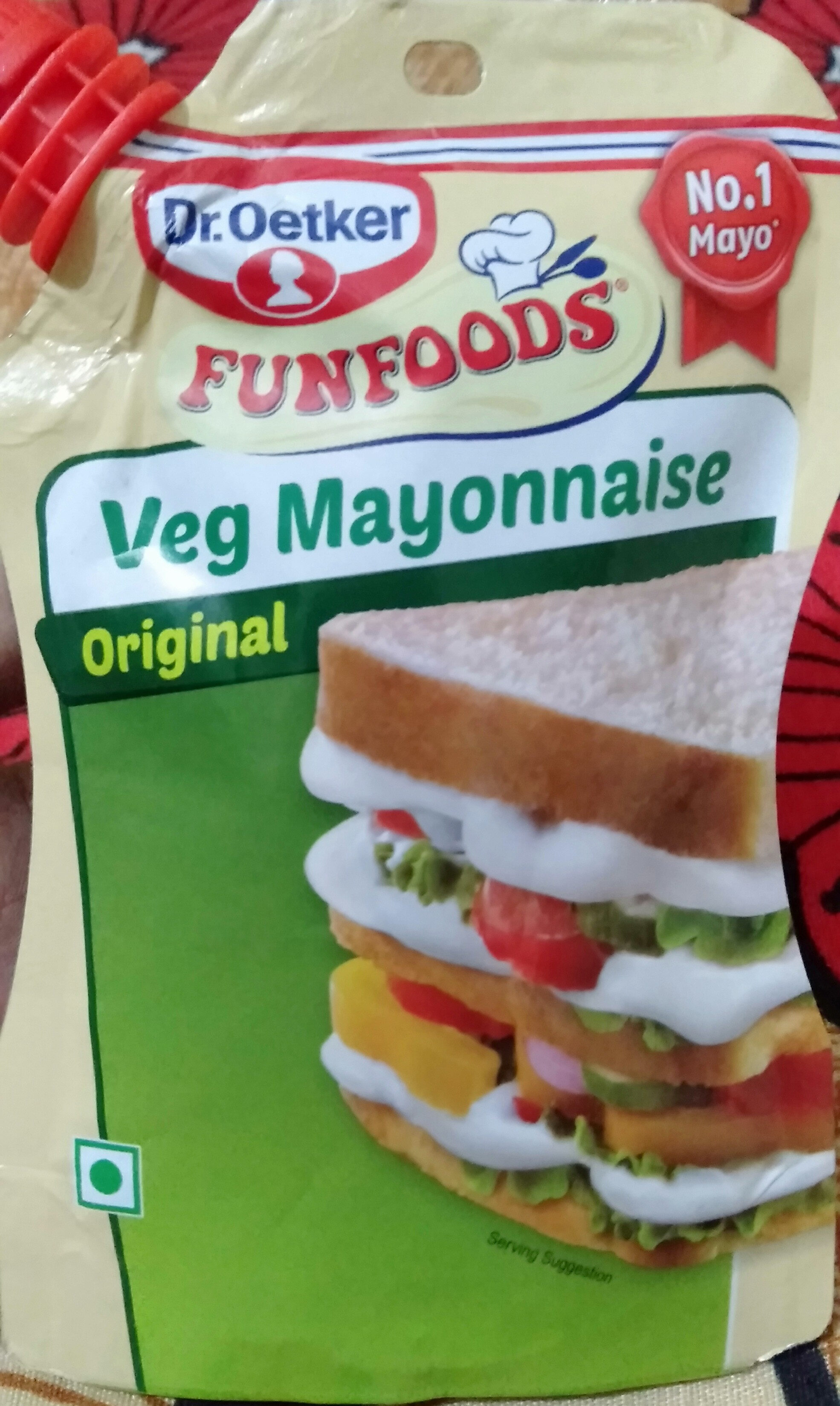
Veg mayonnaise – Dr. Oetker – 100g
This product page is not complete. You can help to complete it by editing it and adding more data from the photos we have, or by taking more photos using the app for Android or iPhone/iPad. Thank you!
×
Barcode:
8906002004430(EAN / EAN-13)
Barcode:
8906002004430(EAN / EAN-13)
Quantity: 100g
Packaging: Plastic pouch
Brands: Dr. Oetker
Categories: Condiments, Sauces, Vegetarian sauces, Mayonnaises, Vegan sauces, Egg-free mayonnaises
Labels, certifications, awards: No gluten, Vegetarian, ISO 22000, No Trans fat
Origin of ingredients: China
Manufacturing or processing places: Rajasthan
Traceability code: FSSAI - 10016013001106
Countries where sold: India
Matching with your preferences
Health
Nutrition
-
Nutri-Score E
Lower nutritional quality
⚠ ️Warning: the amount of fruits, vegetables and nuts is not specified on the label, it was estimated from the list of ingredients: 0-
Discover the new Nutri-Score!
The computation of the Nutri-Score is evolving to provide better recommendations based on the latest scientific evidence.
Main improvements:
- Better score for some fatty fish and oils rich in good fats
- Better score for whole products rich in fiber
- Worse score for products containing a lot of salt or sugar
- Worse score for red meat (compared to poultry)
-
What is the Nutri-Score?
The Nutri-Score is a logo on the overall nutritional quality of products.
The score from A to E is calculated based on nutrients and foods to favor (proteins, fiber, fruits, vegetables and legumes ...) and nutrients to limit (calories, saturated fat, sugars, salt). The score is calculated from the data of the nutrition facts table and the composition data (fruits, vegetables and legumes).
Negative points: 26/55
-
Energy
6/10 points (2103kJ)
Energy intakes above energy requirements are associated with increased risks of weight gain, overweight, obesity, and consequently risk of diet-related chronic diseases.
-
Sugar
2/15 points (7.3g)
A high consumption of sugar can cause weight gain and tooth decay. It also augments the risk of type 2 diabetes and cardio-vascular diseases.
-
Saturated fat
9/10 points (9.2g)
A high consumption of fat, especially saturated fats, can raise cholesterol, which increases the risk of heart diseases.
-
Salt
9/20 points (1.8g)
A high consumption of salt (or sodium) can cause raised blood pressure, which can increase the risk of heart disease and stroke.
Positive points: 0/10
-
Fiber
0/5 points (0g)
Consuming foods rich in fiber (especially whole grain foods) reduces the risks of aerodigestive cancers, cardiovascular diseases, obesity and diabetes.
-
Fruits, vegetables and legumes
0/5 points (0.9%)
Consuming foods rich in fruits, vegetables and legumes reduces the risks of aerodigestive cancers, cardiovascular diseases, obesity and diabetes.
-
Details of the calculation of the Nutri-Score
⚠ ️Warning: the amount of fruits, vegetables and nuts is not specified on the label, it was estimated from the list of ingredients: 0This product is not considered a beverage for the calculation of the Nutri-Score.
Points for proteins are not counted because the negative points greater than or equal to 11.
Nutritional score: 26 (26 - 0)
Nutri-Score: E
-
-
Nutrient levels
-
Fat in high quantity (51.8%)
What you need to know- A high consumption of fat, especially saturated fats, can raise cholesterol, which increases the risk of heart diseases.
Recommendation: Limit the consumption of fat and saturated fat- Choose products with lower fat and saturated fat content.
-
Saturated fat in high quantity (9.2%)
What you need to know- A high consumption of fat, especially saturated fats, can raise cholesterol, which increases the risk of heart diseases.
Recommendation: Limit the consumption of fat and saturated fat- Choose products with lower fat and saturated fat content.
-
Sugars in moderate quantity (7.3%)
What you need to know- A high consumption of sugar can cause weight gain and tooth decay. It also augments the risk of type 2 diabetes and cardio-vascular diseases.
Recommendation: Limit the consumption of sugar and sugary drinks- Sugary drinks (such as sodas, fruit beverages, and fruit juices and nectars) should be limited as much as possible (no more than 1 glass a day).
- Choose products with lower sugar content and reduce the consumption of products with added sugars.
-
Salt in high quantity (1.8%)
What you need to know- A high consumption of salt (or sodium) can cause raised blood pressure, which can increase the risk of heart disease and stroke.
- Many people who have high blood pressure do not know it, as there are often no symptoms.
- Most people consume too much salt (on average 9 to 12 grams per day), around twice the recommended maximum level of intake.
Recommendation: Limit the consumption of salt and salted food- Reduce the quantity of salt used when cooking, and don't salt again at the table.
- Limit the consumption of salty snacks and choose products with lower salt content.
-
-
Nutrition facts
Nutrition facts As sold
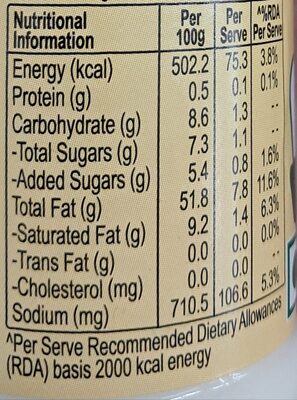
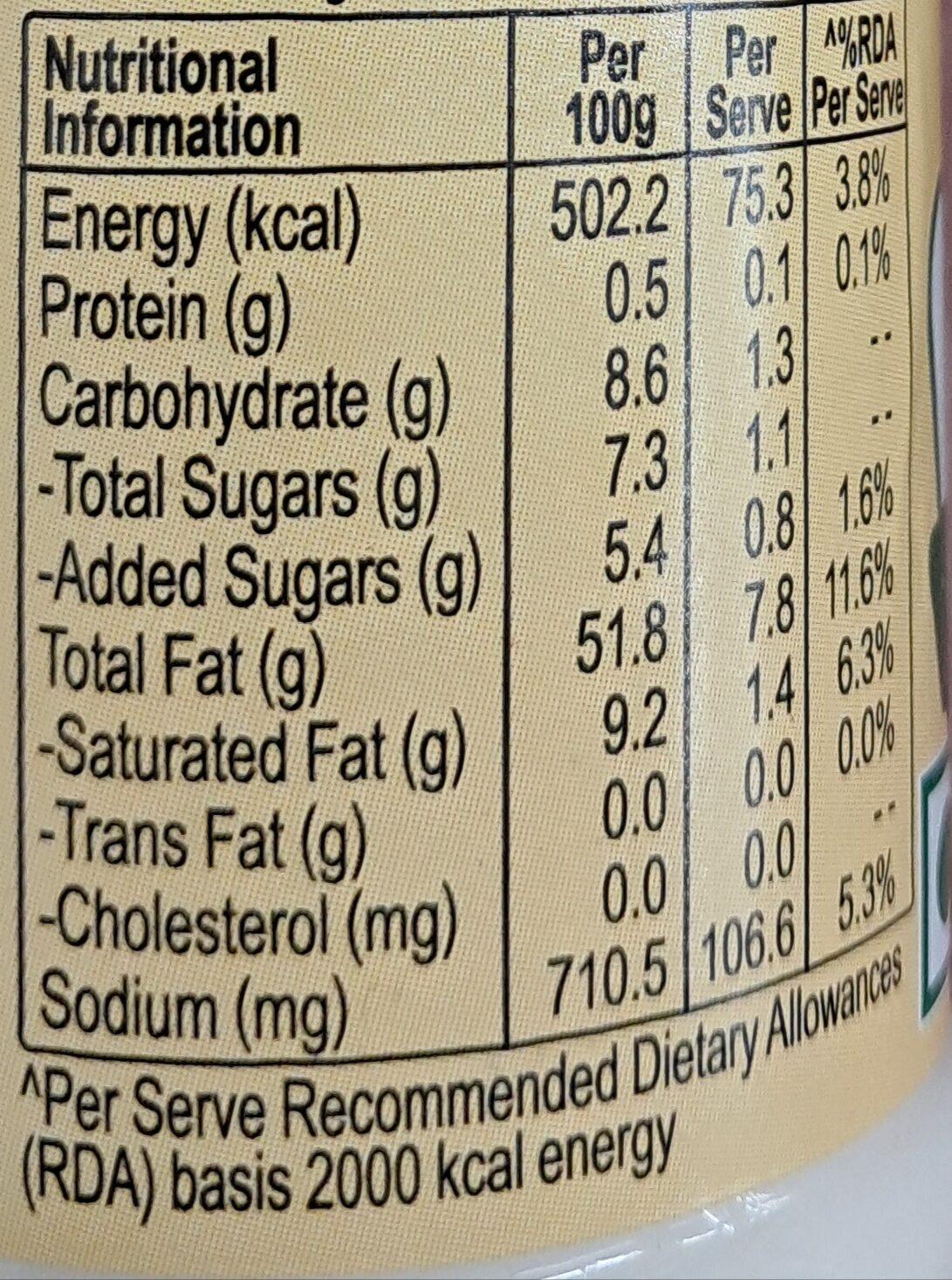
for 100 g / 100 mlCompared to: Egg-free mayonnaises Energy 2103 kJ
(502 kcal)2,109.428 kj (508 kcal) (-0%) Fat 51.8 g 53.676 g (-3%) Saturated fat 9.2 g 4.629 g (+99%) Trans fat 0 g 0.053 g (-100%) Cholesterol 0 g 0 mg Carbohydrates 8.6 g 5.637 g (+53%) Sugars 7.3 g 2.933 g (+149%) Fiber 0 g 0.219 g (-100%) Proteins 0.5 g 0.645 g (-22%) Salt 1.80467 g 1.237 g (+46%) Sodium 0.721868 g 0.495 g (+46%) Alcohol 0 % vol 0.012 % vol (-100%) Fruits‚ vegetables‚ legumes ? 2.178 % -
Nutrition facts (Detailed data)
Nutrition facts As sold
for 100 g / 100 mlAs sold for 100 g (packaging) Energy 2103 kJ
(502 kcal)2103 kJ
(502 kcal)Fat 51.8 g 51.8 g Saturated fat 9.2 g 9.2 g Trans fat 0 g 0 g Cholesterol 0 g 0 g Carbohydrates 8.6 g 8.6 g Sugars 7.3 g 7.3 g Fiber 0 g 0 g Proteins 0.5 g 0.5 g Salt 1.80467 g 1.80467 g Sodium 0.721868 g 0.721868 g Alcohol 0 % vol 0 % vol Fruits‚ vegetables‚ legumes ? ?
-
Ingredients
-
18 ingredients
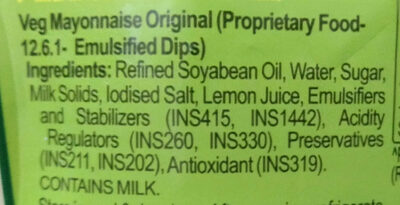
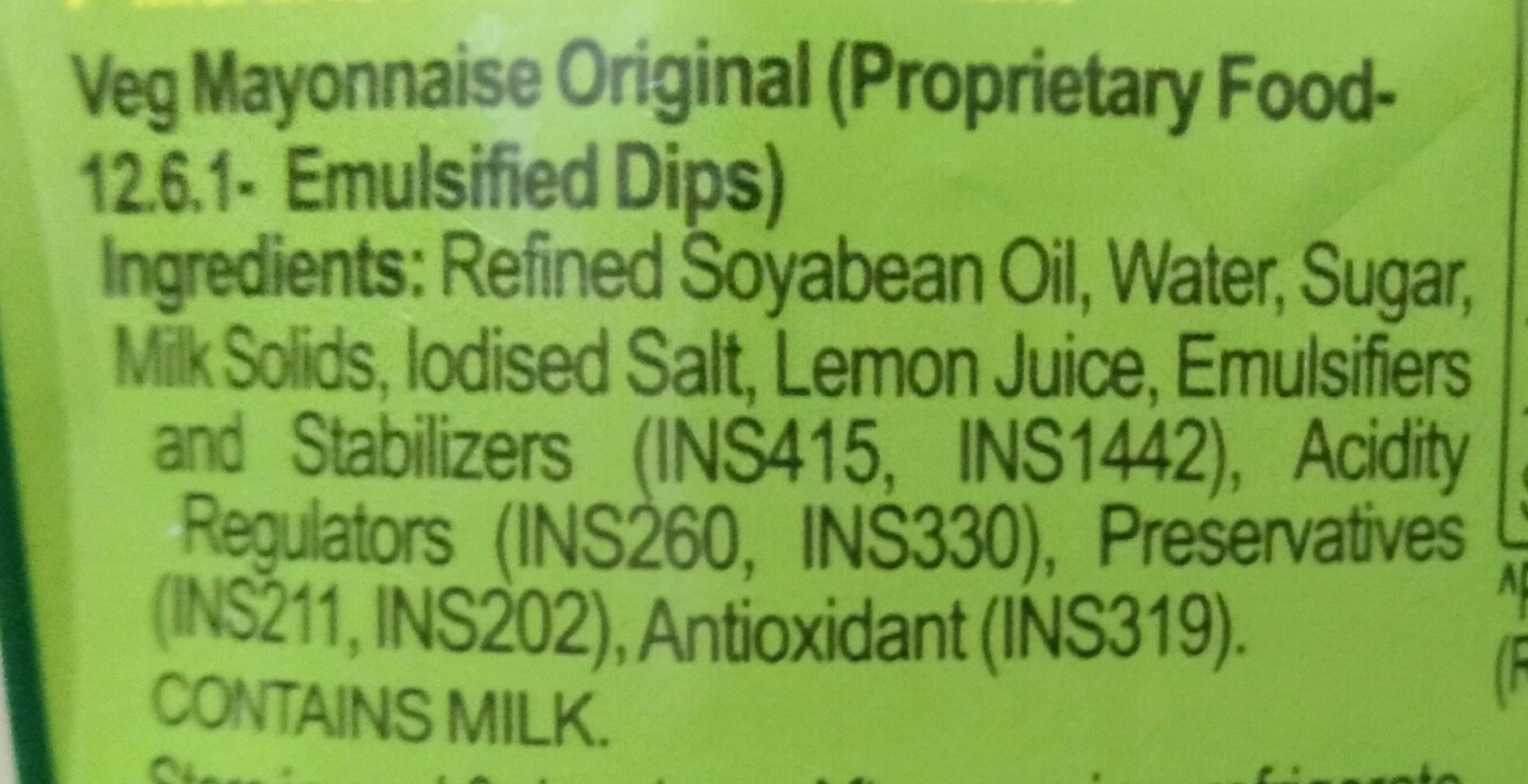
Refined Soyabean Oil, Water, Sugar, Milk Solids, iodised Salt, Lemon Juice, Emulsifiers and Stabilizers (INS415, INS1442), Acidity Regulators (INS260, INS330), Preservatives (INS211, INS202), Antioxidant (INS319). CONTAINS MILK.Allergens: Milk, SoybeansTraces: Milk-
Ingredient information
-
Refined soya oil: 61.4% (estimate)
-
Water: 19.3% (estimate)
-
Sugar: 3.6% (estimate)
-
Milk: 3.6% (estimate)
-
Iodised salt: < 2% (estimate)
-
Lemon juice: < 2% (estimate)
-
Emulsifier: < 2% (estimate)
-
— Stabiliser: < 2% (estimate)
-
— E415: < 2% (estimate)
-
E1442: < 2% (estimate)
-
Acidity regulator: < 2% (estimate)
-
— E260: < 2% (estimate)
-
— E330: < 2% (estimate)
-
Preservative: < 2% (estimate)
-
— E211: < 2% (estimate)
-
— E202: < 2% (estimate)
-
Antioxidant: 6.6% (estimate)
-
— E319: 6.6% (estimate)
-
-
-
Contains added sugars (~ 3%)
Added sugars: Sugar
Estimated quantity of added sugars in ingredients: 3%Search for products in the same category without added sugars: Egg-free mayonnaisesWhat you need to know- A high consumption of sugar can cause weight gain and tooth decay. It also augments the risk of type 2 diabetes and cardio-vascular diseases.
Recommendation: Limit the consumption of sugar and sugary drinks- Sugary drinks (such as sodas, fruit beverages, and fruit juices and nectars) should be limited as much as possible (no more than 1 glass a day).
- Choose products with lower sugar content and reduce the consumption of products with added sugars.
Food processing
-
Ultra-processed foods
3 ultra-processing markers
-
Limit ultra-processed foods
Limiting ultra-processed foods reduces the risk of noncommunicable chronic diseases
Several studies have found that a lower consumption of ultra-processed foods is associated with a reduced risk of noncommunicable chronic diseases, such as obesity, hypertension and diabetes.
Source: Ultra-processed foods increase noncommunicable chronic disease risk
Elements that indicate the product is in the 4 - Ultra processed food and drink products group:
- Additive: E1442 - Hydroxypropyl distarch phosphate
- Additive: E415 - Xanthan gum
- Ingredient: Emulsifier
Food products are classified into 4 groups according to their degree of processing:
- Unprocessed or minimally processed foods
- Processed culinary ingredients
- Processed foods
- Ultra-processed foods
The determination of the group is based on the category of the product and on the ingredients it contains.
-
Additives
-
E1442 - Hydroxypropyl distarch phosphate
Hydroxypropyl distarch phosphate: Hydroxypropyl distarch phosphate -HDP- is a modified resistant starch. It is currently used as a food additive -INS number 1442-. It is approved for use in the European Union -listed as E1442-, the United States, Australia, Taiwan, and New Zealand.Source: Wikipedia
-
E202 - Potassium sorbate
Potassium sorbate (E202) is a synthetic food preservative commonly used to extend the shelf life of various food products.
It works by inhibiting the growth of molds, yeast, and some bacteria, preventing spoilage. When added to foods, it helps maintain their freshness and quality.
Some studies have shown that when combined with nitrites, potassium sorbate have genotoxic activity in vitro. However, potassium sorbate is generally recognized as safe (GRAS) by regulatory authorities.
-
E211 - Sodium benzoate
Sodium benzoate: Sodium benzoate is a substance which has the chemical formula NaC7H5O2. It is a widely used food preservative, with an E number of E211. It is the sodium salt of benzoic acid and exists in this form when dissolved in water. It can be produced by reacting sodium hydroxide with benzoic acid.Source: Wikipedia
-
E260 - Acetic acid
Acetic acid: Acetic acid , systematically named ethanoic acid , is a colorless liquid organic compound with the chemical formula CH3COOH -also written as CH3CO2H or C2H4O2-. When undiluted, it is sometimes called glacial acetic acid. Vinegar is no less than 4% acetic acid by volume, making acetic acid the main component of vinegar apart from water. Acetic acid has a distinctive sour taste and pungent smell. In addition to household vinegar, it is mainly produced as a precursor to polyvinyl acetate and cellulose acetate. It is classified as a weak acid since it only partially dissociates in solution, but concentrated acetic acid is corrosive and can attack the skin. Acetic acid is the second simplest carboxylic acid -after formic acid-. It consists of a methyl group attached to a carboxyl group. It is an important chemical reagent and industrial chemical, used primarily in the production of cellulose acetate for photographic film, polyvinyl acetate for wood glue, and synthetic fibres and fabrics. In households, diluted acetic acid is often used in descaling agents. In the food industry, acetic acid is controlled by the food additive code E260 as an acidity regulator and as a condiment. In biochemistry, the acetyl group, derived from acetic acid, is fundamental to all forms of life. When bound to coenzyme A, it is central to the metabolism of carbohydrates and fats. The global demand for acetic acid is about 6.5 million metric tons per year -Mt/a-, of which approximately 1.5 Mt/a is met by recycling; the remainder is manufactured from methanol. Vinegar is mostly dilute acetic acid, often produced by fermentation and subsequent oxidation of ethanol.Source: Wikipedia
-
E319 - Tertiary-butylhydroquinone (tbhq)
Tert-Butylhydroquinone: tert-Butylhydroquinone -TBHQ, tertiary butylhydroquinone- is a synthetic aromatic organic compound which is a type of phenol. It is a derivative of hydroquinone, substituted with a tert-butyl group.Source: Wikipedia
-
E330 - Citric acid
Citric acid is a natural organic acid found in citrus fruits such as lemons, oranges, and limes.
It is widely used in the food industry as a flavor enhancer, acidulant, and preservative due to its tart and refreshing taste.
Citric acid is safe for consumption when used in moderation and is considered a generally recognized as safe (GRAS) food additive by regulatory agencies worldwide.
-
E415 - Xanthan gum
Xanthan gum (E415) is a natural polysaccharide derived from fermented sugars, often used in the food industry as a thickening and stabilizing agent.
This versatile food additive enhances texture and prevents ingredient separation in a wide range of products, including salad dressings, sauces, and gluten-free baked goods.
It is considered safe for consumption even at high intake amounts.
Ingredients analysis
-
Palm oil free
No ingredients containing palm oil detected
-
Non-vegan
Non-vegan ingredients: Milk
-
Vegetarian
No non-vegetarian ingredients detected
-
Details of the analysis of the ingredients
en: Refined Soyabean Oil, Water, Sugar, Milk, iodised Salt, Lemon Juice, Emulsifiers (and Stabilizers, e415), e1442, Acidity Regulators (e260, e330), Preservatives (e211, e202), Antioxidant (e319)- Refined Soyabean Oil -> en:refined-soya-oil – vegan: yes – vegetarian: yes – from_palm_oil: no – ciqual_food_code: 17420 – percent_min: 22.76731 – percent_estimate: 61.383655 – percent_max: 100
- Water -> en:water – vegan: yes – vegetarian: yes – ciqual_food_code: 18066 – percent_min: 0 – percent_estimate: 19.3081725 – percent_max: 50
- Sugar -> en:sugar – vegan: yes – vegetarian: yes – ciqual_proxy_food_code: 31016 – percent_min: 0 – percent_estimate: 3.65 – percent_max: 7.3
- Milk -> en:milk – vegan: no – vegetarian: yes – ciqual_proxy_food_code: 19051 – percent_min: 0 – percent_estimate: 3.65 – percent_max: 7.3
- iodised Salt -> en:iodised-salt – vegan: yes – vegetarian: yes – ciqual_food_code: 11058 – percent_min: 0 – percent_estimate: 0.902335 – percent_max: 1.80467
- Lemon Juice -> en:lemon-juice – vegan: yes – vegetarian: yes – ciqual_food_code: 2028 – percent_min: 0 – percent_estimate: 0.902335 – percent_max: 1.80467
- Emulsifiers -> en:emulsifier – percent_min: 0 – percent_estimate: 0.902335 – percent_max: 1.80467
- and Stabilizers -> en:stabiliser – percent_min: 0 – percent_estimate: 0.4511675 – percent_max: 1.80467
- e415 -> en:e415 – vegan: yes – vegetarian: yes – percent_min: 0 – percent_estimate: 0.4511675 – percent_max: 0.902335
- e1442 -> en:e1442 – vegan: yes – vegetarian: yes – percent_min: 0 – percent_estimate: 0.902335 – percent_max: 1.80467
- Acidity Regulators -> en:acidity-regulator – percent_min: 0 – percent_estimate: 0.902335 – percent_max: 1.80467
- e260 -> en:e260 – vegan: yes – vegetarian: yes – percent_min: 0 – percent_estimate: 0.4511675 – percent_max: 1.80467
- e330 -> en:e330 – vegan: yes – vegetarian: yes – percent_min: 0 – percent_estimate: 0.4511675 – percent_max: 0.902335
- Preservatives -> en:preservative – percent_min: 0 – percent_estimate: 0.902335 – percent_max: 1.80467
- e211 -> en:e211 – vegan: yes – vegetarian: yes – percent_min: 0 – percent_estimate: 0.4511675 – percent_max: 1.80467
- e202 -> en:e202 – vegan: yes – vegetarian: yes – percent_min: 0 – percent_estimate: 0.4511675 – percent_max: 0.902335
- Antioxidant -> en:antioxidant – percent_min: 0 – percent_estimate: 6.59416250000002 – percent_max: 1.80467
- e319 -> en:e319 – vegan: yes – vegetarian: yes – percent_min: 0 – percent_estimate: 6.59416250000002 – percent_max: 1.80467
Environment
-
Green-Score D
High environmental impact
⚠ ️Select a country in order to include the full impact of transportation.The Green-Score is an experimental score that summarizes the environmental impacts of food products.→ The Green-Score was initially developed for France and it is being extended to other European countries. The Green-Score formula is subject to change as it is regularly improved to make it more precise and better suited to each country.Life cycle analysis
-
Average impact of products of the same category: C (Score: 57/100)
Category: Mayonnaise (70% fat and more)
- PEF environmental score: 0.45 (the lower the score, the lower the impact)
- including impact on climate change: 2.69 kg CO2 eq/kg of product
Stage Impact Agriculture
67.0 %Processing
11.0 %Packaging
13.6 %Transportation
5.6 %Distribution
2.2 %Consumption
0.6 %
Bonuses and maluses
-
Origins of ingredients with a high impact
Malus: -5
Environmental policy: -5
Transportation: 0
Origin of the product and/or its ingredients % of ingredients Impact China 100 %High
-
No ingredients that threaten species
-
Packaging with a medium impact
Malus: -10
Shape Material Recycling Impact Pouch flask Plastic High
Green-Score for this product
-
Impact for this product: D (Score: 42/100)
Product: Veg mayonnaise – Dr. Oetker – 100g
Life cycle analysis score: 57
Sum of bonuses and maluses: -15
Final score: 42/100
-
Carbon footprint
-
Equal to driving 1.4 km in a petrol car
269 g CO₂e per 100g of product
The carbon emission figure comes from ADEME's Agribalyse database, for the category: Mayonnaise (70% fat and more) (Source: ADEME Agribalyse Database)
Stage Impact Agriculture
58.4 %Processing
11.8 %Packaging
15.4 %Transportation
12.2 %Distribution
1.8 %Consumption
0.3 %
Packaging
-
Packaging with a medium impact
-
Packaging parts
Pouch flask (Plastic) - In contact with food
-
Packaging materials
Material % Packaging weight Packaging weight per 100 g of product Plastic
-
Transportation
-
Origins of ingredients
Origins of ingredients with a high impact
Origin of the product and/or its ingredients % of ingredients Impact China 100 %High

Report a problem
-
Incomplete or incorrect information?
Category, labels, ingredients, allergens, nutritional information, photos etc.
If the information does not match the information on the packaging, you can complete or correct it. Thank you! Open Food Facts is a collaborative database, and every contribution is useful for all.If you want to report vandalism, inappropriate content or erroneous data you can't fix yourself, report it to our moderators team.
Data sources
Product added on by kiliweb
Last edit of product page on by foodless.
Product page also edited by itsumit, moon-rabbit, openfoodfacts-contributors, rihaal, yuka.sY2b0xO6T85zoF3NwEKvllFocNHjgBmaETXRhHHU3faKIsX1QNBW8I3jDqs.