Help us inform millions of consumers around the world about what they eat

group photo donation 2024
open food facts logo

Please give to our 2025 Fundraiser

Your donations fund the day-to-day operations of our non-profit association:

  • keeping our database open & available to all,
    • technical infrastructure (website/mobile app) & a small permanent team
  • remain independent of the food industry,

  • engage a community of committed citizens,

  • support the advancement of public health research.

Each donation counts! We appreciate your support in bringing further food transparency in the world.

arrow_upward

Soda – Super Chill

This product page is not complete. You can help to complete it by editing it and adding more data from the photos we have, or by taking more photos using the app for Android or iPhone/iPad. Thank you! ×

Barcode:
0041130210051(EAN / EAN-13) 041130210051 (UPC / UPC-A)

Brands: Super Chill, Supervalu Inc.

Brand owner: Supervalu, Inc.

Categories: Beverages, Carbonated drinks, Sodas

Countries where sold: United States

Matching with your preferences

Health

Nutrition

  • icon

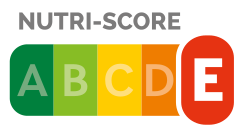
    Nutri-Score E

    Lower nutritional quality
    ⚠ ️Warning: the amount of fruits, vegetables and nuts is not specified on the label, it was estimated from the list of ingredients: 0
    • icon

      Discover the new Nutri-Score!


      The computation of the Nutri-Score is evolving to provide better recommendations based on the latest scientific evidence.

      Main improvements:

      • Better score for some fatty fish and oils rich in good fats
      • Better score for whole products rich in fiber
      • Worse score for products containing a lot of salt or sugar
      • Worse score for red meat (compared to poultry)
    • icon

      What is the Nutri-Score?


      The Nutri-Score is a logo on the overall nutritional quality of products.

      The score from A to E is calculated based on nutrients and foods to favor (proteins, fiber, fruits, vegetables and legumes ...) and nutrients to limit (calories, saturated fat, sugars, salt). The score is calculated from the data of the nutrition facts table and the composition data (fruits, vegetables and legumes).

    icon

    Negative points: 14/54

    • icon

      Energy

      4/10 points (222kJ)

      Energy intakes above energy requirements are associated with increased risks of weight gain, overweight, obesity, and consequently risk of diet-related chronic diseases.

    • icon

      Sugar

      10/10 points (13.89g)

      A high consumption of sugar can cause weight gain and tooth decay. It also augments the risk of type 2 diabetes and cardio-vascular diseases.

    • icon

      Salt

      0/20 points (0g)

      A high consumption of salt (or sodium) can cause raised blood pressure, which can increase the risk of heart disease and stroke.

    • icon

      Non-nutritive sweeteners

      0/4 points (0 sweetener)

      Non-nutritive sweeteners may not confer any long-term benefit in reducing body fat in adults or children. There may be potential undesirable effects from long-term use of non-nutritive sweeteners, such as an increased risk of type 2 diabetes and cardiovascular diseases in adults.

    icon

    Positive points: 0/18

    • icon

      Proteins

      0/7 points (0g)

      Foods that are rich in proteins are usually rich in calcium or iron which are essential minerals with numerous health benefits.

    • icon

      Fiber

      0/5 points (unknown)

      Consuming foods rich in fiber (especially whole grain foods) reduces the risks of aerodigestive cancers, cardiovascular diseases, obesity and diabetes.

    • icon

      Details of the calculation of the Nutri-Score


      ⚠ ️Warning: the amount of fruits, vegetables and nuts is not specified on the label, it was estimated from the list of ingredients: 0

      This product is considered a beverage for the calculation of the Nutri-Score.

      Points for proteins are counted because the product is considered to be a beverage.

      Nutritional score: 14 (14 - 0)

      Nutri-Score: E

  • icon

    Nutrient levels


    • icon

      Sugars in high quantity (13.9%)


      What you need to know
      • A high consumption of sugar can cause weight gain and tooth decay. It also augments the risk of type 2 diabetes and cardio-vascular diseases.

      Recommendation: Limit the consumption of sugar and sugary drinks
      • Sugary drinks (such as sodas, fruit beverages, and fruit juices and nectars) should be limited as much as possible (no more than 1 glass a day).
      • Choose products with lower sugar content and reduce the consumption of products with added sugars.
    • icon

      Salt in low quantity (0%)


      What you need to know
      • A high consumption of salt (or sodium) can cause raised blood pressure, which can increase the risk of heart disease and stroke.
      • Many people who have high blood pressure do not know it, as there are often no symptoms.
      • Most people consume too much salt (on average 9 to 12 grams per day), around twice the recommended maximum level of intake.

      Recommendation: Limit the consumption of salt and salted food
      • Reduce the quantity of salt used when cooking, and don't salt again at the table.
      • Limit the consumption of salty snacks and choose products with lower salt content.

  • icon

    Nutrition facts


    Nutrition facts As sold
    for 100 g / 100 ml
    As sold
    per serving (12 OZA (360 ml))
    Compared to: Sodas
    Energy 222 kj
    (53 kcal)
    799 kj
    (191 kcal)
    +90%
    Fat 0 g 0 g -100%
    Saturated fat ? ?
    Carbohydrates 13.89 g 50 g +99%
    Sugars 13.89 g 50 g +103%
    Fiber ? ?
    Proteins 0 g 0 g -100%
    Salt 0 g 0 g -100%
    Fruits‚ vegetables‚ nuts and rapeseed‚ walnut and olive oils (estimate from ingredients list analysis) 0.703 % 0.703 %
Serving size: 12 OZA (360 ml)

Ingredients

  • icon

    11 ingredients


    Carbonated water, high fructose corn syrup, tartaric acid, citric acid, potassium benzoate (a preservative), natural and artificial flavor, grape juice concentrate, gum acacia, red 40, blue 1.
    • Ingredient information


      • Carbonated water: 55.0% (estimate)


      • High fructose corn syrup: 22.5% (estimate)


      • E334: 11.2% (estimate)


      • E330: 5.6% (estimate)


      • E212: 2.8% (estimate)


      • — Preservative: 2.8% (estimate)


      • Natural and artificial flavouring: < 2% (estimate)


      • Concentrated grape juice: < 2% (estimate)


      • E414: < 2% (estimate)


      • E129: < 2% (estimate)


      • E133: < 2% (estimate)


  • icon

    Contains added sugars (~ 22%)

    Added sugars: High fructose corn syrup
    Estimated quantity of added sugars in ingredients: 22%
    Search for products in the same category without added sugars: Sodas
    What you need to know
    • A high consumption of sugar can cause weight gain and tooth decay. It also augments the risk of type 2 diabetes and cardio-vascular diseases.

    Recommendation: Limit the consumption of sugar and sugary drinks
    • Sugary drinks (such as sodas, fruit beverages, and fruit juices and nectars) should be limited as much as possible (no more than 1 glass a day).
    • Choose products with lower sugar content and reduce the consumption of products with added sugars.

Food processing

Additives

  • E129 - Allura red


    Allura Red AC: Allura Red AC is a red azo dye that goes by several names, including FD&C Red 40. It is used as a food dye and has the E number E129. It is usually supplied as its red sodium salt, but can also be used as the calcium and potassium salts. These salts are soluble in water. In solution, its maximum absorbance lies at about 504 nm.
    Source: Wikipedia
  • E133 - Brilliant blue FCF


    Brilliant Blue FCF: Brilliant Blue FCF -Blue 1- is an organic compound classified as a triarylmethane dye and a blue azo dye, reflecting its chemical structure. Known under various commercial names, it is a colorant for foods and other substances. It is denoted by E number E133 and has a color index of 42090. It has the appearance of a blue powder. It is soluble in water, and the solution has a maximum absorption at about 628 nanometers.
    Source: Wikipedia
  • E212 - Potassium benzoate


    Potassium benzoate: Potassium benzoate -E212-, the potassium salt of benzoic acid, is a food preservative that inhibits the growth of mold, yeast and some bacteria. It works best in low-pH products, below 4.5, where it exists as benzoic acid. Acidic foods and beverages such as fruit juice -citric acid-, sparkling drinks -carbonic acid-, soft drinks -phosphoric acid-, pickles -vinegar-, and frogurt toppings may be preserved with potassium benzoate. It is approved for use in most countries including Canada, the U.S., and the EU, where it is designated by the E number E212. Potassium benzoate is also used in the whistle in many fireworks.
    Source: Wikipedia
  • E330 - Citric acid


    Citric acid is a natural organic acid found in citrus fruits such as lemons, oranges, and limes.

    It is widely used in the food industry as a flavor enhancer, acidulant, and preservative due to its tart and refreshing taste.

    Citric acid is safe for consumption when used in moderation and is considered a generally recognized as safe (GRAS) food additive by regulatory agencies worldwide.

  • E334 - L(+)-tartaric acid


    Tartaric acid: Tartaric acid is a white, crystalline organic acid that occurs naturally in many fruits, most notably in grapes, but also in bananas, tamarinds, and citrus. Its salt, potassium bitartrate, commonly known as cream of tartar, develops naturally in the process of winemaking. It is commonly mixed with sodium bicarbonate and is sold as baking powder used as a leavening agent in food preparation. The acid itself is added to foods as an antioxidant and to impart its distinctive sour taste. Tartaric is an alpha-hydroxy-carboxylic acid, is diprotic and aldaric in acid characteristics, and is a dihydroxyl derivative of succinic acid.
    Source: Wikipedia
  • E414 - Acacia gum


    Gum arabic: Gum arabic, also known as acacia gum, arabic gum, gum acacia, acacia, Senegal gum and Indian gum, and by other names, is a natural gum consisting of the hardened sap of various species of the acacia tree. Originally, gum arabic was collected from Acacia nilotica which was called the "gum arabic tree"; in the present day, gum arabic is collected from acacia species, predominantly Acacia senegal and Vachellia -Acacia- seyal; the term "gum arabic" does not indicate a particular botanical source. In a few cases so‐called "gum arabic" may not even have been collected from Acacia species, but may originate from Combretum, Albizia or some other genus. Producers harvest the gum commercially from wild trees, mostly in Sudan -80%- and throughout the Sahel, from Senegal to Somalia—though it is historically cultivated in Arabia and West Asia. Gum arabic is a complex mixture of glycoproteins and polysaccharides. It is the original source of the sugars arabinose and ribose, both of which were first discovered and isolated from it, and are named after it. Gum arabic is soluble in water. It is edible, and used primarily in the food industry as a stabilizer, with EU E number E414. Gum arabic is a key ingredient in traditional lithography and is used in printing, paint production, glue, cosmetics and various industrial applications, including viscosity control in inks and in textile industries, though less expensive materials compete with it for many of these roles. While gum arabic is now produced throughout the African Sahel, it is still harvested and used in the Middle East.
    Source: Wikipedia

Ingredients analysis

  • icon

    Maybe vegan


    Ingredients that may not be vegan: Natural and artificial flavouring
  • icon

    Maybe vegetarian


    Ingredients that may not be vegetarian: Natural and artificial flavouring
The analysis is based solely on the ingredients listed and does not take into account processing methods.
  • icon

    Details of the analysis of the ingredients


    en: Carbonated water, high fructose corn syrup, tartaric acid, citric acid, potassium benzoate (a preservative), natural and artificial flavor, grape juice concentrate, gum acacia, red 40, blue 1
    1. Carbonated water -> en:carbonated-water – vegan: yes – vegetarian: yes – ciqual_food_code: 18066 – percent_min: 10 – percent_max: 100
    2. high fructose corn syrup -> en:high-fructose-corn-syrup – vegan: yes – vegetarian: yes – ciqual_food_code: 31077 – percent_min: 0 – percent_max: 50
    3. tartaric acid -> en:e334 – vegan: yes – vegetarian: yes – percent_min: 0 – percent_max: 33.3333333333333
    4. citric acid -> en:e330 – vegan: yes – vegetarian: yes – percent_min: 0 – percent_max: 25
    5. potassium benzoate -> en:e212 – vegan: yes – vegetarian: yes – percent_min: 0 – percent_max: 20
      1. a preservative -> en:preservative – percent_min: 0 – percent_max: 20
    6. natural and artificial flavor -> en:natural-and-artificial-flavouring – vegan: maybe – vegetarian: maybe – percent_min: 0 – percent_max: 5
    7. grape juice concentrate -> en:concentrated-grape-juice – vegan: yes – vegetarian: yes – ciqual_food_code: 13112 – percent_min: 0 – percent_max: 5
    8. gum acacia -> en:e414 – vegan: yes – vegetarian: yes – percent_min: 0 – percent_max: 5
    9. red 40 -> en:e129 – vegan: yes – vegetarian: yes – percent_min: 0 – percent_max: 5
    10. blue 1 -> en:e133 – vegan: yes – vegetarian: yes – percent_min: 0 – percent_max: 5

Environment

Packaging

Transportation

Report a problem

Data sources

Product added on by usda-ndb-import
Last edit of product page on by org-database-usda.

If the data is incomplete or incorrect, you can complete or correct it by editing this page.