Help us inform millions of consumers around the world about what they eat
Please give to our 2026 Fundraiser
Your donations fund the day-to-day operations of our non-profit association:
-
keeping our database open & available to all,
- technical infrastructure (website/mobile app) & a small permanent team
-
remain independent of the food industry,
-
engage a community of committed citizens,
-
support the advancement of public health research.
Buttermilk Ranch – Skinnygirl – 8 oz
This product page is not complete. You can help to complete it by editing it and adding more data from the photos we have, or by taking more photos using the app for Android or iPhone/iPad. Thank you!
×
Barcode:
0074683005942(EAN / EAN-13) 074683005942 (UPC / UPC-A)
Barcode:
0074683005942(EAN / EAN-13) 074683005942 (UPC / UPC-A)
Quantity: 8 oz
Brands: Skinnygirl
Brand owner: Maple Grove Farms Of Vermont Inc.
Categories: Condiments, Sauces, Salad dressings
Labels, certifications, awards: Low or no fat, Low or no sugar, No gluten, No fat, No sugar
Countries where sold: United States
Matching with your preferences
Health
Nutrition
-
Nutri-Score C
Average nutritional quality
⚠ ️Warning: the amount of fruits, vegetables and nuts is not specified on the label, it was estimated from the list of ingredients: 0-
Discover the new Nutri-Score!
The computation of the Nutri-Score is evolving to provide better recommendations based on the latest scientific evidence.
Main improvements:
- Better score for some fatty fish and oils rich in good fats
- Better score for whole products rich in fiber
- Worse score for products containing a lot of salt or sugar
- Worse score for red meat (compared to poultry)
-
What is the Nutri-Score?
The Nutri-Score is a logo on the overall nutritional quality of products.
The score from A to E is calculated based on nutrients and foods to favor (proteins, fiber, fruits, vegetables and legumes ...) and nutrients to limit (calories, saturated fat, sugars, salt). The score is calculated from the data of the nutrition facts table and the composition data (fruits, vegetables and legumes).
Negative points: 11/55
-
Energy
0/10 points (226.67kJ)
Energy intakes above energy requirements are associated with increased risks of weight gain, overweight, obesity, and consequently risk of diet-related chronic diseases.
-
Sugar
0/15 points (3.33g)
A high consumption of sugar can cause weight gain and tooth decay. It also augments the risk of type 2 diabetes and cardio-vascular diseases.
-
Saturated fat
0/10 points (0g)
A high consumption of fat, especially saturated fats, can raise cholesterol, which increases the risk of heart diseases.
-
Salt
11/20 points (2.33g)
A high consumption of salt (or sodium) can cause raised blood pressure, which can increase the risk of heart disease and stroke.
Positive points: 5/10
-
Fiber
5/5 points (10g)
Consuming foods rich in fiber (especially whole grain foods) reduces the risks of aerodigestive cancers, cardiovascular diseases, obesity and diabetes.
-
Fruits, vegetables and legumes
0/5 points (0.7%)
Consuming foods rich in fruits, vegetables and legumes reduces the risks of aerodigestive cancers, cardiovascular diseases, obesity and diabetes.
-
Details of the calculation of the Nutri-Score
⚠ ️Warning: the amount of fruits, vegetables and nuts is not specified on the label, it was estimated from the list of ingredients: 0This product is not considered a beverage for the calculation of the Nutri-Score.
Points for proteins are not counted because the negative points greater than or equal to 11.
Nutritional score: 6 (11 - 5)
Nutri-Score: C
-
-
Nutrient levels
-
Fat in low quantity (0%)
What you need to know- A high consumption of fat, especially saturated fats, can raise cholesterol, which increases the risk of heart diseases.
Recommendation: Limit the consumption of fat and saturated fat- Choose products with lower fat and saturated fat content.
-
Sugars in low quantity (3.33%)
What you need to know- A high consumption of sugar can cause weight gain and tooth decay. It also augments the risk of type 2 diabetes and cardio-vascular diseases.
Recommendation: Limit the consumption of sugar and sugary drinks- Sugary drinks (such as sodas, fruit beverages, and fruit juices and nectars) should be limited as much as possible (no more than 1 glass a day).
- Choose products with lower sugar content and reduce the consumption of products with added sugars.
-
Salt in high quantity (2.33%)
What you need to know- A high consumption of salt (or sodium) can cause raised blood pressure, which can increase the risk of heart disease and stroke.
- Many people who have high blood pressure do not know it, as there are often no symptoms.
- Most people consume too much salt (on average 9 to 12 grams per day), around twice the recommended maximum level of intake.
Recommendation: Limit the consumption of salt and salted food- Reduce the quantity of salt used when cooking, and don't salt again at the table.
- Limit the consumption of salty snacks and choose products with lower salt content.
-
-
Nutrition facts
Nutrition facts As sold
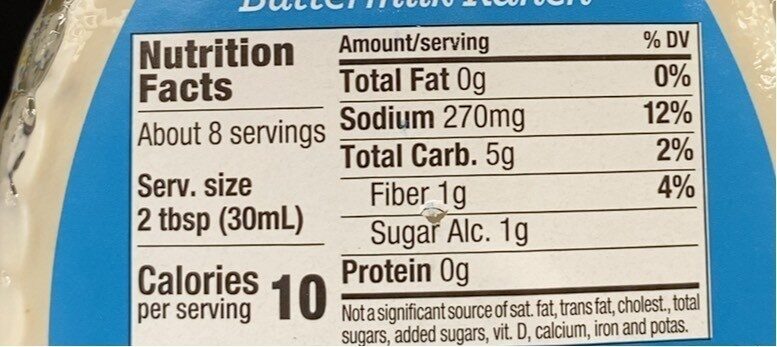
for 100 g / 100 mlCompared to: Salad dressings Energy ~ 226.666666666667 kJ
(33 kcal)1,260.965 kj (306 kcal) (-82%) Fat 0 g 29.034 g (-100%) Saturated fat ? 2.995 g Carbohydrates 10 g 7.71 g (+30%) Sugars 3.33333333333333 g 5.419 g (-38%) Polyols (sugar alcohols) 3.33333333333333 g 0.101 g (+3,190%) Fiber 10 g 0.349 g (+2,762%) Proteins 0 g 0.929 g (-100%) Salt 2.33333333333333 g 1.779 g (+31%) Sodium 0.933333333333333 g 0.71 g (+31%) Fruits‚ vegetables‚ legumes ~ 0.700488413935116 % 3.518 % (-80%) -
Nutrition facts (Detailed data)
Nutrition facts As sold
for 100 g / 100 mlAs sold per serving (30 g) (packaging) As sold for 100 g (estimate) Energy ~ 226.666666666667 kJ
(33 kcal)? kcal
(10 kcal)? Fat 0 g 0 g ? Saturated fat ? ? ? Carbohydrates 10 g 3 g ? Sugars 3.33333333333333 g 1 g ? Polyols (sugar alcohols) 3.33333333333333 g 1 g ? Fiber 10 g 3 g ? Proteins 0 g 0 g ? Salt 2.33333333333333 g 0.7 g ? Sodium 0.933333333333333 g 0.28 g ? Fruits‚ vegetables‚ legumes ~ 0.700488413935116 % ? ~ 0.700488413935116 %
-
Ingredients
-
25 ingredients
Water, distilled vinegar, maltodextrin, sorbitol, cellulose gel, buttermilk, salt, garlic, onion, propylene glycol alginate, lactic acid, xanthan gum, potassium sorbate, sodium benzoate and calcium disodium edta (to preserve freshness), titanium dioxide (color), black pepper, phosphoric acid, parsley, citric acid, sucralose, ground celery, natural flavor.Allergens: Celery, Milk-
Ingredient information
-
Water: 52.2% (estimate)
-
Distilled vinegar: 23.9% (estimate)
-
Maltodextrin: 12.0% (estimate)
-
E420: 6.0% (estimate)
-
Cellulose-gel: 3.0% (estimate)
-
Buttermilk: < 2% (estimate)
-
Salt: < 2% (estimate)
-
Garlic: < 2% (estimate)
-
Onion: < 2% (estimate)
-
E405: < 2% (estimate)
-
E270: < 2% (estimate)
-
E415: < 2% (estimate)
-
E202: < 2% (estimate)
-
E211: < 2% (estimate)
-
E385: < 2% (estimate)
-
— To-preserve-freshness: < 2% (estimate)
-
E171: < 2% (estimate)
-
— Colour: < 2% (estimate)
-
Black pepper: < 2% (estimate)
-
E338: < 2% (estimate)
-
Parsley: < 2% (estimate)
-
E330: < 2% (estimate)
-
E955: < 2% (estimate)
-
Celery: < 2% (estimate)
-
Natural flavouring: < 2% (estimate)
-
-
Food processing
-
Ultra-processed foods
8 ultra-processing markers
-
Limit ultra-processed foods
Limiting ultra-processed foods reduces the risk of noncommunicable chronic diseases
Several studies have found that a lower consumption of ultra-processed foods is associated with a reduced risk of noncommunicable chronic diseases, such as obesity, hypertension and diabetes.
Source: Ultra-processed foods increase noncommunicable chronic disease risk
Elements that indicate the product is in the 4 - Ultra processed food and drink products group:
- Additive: E171 - Titanium dioxide
- Additive: E405 - Propane-1‚2-diol alginate
- Additive: E415 - Xanthan gum
- Additive: E420 - Sorbitol
- Additive: E955 - Sucralose
- Ingredient: Colour
- Ingredient: Flavouring
- Ingredient: Maltodextrin
Food products are classified into 4 groups according to their degree of processing:
- Unprocessed or minimally processed foods
- Processed culinary ingredients
- Processed foods
- Ultra-processed foods
The determination of the group is based on the category of the product and on the ingredients it contains.
-
Additives
-
E171 - Titanium dioxide
Titanium dioxide: Titanium dioxide, also known as titaniumIV oxide or titania, is the naturally occurring oxide of titanium, chemical formula TiO2. When used as a pigment, it is called titanium white, Pigment White 6 -PW6-, or CI 77891. Generally, it is sourced from ilmenite, rutile and anatase. It has a wide range of applications, including paint, sunscreen and food coloring. When used as a food coloring, it has E number E171. World production in 2014 exceeded 9 million metric tons. It has been estimated that titanium dioxide is used in two-thirds of all pigments, and the oxide has been valued at $13.2 billion.Source: Wikipedia
-
E202 - Potassium sorbate
Potassium sorbate (E202) is a synthetic food preservative commonly used to extend the shelf life of various food products.
It works by inhibiting the growth of molds, yeast, and some bacteria, preventing spoilage. When added to foods, it helps maintain their freshness and quality.
Some studies have shown that when combined with nitrites, potassium sorbate have genotoxic activity in vitro. However, potassium sorbate is generally recognized as safe (GRAS) by regulatory authorities.
-
E211 - Sodium benzoate
Sodium benzoate: Sodium benzoate is a substance which has the chemical formula NaC7H5O2. It is a widely used food preservative, with an E number of E211. It is the sodium salt of benzoic acid and exists in this form when dissolved in water. It can be produced by reacting sodium hydroxide with benzoic acid.Source: Wikipedia
-
E270 - Lactic acid
Lactic acid: Lactic acid is an organic compound with the formula CH3CH-OH-COOH. In its solid state, it is white and water-soluble. In its liquid state, it is colorless. It is produced both naturally and synthetically. With a hydroxyl group adjacent to the carboxyl group, lactic acid is classified as an alpha-hydroxy acid -AHA-. In the form of its conjugate base called lactate, it plays a role in several biochemical processes. In solution, it can ionize a proton from the carboxyl group, producing the lactate ion CH3CH-OH-CO−2. Compared to acetic acid, its pKa is 1 unit less, meaning lactic acid deprotonates ten times more easily than acetic acid does. This higher acidity is the consequence of the intramolecular hydrogen bonding between the α-hydroxyl and the carboxylate group. Lactic acid is chiral, consisting of two optical isomers. One is known as L--+--lactic acid or -S--lactic acid and the other, its mirror image, is D--−--lactic acid or -R--lactic acid. A mixture of the two in equal amounts is called DL-lactic acid, or racemic lactic acid. Lactic acid is hygroscopic. DL-lactic acid is miscible with water and with ethanol above its melting point which is around 17 or 18 °C. D-lactic acid and L-lactic acid have a higher melting point. In animals, L-lactate is constantly produced from pyruvate via the enzyme lactate dehydrogenase -LDH- in a process of fermentation during normal metabolism and exercise. It does not increase in concentration until the rate of lactate production exceeds the rate of lactate removal, which is governed by a number of factors, including monocarboxylate transporters, concentration and isoform of LDH, and oxidative capacity of tissues. The concentration of blood lactate is usually 1–2 mM at rest, but can rise to over 20 mM during intense exertion and as high as 25 mM afterward. In addition to other biological roles, L-lactic acid is the primary endogenous agonist of hydroxycarboxylic acid receptor 1 -HCA1-, which is a Gi/o-coupled G protein-coupled receptor -GPCR-.In industry, lactic acid fermentation is performed by lactic acid bacteria, which convert simple carbohydrates such as glucose, sucrose, or galactose to lactic acid. These bacteria can also grow in the mouth; the acid they produce is responsible for the tooth decay known as caries. In medicine, lactate is one of the main components of lactated Ringer's solution and Hartmann's solution. These intravenous fluids consist of sodium and potassium cations along with lactate and chloride anions in solution with distilled water, generally in concentrations isotonic with human blood. It is most commonly used for fluid resuscitation after blood loss due to trauma, surgery, or burns.Source: Wikipedia
-
E330 - Citric acid
Citric acid is a natural organic acid found in citrus fruits such as lemons, oranges, and limes.
It is widely used in the food industry as a flavor enhancer, acidulant, and preservative due to its tart and refreshing taste.
Citric acid is safe for consumption when used in moderation and is considered a generally recognized as safe (GRAS) food additive by regulatory agencies worldwide.
-
E338 - Phosphoric acid
Phosphoric acid: Phosphoric acid -also known as orthophosphoric acid or phosphoricV acid- is a weak acid with the chemical formula H3PO4. Orthophosphoric acid refers to phosphoric acid, which is the IUPAC name for this compound. The prefix ortho- is used to distinguish the acid from related phosphoric acids, called polyphosphoric acids. Orthophosphoric acid is a non-toxic acid, which, when pure, is a solid at room temperature and pressure. The conjugate base of phosphoric acid is the dihydrogen phosphate ion, H2PO−4, which in turn has a conjugate base of hydrogen phosphate, HPO2−4, which has a conjugate base of phosphate, PO3−4. Phosphates are essential for life.The most common source of phosphoric acid is an 85% aqueous solution; such solutions are colourless, odourless, and non-volatile. The 85% solution is a syrupy liquid, but still pourable. Although phosphoric acid does not meet the strict definition of a strong acid, the 85% solution is acidic enough to be corrosive. Because of the high percentage of phosphoric acid in this reagent, at least some of the orthophosphoric acid is condensed into polyphosphoric acids; for the sake of labeling and simplicity, the 85% represents H3PO4 as if it were all in the ortho form. Dilute aqueous solutions of phosphoric acid exist in the ortho form.Source: Wikipedia
-
E385 - Calcium disodium ethylenediaminetetraacetate
-
E405 - Propane-1‚2-diol alginate
Propylene glycol alginate: Propylene glycol alginate -PGA- is an emulsifier, stabilizer, and thickener used in food products. It is a food additive with E number E405. Chemically, propylene glycol alginate is an ester of alginic acid, which is derived from kelp. Some of the carboxyl groups are esterified with propylene glycol, some are neutralized with an appropriate alkali, and some remain free.Source: Wikipedia
-
E415 - Xanthan gum
Xanthan gum (E415) is a natural polysaccharide derived from fermented sugars, often used in the food industry as a thickening and stabilizing agent.
This versatile food additive enhances texture and prevents ingredient separation in a wide range of products, including salad dressings, sauces, and gluten-free baked goods.
It is considered safe for consumption even at high intake amounts.
-
E420 - Sorbitol
Sorbitol: Sorbitol --, less commonly known as glucitol --, is a sugar alcohol with a sweet taste which the human body metabolizes slowly. It can be obtained by reduction of glucose, which changes the aldehyde group to a hydroxyl group. Most sorbitol is made from corn syrup, but it is also found in nature, for example in apples, pears, peaches, and prunes. It is converted to fructose by sorbitol-6-phosphate 2-dehydrogenase. Sorbitol is an isomer of mannitol, another sugar alcohol; the two differ only in the orientation of the hydroxyl group on carbon 2. While similar, the two sugar alcohols have very different sources in nature, melting points, and uses.Source: Wikipedia
-
E955 - Sucralose
Sucralose: Sucralose is an artificial sweetener and sugar substitute. The majority of ingested sucralose is not broken down by the body, so it is noncaloric. In the European Union, it is also known under the E number E955. It is produced by chlorination of sucrose. Sucralose is about 320 to 1‚000 times sweeter than sucrose, three times as sweet as both aspartame and acesulfame potassium, and twice as sweet as sodium saccharin. Evidence of benefit is lacking for long-term weight loss with some data supporting weight gain and heart disease risks.It is stable under heat and over a broad range of pH conditions. Therefore, it can be used in baking or in products that require a long shelf life. The commercial success of sucralose-based products stems from its favorable comparison to other low-calorie sweeteners in terms of taste, stability, and safety. Common brand names of sucralose-based sweeteners are Splenda, Zerocal, Sukrana, SucraPlus, Candys, Cukren, and Nevella. Canderel Yellow also contains sucralose, but the original Canderel and Green Canderel do not.Source: Wikipedia
Ingredients analysis
-
Palm oil free
No ingredients containing palm oil detected
-
Non-vegan
Non-vegan ingredients: ButtermilkSome ingredients could not be recognized.
We need your help!
You can help us recognize more ingredients and better analyze the list of ingredients for this product and others:
- Edit this product page to correct spelling mistakes in the ingredients list, and/or to remove ingredients in other languages and sentences that are not related to the ingredients.
- Add new entries, synonyms or translations to our multilingual lists of ingredients, ingredient processing methods, and labels.
If you would like to help, join the #ingredients channel on our Slack discussion space and/or learn about ingredients analysis on our wiki. Thank you!
-
Vegetarian status unknown
Unrecognized ingredients: Cellulose-gel, To-preserve-freshnessSome ingredients could not be recognized.
We need your help!
You can help us recognize more ingredients and better analyze the list of ingredients for this product and others:
- Edit this product page to correct spelling mistakes in the ingredients list, and/or to remove ingredients in other languages and sentences that are not related to the ingredients.
- Add new entries, synonyms or translations to our multilingual lists of ingredients, ingredient processing methods, and labels.
If you would like to help, join the #ingredients channel on our Slack discussion space and/or learn about ingredients analysis on our wiki. Thank you!
-
Details of the analysis of the ingredients
We need your help!
Some ingredients could not be recognized.
We need your help!
You can help us recognize more ingredients and better analyze the list of ingredients for this product and others:
- Edit this product page to correct spelling mistakes in the ingredients list, and/or to remove ingredients in other languages and sentences that are not related to the ingredients.
- Add new entries, synonyms or translations to our multilingual lists of ingredients, ingredient processing methods, and labels.
If you would like to help, join the #ingredients channel on our Slack discussion space and/or learn about ingredients analysis on our wiki. Thank you!
en: Water, distilled vinegar, maltodextrin, sorbitol, cellulose gel, buttermilk, salt, garlic, onion, propylene glycol alginate, lactic acid, xanthan gum, potassium sorbate, sodium benzoate, calcium disodium edta (to preserve freshness), titanium dioxide (color), black pepper, phosphoric acid, parsley, citric acid, sucralose, celery, natural flavor- Water -> en:water – vegan: yes – vegetarian: yes – ciqual_food_code: 18066 – percent_min: 4.34782608695652 – percent_estimate: 52.1739130434783 – percent_max: 100
- distilled vinegar -> en:distilled-vinegar – vegan: yes – vegetarian: yes – ciqual_food_code: 11018 – percent_min: 0 – percent_estimate: 23.9130434782609 – percent_max: 50
- maltodextrin -> en:maltodextrin – vegan: yes – vegetarian: yes – percent_min: 0 – percent_estimate: 11.9565217391304 – percent_max: 33.3333333333333
- sorbitol -> en:e420 – vegan: yes – vegetarian: yes – percent_min: 0 – percent_estimate: 5.97826086956522 – percent_max: 25
- cellulose gel -> en:cellulose-gel – percent_min: 0 – percent_estimate: 2.98913043478261 – percent_max: 20
- buttermilk -> en:buttermilk – vegan: no – vegetarian: yes – ciqual_food_code: 19801 – percent_min: 0 – percent_estimate: 1.4945652173913 – percent_max: 16.6666666666667
- salt -> en:salt – vegan: yes – vegetarian: yes – ciqual_food_code: 11058 – percent_min: 0 – percent_estimate: 0.35 – percent_max: 0.7
- garlic -> en:garlic – vegan: yes – vegetarian: yes – ciqual_food_code: 11000 – percent_min: 0 – percent_estimate: 0.35 – percent_max: 0.7
- onion -> en:onion – vegan: yes – vegetarian: yes – ciqual_food_code: 20034 – percent_min: 0 – percent_estimate: 0.35 – percent_max: 0.7
- propylene glycol alginate -> en:e405 – vegan: yes – vegetarian: yes – percent_min: 0 – percent_estimate: 0.222282608695664 – percent_max: 0.7
- lactic acid -> en:e270 – vegan: yes – vegetarian: yes – percent_min: 0 – percent_estimate: 0.111141304347832 – percent_max: 0.7
- xanthan gum -> en:e415 – vegan: yes – vegetarian: yes – percent_min: 0 – percent_estimate: 0.0555706521739125 – percent_max: 0.7
- potassium sorbate -> en:e202 – vegan: yes – vegetarian: yes – percent_min: 0 – percent_estimate: 0.0277853260869563 – percent_max: 0.7
- sodium benzoate -> en:e211 – vegan: yes – vegetarian: yes – percent_min: 0 – percent_estimate: 0.0138926630434781 – percent_max: 0.7
- calcium disodium edta -> en:e385 – vegan: yes – vegetarian: yes – percent_min: 0 – percent_estimate: 0.00694633152173907 – percent_max: 0.7
- to preserve freshness -> en:to-preserve-freshness – percent_min: 0 – percent_estimate: 0.00694633152173907 – percent_max: 0.7
- titanium dioxide -> en:e171 – vegan: yes – vegetarian: yes – percent_min: 0 – percent_estimate: 0.00347316576086598 – percent_max: 0.7
- color -> en:colour – percent_min: 0 – percent_estimate: 0.00347316576086598 – percent_max: 0.7
- black pepper -> en:black-pepper – vegan: yes – vegetarian: yes – ciqual_food_code: 11015 – percent_min: 0 – percent_estimate: 0.00173658288043299 – percent_max: 0.7
- phosphoric acid -> en:e338 – vegan: yes – vegetarian: yes – percent_min: 0 – percent_estimate: 0.000868291440212943 – percent_max: 0.7
- parsley -> en:parsley – vegan: yes – vegetarian: yes – ciqual_proxy_food_code: 11014 – percent_min: 0 – percent_estimate: 0.000434145720106471 – percent_max: 0.7
- citric acid -> en:e330 – vegan: yes – vegetarian: yes – percent_min: 0 – percent_estimate: 0.000217072860053236 – percent_max: 0.7
- sucralose -> en:e955 – vegan: yes – vegetarian: yes – percent_min: 0 – percent_estimate: 0.000108536430026618 – percent_max: 0.7
- celery -> en:celery – vegan: yes – vegetarian: yes – ciqual_proxy_food_code: 20055 – percent_min: 0 – percent_estimate: 5.42682150097562e-05 – percent_max: 0.7
- natural flavor -> en:natural-flavouring – vegan: maybe – vegetarian: maybe – percent_min: 0 – percent_estimate: 5.42682150097562e-05 – percent_max: 0.7
Environment
-
Green-Score D
High environmental impact
⚠ ️Select a country in order to include the full impact of transportation.The Green-Score is an experimental score that summarizes the environmental impacts of food products.→ The Green-Score was initially developed for France and it is being extended to other European countries. The Green-Score formula is subject to change as it is regularly improved to make it more precise and better suited to each country.Life cycle analysis
-
Average impact of products of the same category: C (Score: 58/100)
Category: Salad dressing, prepacked
- PEF environmental score: 0.44 (the lower the score, the lower the impact)
- including impact on climate change: 2.63 kg CO2 eq/kg of product
Stage Impact Agriculture
68.6 %Processing
11.3 %Packaging
11.6 %Transportation
5.8 %Distribution
2.3 %Consumption
0.6 %
Bonuses and maluses
-
Missing origins of ingredients information
Malus: -5
⚠ ️ The origins of the ingredients of this product are not indicated.
If they are indicated on the packaging, you can modify the product sheet and add them.
If you are the manufacturer of this product, you can send us the information with our free platform for producers.
-
No ingredients that threaten species
-
Missing packaging information for this product
Malus: -15
⚠ ️ The information about the packaging of this product is not filled in.⚠ ️ For a more precise calculation of the Green-Score, you can edit the product page and add them.
If you are the manufacturer of this product, you can send us the information with our free platform for producers.
Green-Score for this product
-
Impact for this product: D (Score: 38/100)
Product: Buttermilk Ranch – Skinnygirl – 8 oz
Life cycle analysis score: 58
Sum of bonuses and maluses: -20
Final score: 38/100
-
Carbon footprint
-
Equal to driving 1.4 km in a petrol car
263 g CO₂e per 100g of product
The carbon emission figure comes from ADEME's Agribalyse database, for the category: Salad dressing, prepacked (Source: ADEME Agribalyse Database)
Stage Impact Agriculture
59.7 %Processing
12.1 %Packaging
13.7 %Transportation
12.4 %Distribution
1.8 %Consumption
0.3 %
Packaging
-
Missing packaging information for this product
⚠ ️ The information about the packaging of this product is not filled in.Take a photo of the recycling information
Transportation
-
Origins of ingredients
Missing origins of ingredients information
⚠ ️ The origins of the ingredients of this product are not indicated.
If they are indicated on the packaging, you can modify the product sheet and add them.
If you are the manufacturer of this product, you can send us the information with our free platform for producers.Add the origins of ingredients for this product

Report a problem
-
Incomplete or incorrect information?
Category, labels, ingredients, allergens, nutritional information, photos etc.
If the information does not match the information on the packaging, you can complete or correct it. Thank you! Open Food Facts is a collaborative database, and every contribution is useful for all.If you want to report vandalism, inappropriate content or erroneous data you can't fix yourself, report it to our moderators team.
Data sources
Product added on by org-database-usda
Last edit of product page on by municorn-calorie-counter-app.
Product page also edited by kiliweb, macrofactor, naruyoko, roboto-app, wolfgang8741, yuka.KZdjP8K6Tux6R_HDw7sd_x-dH_fPH_JrKW5cog, yuka.sY2b0xO6T85zoF3NwEKvlk0ZWfv1hx7HHQfQn3yLl_KXFJPnZ49rwJrfNqs.