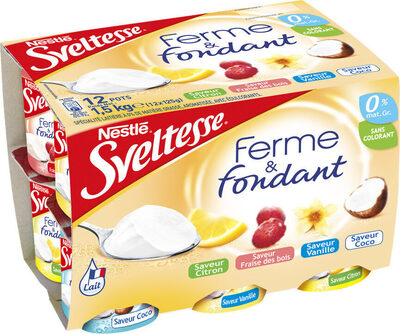
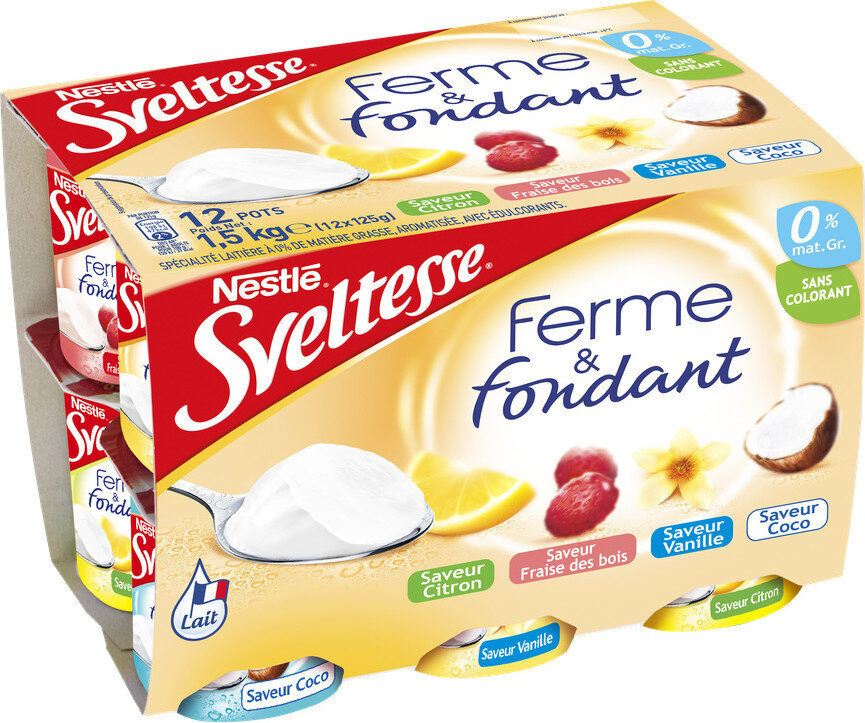
Sveltesse Ferme & Fondant Panaché 12 x 125 g - Nestlé - 1,5 kg
Barcode: 3023291415909 (EAN / EAN-13)
Common name: Spécialité laitière à 0 % de matière grasse, aromatisée, avec édulcorants
Quantity: 1,5 kg
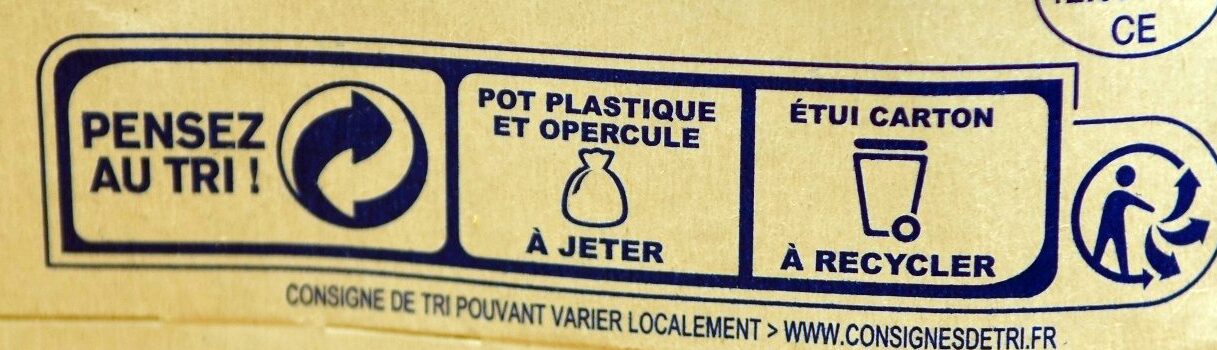
Packaging: Plastic, Pot, Cardboard, Fresh, Seal
Brands: Nestlé
Categories: Dairies, Desserts, Dairy desserts
Labels, certifications, awards:
Low or no fat, Low or no sugar, Contains a source of phenylalanine, French milk, Green Dot, No added sugar, No colorings, No fat, With sweeteners, Tidy man, Triman

Origin of ingredients: France
Manufacturing or processing places: Loire, France
Traceability code: FR 42.005.001 CE - Andrézieux-Bouthéon (Loire, France)
Link to the product page on the official site of the producer: http://www.enviedebienmanger.fr/des-marq...
Stores: Carrefour, Magasins U, carrefour.fr, Auchan
Countries where sold: France
Matching with your preferences
Health
Ingredients


Food processing
-

Ultra processed foods
Elements that indicate the product is in the 4 - Ultra processed food and drink products group:
- Additive: E120 - Cochineal
- Additive: E428 - Gelatine
- Additive: E950 - Acesulfame k
- Additive: E951 - Aspartame
- Ingredient: Colour
- Ingredient: Flavouring
- Ingredient: Milk proteins
- Ingredient: Sweetener
Food products are classified into 4 groups according to their degree of processing:
- Unprocessed or minimally processed foods
- Processed culinary ingredients
- Processed foods
- Ultra processed foods
The determination of the group is based on the category of the product and on the ingredients it contains.
Additives
Ingredients analysis
-

Palm oil free
No ingredients containing palm oil detected
-

Non-vegan
Non-vegan ingredients: Skimmed milk, Milk proteins, Skimmed milk powder, Pork gelatin, E120
-

Non-vegetarian
Non-vegetarian ingredients: Pork gelatin, E120
-

Details of the analysis of the ingredients
fr: _Lait_ écrémé 93.7%, protéines laitières, ferments lactiques, poudre de lait écrémé, gélatine porcine, arôme, colorants (carmins), édulcorants (aspartame, acésulfame-K)- _Lait_ écrémé -> en:skimmed-milk - vegan: no - vegetarian: yes - ciqual_proxy_food_code: 19051 - percent_min: 93.7 - percent: 93.7 - percent_max: 93.7
- protéines laitières -> en:milk-proteins - vegan: no - vegetarian: yes - percent_min: 0.9 - percent_max: 6.3
- ferments lactiques -> en:lactic-ferments - vegan: maybe - vegetarian: yes - percent_min: 0 - percent_max: 5.39999999999999
- poudre de lait écrémé -> en:skimmed-milk-powder - vegan: no - vegetarian: yes - ciqual_food_code: 19054 - percent_min: 0 - percent_max: 2.7
- gélatine porcine -> en:pork-gelatin - vegan: no - vegetarian: no - percent_min: 0 - percent_max: 1.8
- arôme -> en:flavouring - vegan: maybe - vegetarian: maybe - percent_min: 0 - percent_max: 1.35
- colorants -> en:colour - percent_min: 0 - percent_max: 1.08
- carmins -> en:e120 - vegan: no - vegetarian: no - percent_min: 0 - percent_max: 1.08
- édulcorants -> en:sweetener - percent_min: 0 - percent_max: 0.899999999999999
- aspartame -> en:e951 - vegan: yes - vegetarian: yes - percent_min: 0 - percent_max: 0.899999999999999
- acésulfame-K -> en:e950 - vegan: yes - vegetarian: yes - percent_min: 0 - percent_max: 0.449999999999999
en:milk -> en:milk
Nutrition
-

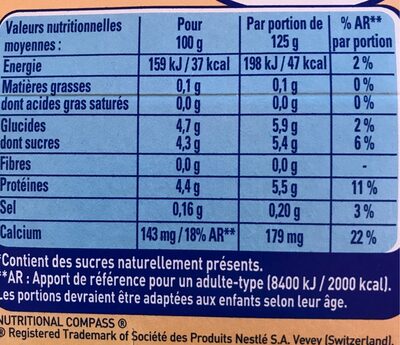
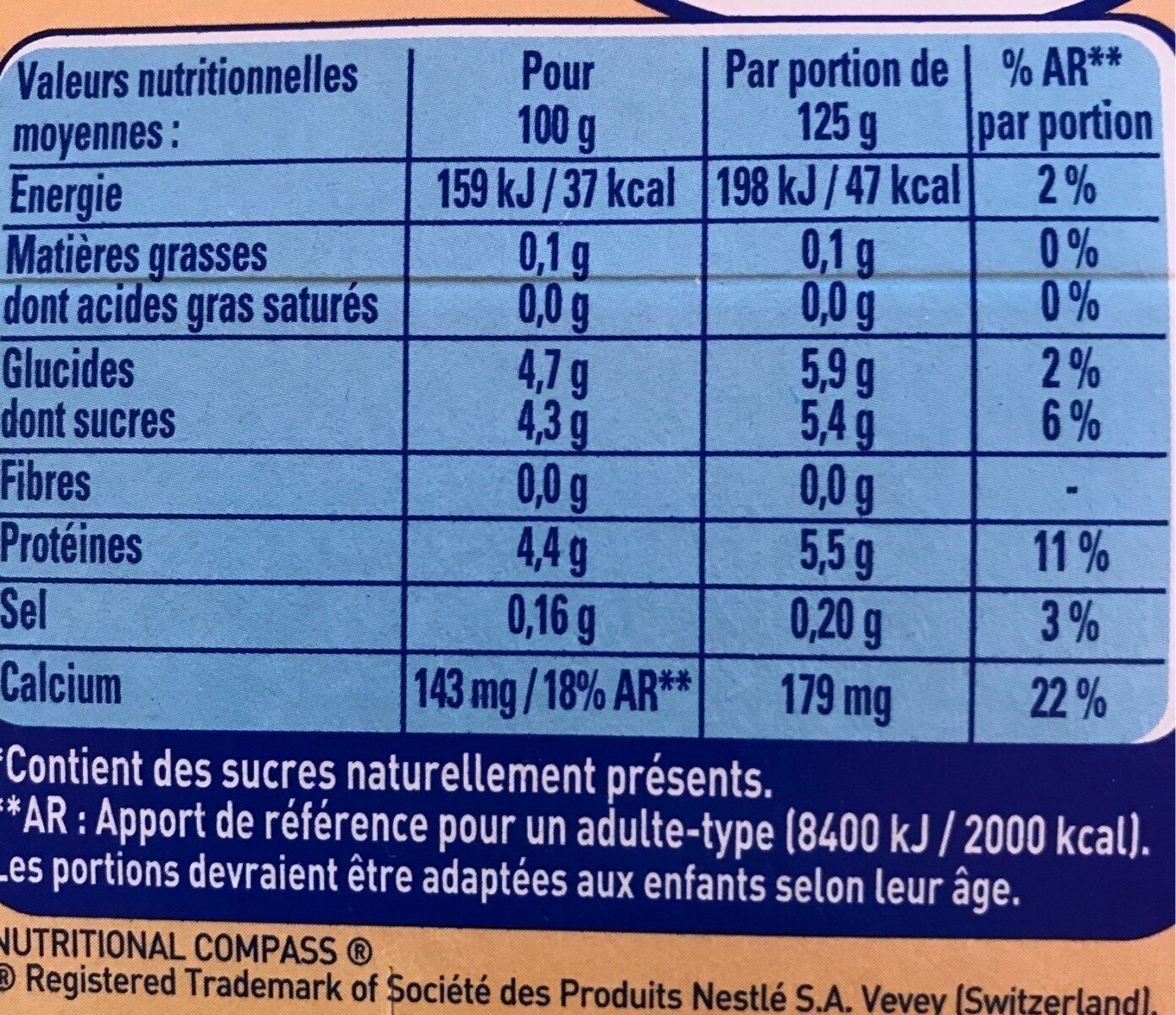
Very good nutritional quality
⚠ ️Warning: the amount of fruits, vegetables and nuts is not specified on the label, it was estimated from the list of ingredients: 0This product is not considered a beverage for the calculation of the Nutri-Score.
Positive points: 2
- Proteins: 2 / 5 (value: 4.4, rounded value: 4.4)
- Fiber: 0 / 5 (value: 0, rounded value: 0)
- Fruits, vegetables, nuts, and colza/walnut/olive oils: 0 / 5 (value: 0, rounded value: 0)
Negative points: 0
- Energy: 0 / 10 (value: 159, rounded value: 159)
- Sugars: 0 / 10 (value: 4.3, rounded value: 4.3)
- Saturated fat: 0 / 10 (value: 0, rounded value: 0)
- Sodium: 0 / 10 (value: 64, rounded value: 64)
The points for proteins are counted because the negative points are less than 11.
Nutritional score: (0 - 2)
Nutri-Score:
-

Nutrient levels
-

Fat in low quantity (0.1%)
What you need to know- A high consumption of fat, especially saturated fats, can raise cholesterol, which increases the risk of heart diseases.
Recommendation: Limit the consumption of fat and saturated fat- Choose products with lower fat and saturated fat content.
-
Saturated fat in low quantity (0%)
What you need to know- A high consumption of fat, especially saturated fats, can raise cholesterol, which increases the risk of heart diseases.
Recommendation: Limit the consumption of fat and saturated fat- Choose products with lower fat and saturated fat content.
-
Sugars in low quantity (4.3%)
What you need to know- A high consumption of sugar can cause weight gain and tooth decay. It also augments the risk of type 2 diabetes and cardio-vascular diseases.
Recommendation: Limit the consumption of sugar and sugary drinks- Sugary drinks (such as sodas, fruit beverages, and fruit juices and nectars) should be limited as much as possible (no more than 1 glass a day).
- Choose products with lower sugar content and reduce the consumption of products with added sugars.
-
Salt in low quantity (0.16%)
What you need to know- A high consumption of salt (or sodium) can cause raised blood pressure, which can increase the risk of heart disease and stroke.
- Many people who have high blood pressure do not know it, as there are often no symptoms.
- Most people consume too much salt (on average 9 to 12 grams per day), around twice the recommended maximum level of intake.
Recommendation: Limit the consumption of salt and salted food- Reduce the quantity of salt used when cooking, and don't salt again at the table.
- Limit the consumption of salty snacks and choose products with lower salt content.
-

Environment
-

Eco-Score not computed - Unknown environmental impact
We could not compute the Eco-Score of this product as it is missing some data, could you help complete it?Could you add a precise product category so that we can compute the Eco-Score? Add a category
Packaging
-

Packaging with a low impact
-
Packaging parts
 Seal (Plastic)
Pot (Cardboard)
-

Transportation

-

Origins of ingredients
Origins of ingredients with a medium impact
Origin of the product and/or its ingredients % of ingredients Impact France 100 %Medium

Data sources
Product added on by openfoodfacts-contributors
Last edit of product page on by sasa.
Product page also edited by beniben, claires, date-limite-app, dea, driveoff, foodvisor, jacob80, kiliweb, magasins-u, moon-rabbit, packbot, phoenix, quentinbrd, roboto-app, tacite, yuka.VC9vYVBxTWJsOWN4d2N3TTlReU9wZU4wd0srcEExMlJlc3dlSWc9PQ, yuka.VEk4OEFva0NxY2d4dlBjOTJpTC8wNGgyd0lQMWIwNlJNc3d1SVE9PQ, yuka.VzY1UlBhQU9tZGRTdjhFNHdRNzF4OVpMNjhHR1hrT05OL0JNSUE9PQ, yuka.YjRVbFFiaGJuNmNMb2NBYytCMzFxdlpTNE02dldEK0hMT2d6SUE9PQ, yuka.sY2b0xO6T85zoF3NwEKvlmBWUdXv8hnCahXjpHGuzOepA5LMPOhWxrThGqo.