pepas marily -
This product page is not complete. You can help to complete it by editing it and adding more data from the photos we have, or by taking more photos using the app for Android or iPhone/iPad. Thank you!
×
Barcode: 7791574000406 (EAN / EAN-13)
Categories: Snacks, Sweet snacks, Biscuits and cakes, Biscuits, Filled biscuits
Countries where sold: Spain
Matching with your preferences
Health
Ingredients

Food processing
-

Ultra processed foods
Elements that indicate the product is in the 4 - Ultra processed food and drink products group:
- Additive: E322 - Lecithins
- Additive: E450 - Diphosphates
- Additive: E471 - Mono- and diglycerides of fatty acids
- Ingredient: Colour
- Ingredient: Emulsifier
- Ingredient: Flavouring
Food products are classified into 4 groups according to their degree of processing:
- Unprocessed or minimally processed foods
- Processed culinary ingredients
- Processed foods
- Ultra processed foods
The determination of the group is based on the category of the product and on the ingredients it contains.
Additives
Ingredients analysis
-

May contain palm oil
Ingredients that may contain palm oil: E471
-

Non-vegan
Non-vegan ingredients: Skimmed milk powderSome ingredients could not be recognized.
We need your help!
You can help us recognize more ingredients and better analyze the list of ingredients for this product and others:
- Edit this product page to correct spelling mistakes in the ingredients list, and/or to remove ingredients in other languages and sentences that are not related to the ingredients.
- Add new entries, synonyms or translations to our multilingual lists of ingredients, ingredient processing methods, and labels.
If you would like to help, join the #ingredients channel on our Slack discussion space and/or learn about ingredients analysis on our wiki. Thank you!
-

Vegetarian status unknown
Unrecognized ingredients: es:oleomargarina, es:esencia-artificial-de-vainilla, es:curcuma-y-rocuSome ingredients could not be recognized.
We need your help!
You can help us recognize more ingredients and better analyze the list of ingredients for this product and others:
- Edit this product page to correct spelling mistakes in the ingredients list, and/or to remove ingredients in other languages and sentences that are not related to the ingredients.
- Add new entries, synonyms or translations to our multilingual lists of ingredients, ingredient processing methods, and labels.
If you would like to help, join the #ingredients channel on our Slack discussion space and/or learn about ingredients analysis on our wiki. Thank you!
-

Details of the analysis of the ingredients
We need your help!
Some ingredients could not be recognized.
We need your help!
You can help us recognize more ingredients and better analyze the list of ingredients for this product and others:
- Edit this product page to correct spelling mistakes in the ingredients list, and/or to remove ingredients in other languages and sentences that are not related to the ingredients.
- Add new entries, synonyms or translations to our multilingual lists of ingredients, ingredient processing methods, and labels.
If you would like to help, join the #ingredients channel on our Slack discussion space and/or learn about ingredients analysis on our wiki. Thank you!
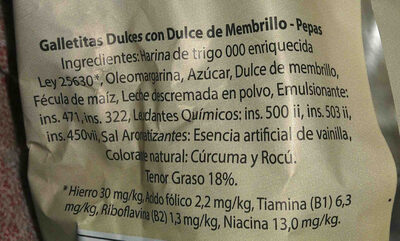
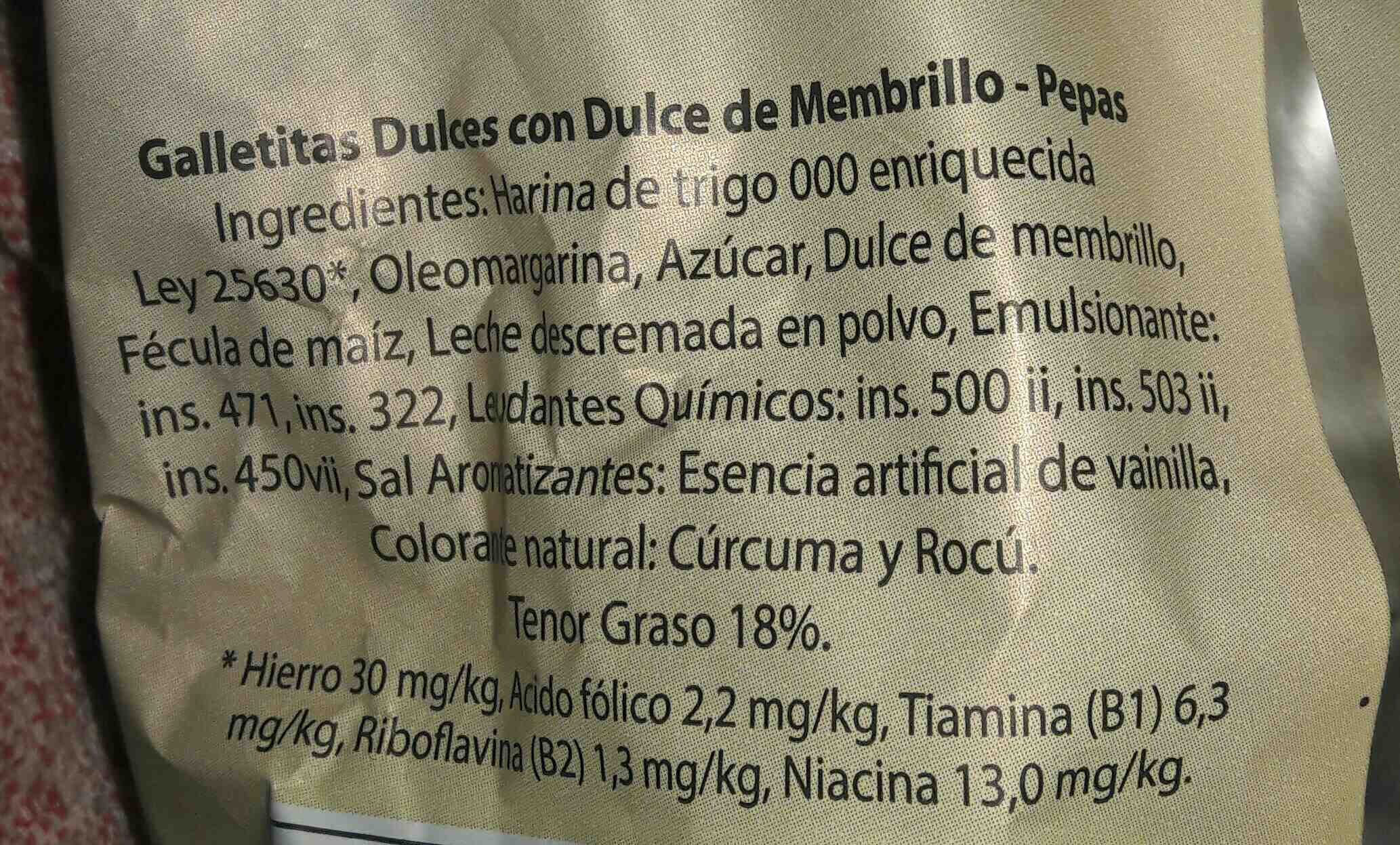
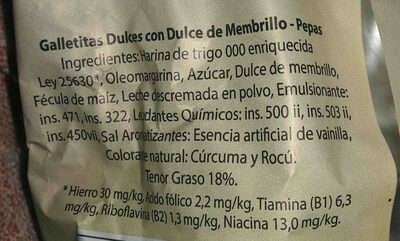
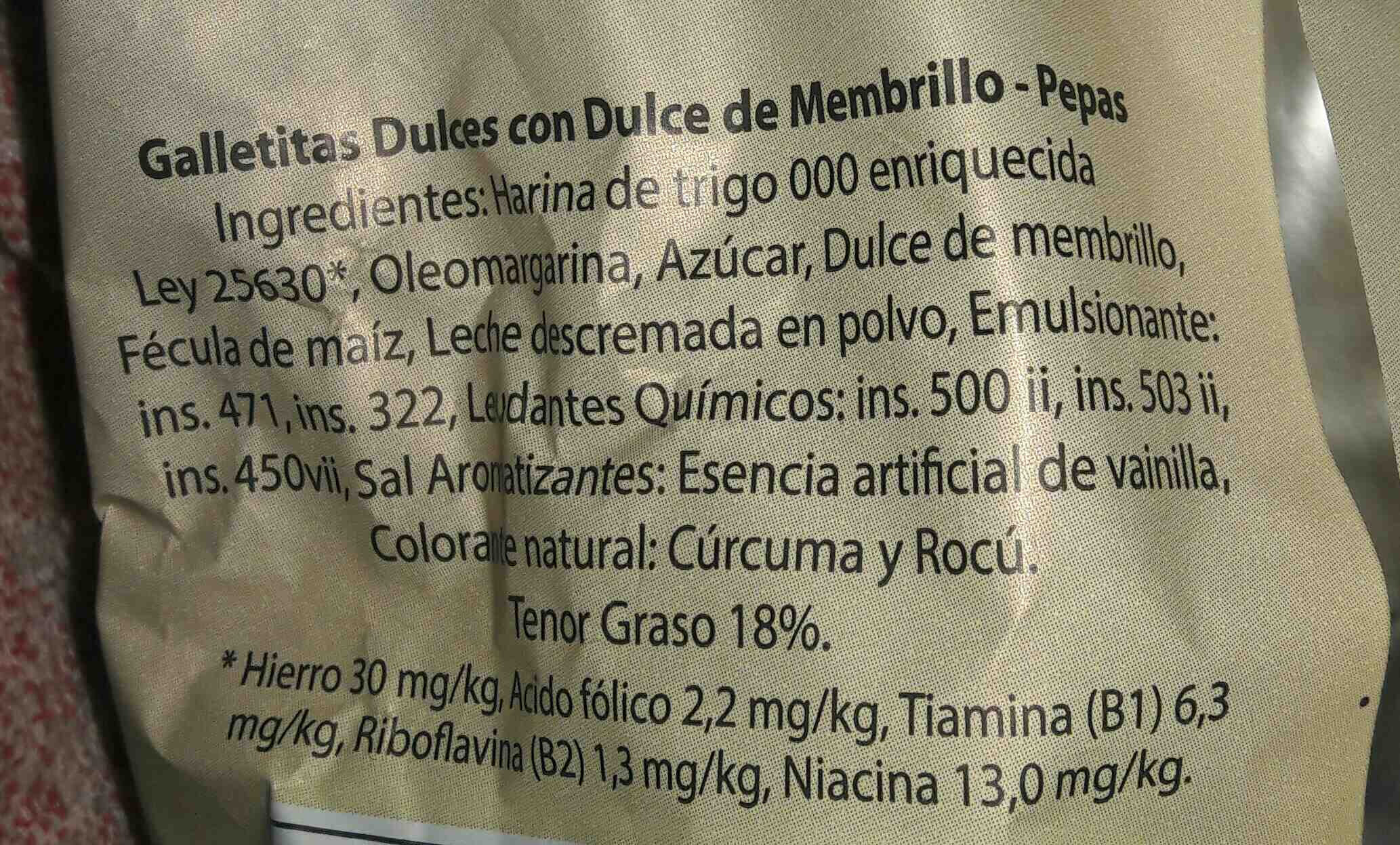
: Harina de trigo 000 enriquecida Ley 25630, Oleomargarina, Azúcar, Dulce de membrillo, Fécula de maiz, Leche descremada en polvo, Emulsionante (e471), e322, Leudantes Químicos (e500ii), e503ii, e450vii, Sal, Aromatizantes (Esencia artificial de vainilla), Colorante natural (Cúrcuma y Rocú)- Harina de trigo 000 enriquecida Ley 25630 -> es:harina-de-trigo-enriquecida-segun-ley-25630 - vegan: yes - vegetarian: yes - ciqual_proxy_food_code: 9410 - percent_min: 7.14285714285714 - percent_max: 100
- Oleomargarina -> es:oleomargarina - percent_min: 0 - percent_max: 50
- Azúcar -> en:sugar - vegan: yes - vegetarian: yes - ciqual_proxy_food_code: 31016 - percent_min: 0 - percent_max: 33.3333333333333
- Dulce de membrillo -> en:quince-jelly - vegan: yes - vegetarian: yes - percent_min: 0 - percent_max: 25
- Fécula de maiz -> en:corn-starch - vegan: yes - vegetarian: yes - ciqual_food_code: 9510 - percent_min: 0 - percent_max: 20
- Leche descremada en polvo -> en:skimmed-milk-powder - vegan: no - vegetarian: yes - ciqual_food_code: 19054 - percent_min: 0 - percent_max: 16.6666666666667
- Emulsionante -> en:emulsifier - percent_min: 0 - percent_max: 14.2857142857143
- e471 -> en:e471 - vegan: maybe - vegetarian: maybe - from_palm_oil: maybe - percent_min: 0 - percent_max: 14.2857142857143
- e322 -> en:e322 - vegan: maybe - vegetarian: maybe - percent_min: 0 - percent_max: 12.5
- Leudantes Químicos -> en:raising-agent - percent_min: 0 - percent_max: 11.1111111111111
- e500ii -> en:e500ii - vegan: yes - vegetarian: yes - percent_min: 0 - percent_max: 11.1111111111111
- e503ii -> en:e503ii - vegan: yes - vegetarian: yes - percent_min: 0 - percent_max: 10
- e450vii -> en:e450vii - vegan: yes - vegetarian: yes - percent_min: 0 - percent_max: 9.09090909090909
- Sal -> en:salt - vegan: yes - vegetarian: yes - ciqual_food_code: 11058 - percent_min: 0 - percent_max: 8.33333333333333
- Aromatizantes -> en:flavouring - vegan: maybe - vegetarian: maybe - percent_min: 0 - percent_max: 5
- Esencia artificial de vainilla -> es:esencia-artificial-de-vainilla - percent_min: 0 - percent_max: 5
- Colorante natural -> en:natural-colours - percent_min: 0 - percent_max: 5
- Cúrcuma y Rocú -> es:curcuma-y-rocu - percent_min: 0 - percent_max: 5
Nutrition
-
Missing data to compute the Nutri-Score
Missing nutrition facts
⚠ ️The nutrition facts of the product must be specified in order to compute the Nutri-Score.Could you add the information needed to compute the Nutri-Score? Add nutrition facts

Environment
-

Eco-Score C - Moderate environmental impact
⚠ ️Select a country in order to include the full impact of transportation.The Eco-Score is an experimental score that summarizes the environmental impacts of food products.→ The Eco-Score was initially developped for France and it is being extended to other European countries. The Eco-Score formula is subject to change as it is regularly improved to make it more precise and better suited to each country.Life cycle analysis
-

Average impact of products of the same category: B (Score: 69/100)
Category: Biscuit (cookie)
Category: Biscuit (cookie)
- PEF environmental score: 0.35 (the lower the score, the lower the impact)
- including impact on climate change: 2.88 kg CO2 eq/kg of product
Stage Impact  Agriculture
80.5 %
Agriculture
80.5 % Processing
11.8 %
Processing
11.8 % Packaging
3.1 %
Packaging
3.1 % Transportation
3.2 %
Transportation
3.2 % Distribution
1.4 %
Distribution
1.4 % Consumption
0.0 %
Consumption
0.0 %
Bonuses and maluses
-

Missing origins of ingredients information
Malus: -5
⚠ ️ The origins of the ingredients of this product are not indicated.
If they are indicated on the packaging, you can modify the product sheet and add them.
If you are the manufacturer of this product, you can send us the information with our free platform for producers.
-
Missing packaging information for this product
Malus: -15
⚠ ️ The information about the packaging of this product is not filled in.⚠ ️ For a more precise calculation of the Eco-Score, you can modify the product page and add them.
If you are the manufacturer of this product, you can send us the information with our free platform for producers.
Eco-Score for this product
-
Impact for this product: C (Score: 49/100)
Product: pepas marily -
Life cycle analysis score: 69
Sum of bonuses and maluses: -20
Final score: 49/100
-

Carbon footprint
-

Equal to driving 1.5 km in a petrol car
288 g CO² per 100g of product
The carbon emission figure comes from ADEME's Agribalyse database, for the category: Biscuit (cookie) (Source: ADEME Agribalyse Database)
Stage Impact
Agriculture
82.9 %
Processing
7.9 %
Packaging
3.8 %
Transportation
4.7 %
Distribution
0.7 %
Consumption
0.0 %
Packaging
-
Missing packaging information for this product
⚠ ️ The information about the packaging of this product is not filled in.Take a photo of the recycling information Take a photo of the recycling information
Transportation
-
Origins of ingredients
Missing origins of ingredients information
⚠ ️ The origins of the ingredients of this product are not indicated.
If they are indicated on the packaging, you can modify the product sheet and add them.
If you are the manufacturer of this product, you can send us the information with our free platform for producers.Add the origins of ingredients for this product Add the origins of ingredients for this product

Data sources
Product added on by veganeamos
Last edit of product page on by acuario.
Product page also edited by musarana, openfoodfacts-contributors.