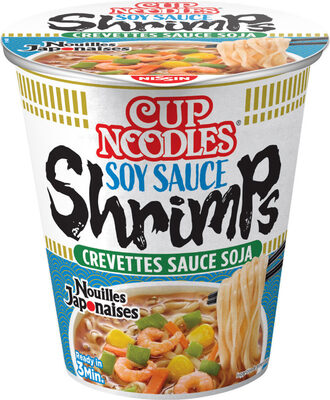

NOUILLES JAP. Crevettes Hamayaki - Nissin - 63g
This product page is not complete. You can help to complete it by editing it and adding more data from the photos we have, or by taking more photos using the app for Android or iPhone/iPad. Thank you!
×
Barcode: 5997523317096 (EAN / EAN-13)
Common name: Soupe de nouilles de style japonais. Saveur crevettes "hamayaki"
Quantity: 63g
Brands: Nissin
Categories: Plant-based foods and beverages, Plant-based foods, Cereals and potatoes, Cereals and their products, Dried products, Pastas, Dried products to be rehydrated, Noodles, Instant noodles, Instant noodle soups
Labels, certifications, awards:
Green Dot
Manufacturing or processing places: Hongrie
Stores: Hyper U, Magasins U, carrefour.fr
Countries where sold: France
Matching with your preferences
Health
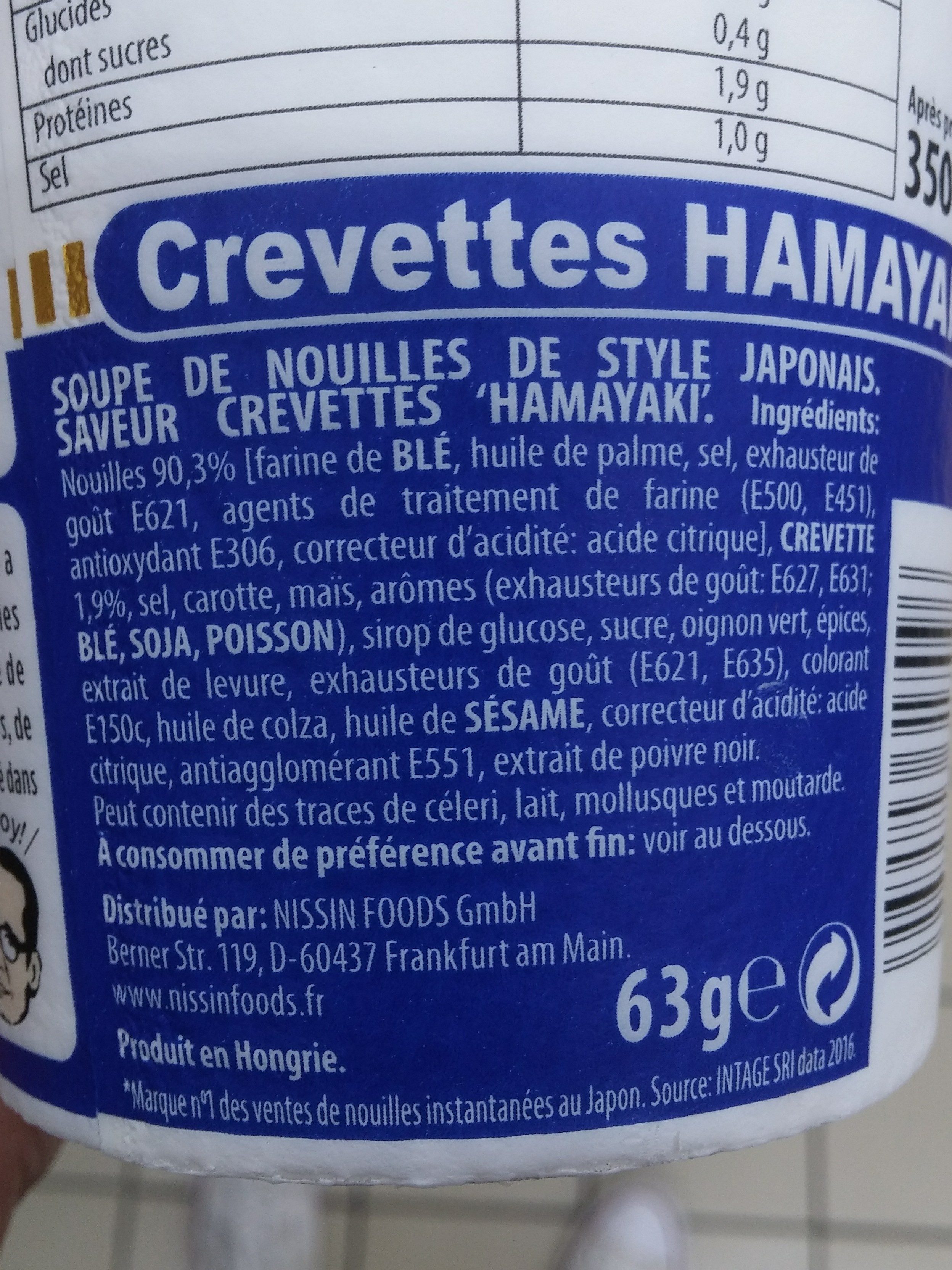
Ingredients


Food processing
-

Ultra processed foods
Elements that indicate the product is in the 4 - Ultra processed food and drink products group:
- Additive: E150c - Ammonia caramel
- Additive: E451 - Triphosphates
- Additive: E551 - Silicon dioxide
- Additive: E621 - Monosodium glutamate
- Additive: E627 - Disodium guanylate
- Additive: E631 - Disodium inosinate
- Additive: E635 - Disodium 5'-ribonucleotide
- Ingredient: Colour
- Ingredient: Flavour enhancer
- Ingredient: Flavouring
- Ingredient: Glucose
- Ingredient: Glucose syrup
Food products are classified into 4 groups according to their degree of processing:
- Unprocessed or minimally processed foods
- Processed culinary ingredients
- Processed foods
- Ultra processed foods
The determination of the group is based on the category of the product and on the ingredients it contains.
Additives
Ingredients analysis
-

Palm oil
Ingredients that contain palm oil: Palm oil
-

Non-vegan
Non-vegan ingredients: Shrimp, Fish
-

Non-vegetarian
Non-vegetarian ingredients: Shrimp, Fish
-

Details of the analysis of the ingredients
: nouilles 90.3% (farine de _blé_, huile de palme, sel, exhausteur de goût (e621), agents de traitement de farine (e500, e451), antioxydant (e306), correcteur d'acidité (acide citrique)), _crevette_ 1.9%, sel, carotte, maïs, arômes (exhausteur de goût (e627), e631, _blé_, _soja_, _poisson_), sirop de glucose, sucre, oignon vert, épices, extrait de levure, exhausteur de goût (e621, e635), colorant (e150c), huile de colza, huile de _sésame_, correcteur d'acidité (acide citrique), antiagglomérant (e551), extrait de poivre noir- nouilles -> en:noodle - vegan: maybe - vegetarian: maybe - percent_min: 90.3 - percent: 90.3 - percent_max: 90.3
- farine de _blé_ -> en:wheat-flour - vegan: yes - vegetarian: yes - ciqual_proxy_food_code: 9410 - percent_min: 40.15 - percent_max: 90.3
- huile de palme -> en:palm-oil - vegan: yes - vegetarian: yes - from_palm_oil: yes - ciqual_food_code: 16129 - percent_min: 0 - percent_max: 45.15
- sel -> en:salt - vegan: yes - vegetarian: yes - ciqual_food_code: 11058 - percent_min: 0 - percent_max: 1
- exhausteur de goût -> en:flavour-enhancer - percent_min: 0 - percent_max: 1
- e621 -> en:e621 - vegan: yes - vegetarian: yes - percent_min: 0 - percent_max: 1
- agents de traitement de farine -> en:flour-treatment-agent - percent_min: 0 - percent_max: 1
- e500 -> en:e500 - vegan: yes - vegetarian: yes - percent_min: 0 - percent_max: 1
- e451 -> en:e451 - vegan: yes - vegetarian: yes - percent_min: 0 - percent_max: 0.5
- antioxydant -> en:antioxidant - percent_min: 0 - percent_max: 1
- e306 -> en:e306 - vegan: yes - vegetarian: yes - percent_min: 0 - percent_max: 1
- correcteur d'acidité -> en:acidity-regulator - percent_min: 0 - percent_max: 1
- acide citrique -> en:e330 - vegan: yes - vegetarian: yes - percent_min: 0 - percent_max: 1
- _crevette_ -> en:shrimp - vegan: no - vegetarian: no - ciqual_food_code: 10021 - percent_min: 1.9 - percent: 1.9 - percent_max: 1.9
- sel -> en:salt - vegan: yes - vegetarian: yes - ciqual_food_code: 11058 - percent_min: 0.4875 - percent_max: 1.9
- carotte -> en:carrot - vegan: yes - vegetarian: yes - ciqual_food_code: 20009 - percent_min: 0.393333333333333 - percent_max: 1.9
- maïs -> en:corn - vegan: yes - vegetarian: yes - ciqual_food_code: 9200 - percent_min: 0.285714285714285 - percent_max: 1.9
- arômes -> en:flavouring - vegan: maybe - vegetarian: maybe - percent_min: 0.16153846153846 - percent_max: 1.78023809523809
- exhausteur de goût -> en:flavour-enhancer - percent_min: 0 - percent_max: 1.78023809523809
- e627 -> en:e627 - vegan: maybe - vegetarian: maybe - percent_min: 0 - percent_max: 1.78023809523809
- e631 -> en:e631 - vegan: maybe - vegetarian: maybe - percent_min: 0 - percent_max: 0.890119047619047
- _blé_ -> en:wheat - vegan: yes - vegetarian: yes - ciqual_proxy_food_code: 9410 - percent_min: 0 - percent_max: 0.593412698412698
- _soja_ -> en:soya - vegan: yes - vegetarian: yes - percent_min: 0 - percent_max: 0.445059523809524
- _poisson_ -> en:fish - vegan: no - vegetarian: no - ciqual_proxy_food_code: 26140 - percent_min: 0 - percent_max: 0.356047619047619
- exhausteur de goût -> en:flavour-enhancer - percent_min: 0 - percent_max: 1.78023809523809
- sirop de glucose -> en:glucose-syrup - vegan: yes - vegetarian: yes - ciqual_proxy_food_code: 31016 - percent_min: 0 - percent_max: 1.39188278388278
- sucre -> en:sugar - vegan: yes - vegetarian: yes - ciqual_proxy_food_code: 31016 - percent_min: 0 - percent_max: 0.4
- oignon vert -> en:spring-onion - vegan: yes - vegetarian: yes - ciqual_food_code: 11003 - percent_min: 0 - percent_max: 0.4
- épices -> en:spice - vegan: yes - vegetarian: yes - percent_min: 0 - percent_max: 0.4
- extrait de levure -> en:yeast-extract - vegan: yes - vegetarian: yes - percent_min: 0 - percent_max: 0.4
- exhausteur de goût -> en:flavour-enhancer - percent_min: 0 - percent_max: 0.4
- e621 -> en:e621 - vegan: yes - vegetarian: yes - percent_min: 0 - percent_max: 0.4
- e635 -> en:e635 - vegan: maybe - vegetarian: maybe - percent_min: 0 - percent_max: 0.2
- colorant -> en:colour - percent_min: 0 - percent_max: 0.4
- e150c -> en:e150a - vegan: yes - vegetarian: yes - percent_min: 0 - percent_max: 0.4
- huile de colza -> en:colza-oil - vegan: yes - vegetarian: yes - from_palm_oil: no - ciqual_food_code: 17130 - percent_min: 0 - percent_max: 0.4
- huile de _sésame_ -> en:sesame-oil - vegan: yes - vegetarian: yes - from_palm_oil: no - ciqual_food_code: 17400 - percent_min: 0 - percent_max: 0.4
- correcteur d'acidité -> en:acidity-regulator - percent_min: 0 - percent_max: 0.4
- acide citrique -> en:e330 - vegan: yes - vegetarian: yes - percent_min: 0 - percent_max: 0.4
- antiagglomérant -> en:anti-caking-agent - percent_min: 0 - percent_max: 0.4
- e551 -> en:e551 - vegan: yes - vegetarian: yes - percent_min: 0 - percent_max: 0.4
- extrait de poivre noir -> en:black-pepper-extract - vegan: yes - vegetarian: yes - ciqual_food_code: 11015 - percent_min: 0 - percent_max: 0.4
- nouilles -> en:noodle - vegan: maybe - vegetarian: maybe - percent_min: 90.3 - percent: 90.3 - percent_max: 90.3



Environment
-

Eco-Score C - Moderate environmental impact
⚠ ️Select a country in order to include the full impact of transportation.The Eco-Score is an experimental score that summarizes the environmental impacts of food products.→ The Eco-Score was initially developped for France and it is being extended to other European countries. The Eco-Score formula is subject to change as it is regularly improved to make it more precise and better suited to each country.Life cycle analysis
-

Average impact of products of the same category: B (Score: 66/100)
Category: Soup, Asian-style with noodles, prepacked, to be reheated
Category: Soup, Asian-style with noodles, prepacked, to be reheated
- PEF environmental score: 0.38 (the lower the score, the lower the impact)
- including impact on climate change: 3.15 kg CO2 eq/kg of product
Stage Impact  Agriculture
59.3 %
Agriculture
59.3 % Processing
25.0 %
Processing
25.0 % Packaging
2.6 %
Packaging
2.6 % Transportation
10.7 %
Transportation
10.7 % Distribution
1.2 %
Distribution
1.2 % Consumption
1.1 %
Consumption
1.1 %
Bonuses and maluses
-

Missing origins of ingredients information
Malus: -5
⚠ ️ The origins of the ingredients of this product are not indicated.
If they are indicated on the packaging, you can modify the product sheet and add them.
If you are the manufacturer of this product, you can send us the information with our free platform for producers.
-

Ingredients that threatens species
Malus: -10
Contains palm oil
Tropical forests in Asia, Africa and Latin America are destroyed to create and expand oil palm tree plantations. The deforestation contributes to climate change, and it endangers species such as the orangutan, the pigmy elephant and the Sumatran rhino.
-
Packaging with a medium impact
Malus: -10
Shape Material Recycling Impact Pot Plastic High
Eco-Score for this product
-
Impact for this product: C (Score: 41/100)
Product: NOUILLES JAP. Crevettes Hamayaki - Nissin - 63g
Life cycle analysis score: 66
Sum of bonuses and maluses: -25
Final score: 41/100
-
Carbon footprint
-

Equal to driving 1.6 km in a petrol car
315 g CO² per 100g of product
The carbon emission figure comes from ADEME's Agribalyse database, for the category: Soup, Asian-style with noodles, prepacked, to be reheated (Source: ADEME Agribalyse Database)
Stage Impact
Agriculture
62.1 %
Processing
19.1 %
Packaging
3.2 %
Transportation
14.7 %
Distribution
0.5 %
Consumption
0.4 %
Packaging
-
Packaging with a medium impact
-
Packaging parts
 Pot (Plastic)
-
Transportation
-
Origins of ingredients
Missing origins of ingredients information
⚠ ️ The origins of the ingredients of this product are not indicated.
If they are indicated on the packaging, you can modify the product sheet and add them.
If you are the manufacturer of this product, you can send us the information with our free platform for producers.Add the origins of ingredients for this product Add the origins of ingredients for this product
Threatened species
-
Contains palm oil
Drives deforestation and threatens species such as the orangutan
Tropical forests in Asia, Africa and Latin America are destroyed to create and expand oil palm tree plantations. The deforestation contributes to climate change, and it endangers species such as the orangutan, the pigmy elephant and the Sumatran rhino.

Data sources
Product added on by openfoodfacts-contributors
Last edit of product page on by spotter.
Product page also edited by date-limite-app, driveoff, khorkaadren, kiliweb, magasins-u, packbot, tib-de-bar, yuka.FuBvItymOOd_GN3rjoxr-jqrO9fhWsQHHHMQoQ, yuka.UbZMAP2rA8o7JPT324kLxTSFOeHcEu8ACC9cow, yuka.UmFrNVA0QlpsS1Zhc01VaTJnTHo0OUVrbWMrMlVFZXFPYk1CSWc9PQ, yuka.YXY4S0dhRWhvS0pXdGN3NTNUL2Z4OU1xOXJLNGVGbTlMOGt4SVE9PQ, yuka.sY2b0xO6T85zoF3NwEKvlndIceX-rxT9NB_4i0qmzOiLDKfnRoBY_qvDMqg.