Help us inform millions of consumers around the world about what they eat
Please give to our 2026 Fundraiser
Your donations fund the day-to-day operations of our non-profit association:
-
keeping our database open & available to all,
- technical infrastructure (website/mobile app) & a small permanent team
-
remain independent of the food industry,
-
engage a community of committed citizens,
-
support the advancement of public health research.
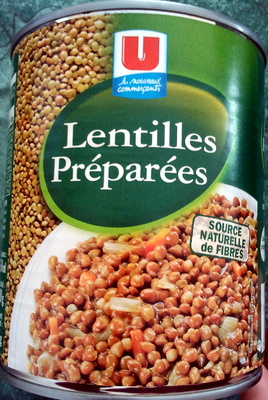
Lentilles préparées - 800 g - U – 800 g (530 g net égoutté), 850 ml
This product page is not complete. You can help to complete it by editing it and adding more data from the photos we have, or by taking more photos using the app for Android or iPhone/iPad. Thank you!
×
Barcode:
3256221129151(EAN / EAN-13)
Barcode:
3256221129151(EAN / EAN-13)
Common name: Plat préparé en conserve
Quantity: 800 g (530 g net égoutté), 850 ml
Brands: U
Categories: Plant-based foods and beverages, Plant-based foods, Fruits and vegetables based foods, Legumes and their products, Canned foods, Legumes, Seeds, Vegetables based foods, Canned plant-based foods, Legume seeds, Meals, Canned vegetables, Pulses, Lentils, Canned meals, Prepared lentils
Labels, certifications, awards:
Green Dot, fr:Eco-Emballages
Stores: Super U, Magasins U
Countries where sold: France
Matching with your preferences
Health
Nutrition
-
Nutri-Score B
Good nutritional quality
⚠ ️Warning: the amount of fruits, vegetables and nuts is not specified on the label, it was estimated from the list of ingredients: 85-
Discover the new Nutri-Score!
The computation of the Nutri-Score is evolving to provide better recommendations based on the latest scientific evidence.
Main improvements:
- Better score for some fatty fish and oils rich in good fats
- Better score for whole products rich in fiber
- Worse score for products containing a lot of salt or sugar
- Worse score for red meat (compared to poultry)
-
What is the Nutri-Score?
The Nutri-Score is a logo on the overall nutritional quality of products.
The score from A to E is calculated based on nutrients and foods to favor (proteins, fiber, fruits, vegetables and legumes ...) and nutrients to limit (calories, saturated fat, sugars, salt). The score is calculated from the data of the nutrition facts table and the composition data (fruits, vegetables and legumes).
Negative points: 2/55
-
Energy from saturated fat
0/10 points (0kJ)
A high consumption of fat, especially saturated fats, can raise cholesterol, which increases the risk of heart diseases.
-
Sugar
0/15 points (0.5g)
A high consumption of sugar can cause weight gain and tooth decay. It also augments the risk of type 2 diabetes and cardio-vascular diseases.
-
Saturated fat / fat
0/10 points (0%)
A high consumption of fat, especially saturated fats, can raise cholesterol, which increases the risk of heart diseases.
-
Salt
2/20 points (0.56g)
A high consumption of salt (or sodium) can cause raised blood pressure, which can increase the risk of heart disease and stroke.
Positive points: 7/17
-
Proteins
1/7 points (4.7g)
Foods that are rich in proteins are usually rich in calcium or iron which are essential minerals with numerous health benefits.
-
Fiber
1/5 points (4.1g)
Consuming foods rich in fiber (especially whole grain foods) reduces the risks of aerodigestive cancers, cardiovascular diseases, obesity and diabetes.
-
Fruits, vegetables and legumes
5/5 points (85.6%)
Consuming foods rich in fruits, vegetables and legumes reduces the risks of aerodigestive cancers, cardiovascular diseases, obesity and diabetes.
-
Details of the calculation of the Nutri-Score
⚠ ️Warning: the amount of fruits, vegetables and nuts is not specified on the label, it was estimated from the list of ingredients: 85This product is not considered a beverage for the calculation of the Nutri-Score.
This product is considered to be fat, oil, nuts or seeds for the calculation of the Nutri-Score.
Points for proteins are counted because the negative points are less than 7.
Nutritional score: -5 (2 - 7)
Nutri-Score: B
-
-
Nutrient levels
-
Fat in low quantity (0.5%)
What you need to know- A high consumption of fat, especially saturated fats, can raise cholesterol, which increases the risk of heart diseases.
Recommendation: Limit the consumption of fat and saturated fat- Choose products with lower fat and saturated fat content.
-
Saturated fat in low quantity (0%)
What you need to know- A high consumption of fat, especially saturated fats, can raise cholesterol, which increases the risk of heart diseases.
Recommendation: Limit the consumption of fat and saturated fat- Choose products with lower fat and saturated fat content.
-
Sugars in low quantity (0.5%)
What you need to know- A high consumption of sugar can cause weight gain and tooth decay. It also augments the risk of type 2 diabetes and cardio-vascular diseases.
Recommendation: Limit the consumption of sugar and sugary drinks- Sugary drinks (such as sodas, fruit beverages, and fruit juices and nectars) should be limited as much as possible (no more than 1 glass a day).
- Choose products with lower sugar content and reduce the consumption of products with added sugars.
-
Salt in moderate quantity (0.559%)
What you need to know- A high consumption of salt (or sodium) can cause raised blood pressure, which can increase the risk of heart disease and stroke.
- Many people who have high blood pressure do not know it, as there are often no symptoms.
- Most people consume too much salt (on average 9 to 12 grams per day), around twice the recommended maximum level of intake.
Recommendation: Limit the consumption of salt and salted food- Reduce the quantity of salt used when cooking, and don't salt again at the table.
- Limit the consumption of salty snacks and choose products with lower salt content.
-
-
Nutrition facts
Nutrition facts As sold
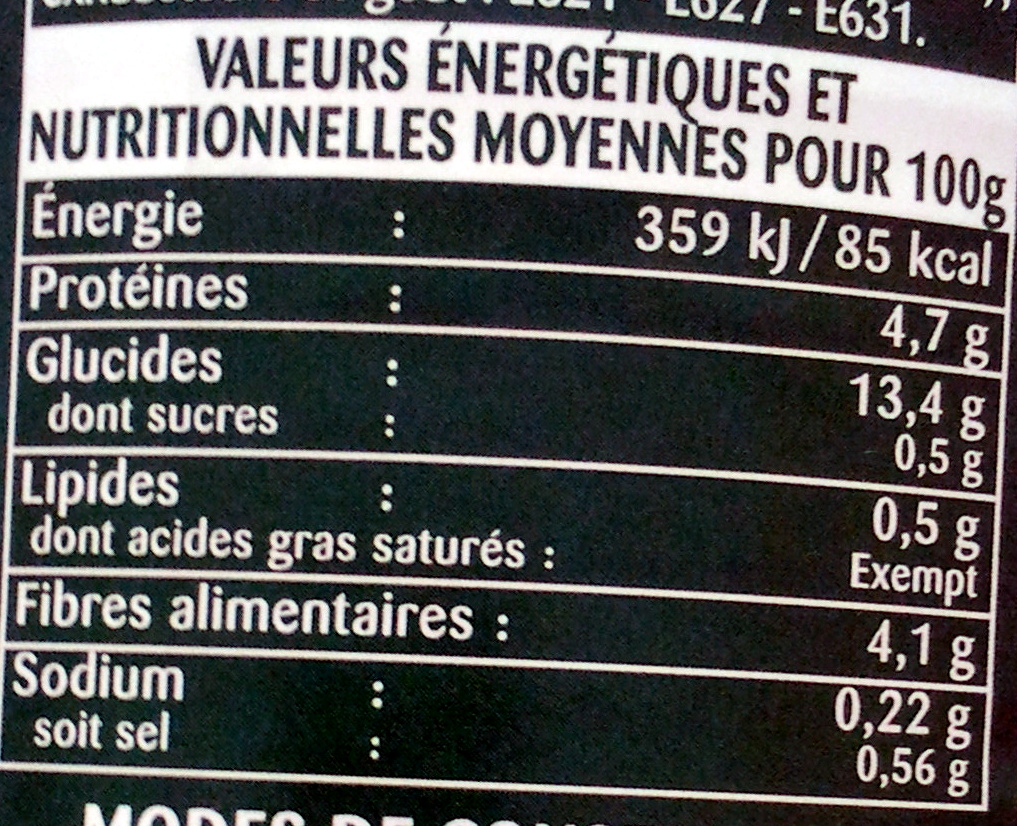
for 100 g / 100 mlCompared to: Prepared lentils Energy 359 kJ
(85 kcal)390.173 kj (95 kcal) (-8%) Fat 0.5 g 1.577 g (-68%) Saturated fat 0 g 0.389 g (-100%) Carbohydrates 13.4 g 11.525 g (+16%) Sugars 0.5 g 0.724 g (-31%) Fiber 4.1 g 4.221 g (-3%) Proteins 4.7 g 6.2 g (-24%) Salt 0.5588 g 0.708 g (-21%) Sodium 0.22352 g 0.283 g (-21%) Fruits‚ vegetables‚ legumes ~ 85.5964163508591 % 66.487 % (+29%) -
Nutrition facts (Detailed data)
Nutrition facts As sold
for 100 g / 100 mlAs sold for 100 g (packaging) As sold for 100 g (estimate) Energy 359 kJ
(85 kcal)359 kJ
(86 kcal)? Fat 0.5 g 0.5 g ? Saturated fat 0 g 0 g ? Carbohydrates 13.4 g 13.4 g ? Sugars 0.5 g 0.5 g ? Fiber 4.1 g 4.1 g ? Proteins 4.7 g 4.7 g ? Salt 0.5588 g 0.5588 g ? Sodium 0.22352 g 0.22352 g ? Fruits‚ vegetables‚ legumes ~ 85.5964163508591 % ? ~ 85.5964163508591 %
-
Ingredients
-
10 ingredients
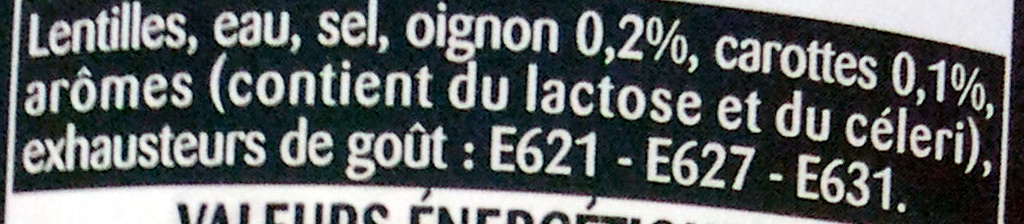
French: Lentilles, eau, sel, oignon 0,2%, carottes 0,1%, arômes (contient du lactose et du céleri), exhausteurs de goût : E621 - E627 - E631.Allergens: Celery, MilkTraces: Celery, Milk-
Ingredient information
-
Lentils: 74.1% (estimate)
-
Water: 13.0% (estimate)
-
Salt: < 2% (estimate)
-
Onion: 0.2%
-
Carrot: 0.1%
-
Flavouring: < 2% (estimate)
-
Flavour enhancer: < 2% (estimate)
-
— E621: < 2% (estimate)
Monosodium glutamate: Monosodium glutamate -MSG, also known as sodium glutamate- is the sodium salt of glutamic acid, one of the most abundant naturally occurring non-essential amino acids. Glutamic acid is found naturally in tomatoes, grapes, cheese, mushrooms and other foods.MSG is used in the food industry as a flavor enhancer with an umami taste that intensifies the meaty, savory flavor of food, as naturally occurring glutamate does in foods such as stews and meat soups. It was first prepared in 1908 by Japanese biochemist Kikunae Ikeda, who was trying to isolate and duplicate the savory taste of kombu, an edible seaweed used as a base for many Japanese soups. MSG as a flavor enhancer balances, blends, and rounds the perception of other tastes.The U.S. Food and Drug Administration has given MSG its generally recognized as safe -GRAS- designation. A popular belief is that large doses of MSG can cause headaches and other feelings of discomfort, known as "Chinese restaurant syndrome," but double-blind tests fail to find evidence of such a reaction. The European Union classifies it as a food additive permitted in certain foods and subject to quantitative limits. MSG has the HS code 29224220 and the E number E621.Source: Wikipedia
-
E627: < 2% (estimate)
-
E631: 12.0% (estimate)
-
-
-
Good for agricultural biodiversity
Contains neglected or underutilized crops: Lentils
Did you know?Since 1900, 75% of plant diversity has been lost as farmers around the world have abandoned local varieties for high-yielding varieties adapted to mass industrial processing. As a result, 60 % of human energy intake in the world comes from only 3 species: wheat, rice and corn.
Why it mattersThe lack of variety of crops makes our food supply more vulnerable to pests, diseases and climate change.
What you can doConsuming diverse cereals, legumes, vegetables and fruits contributes to:
- preserving neglected and underutilized species
- rural development and support of local farmers and companies
- preserving of diversified landscapes
- food security
- and your health!
Open Food Facts participates in the European project DIVINFOOD (funded from European Union’s Horizon 2020 research and innovation programme). DIVINFOOD aims to develop food chains that value under-utilised agrobiodiversity in order to act against the decline of biodiversity and to meet the growing expectations of consumers for healthy, local products that contribute to sustainable food systems.
Food processing
-
Ultra-processed foods
5 ultra-processing markers
-
Limit ultra-processed foods
Limiting ultra-processed foods reduces the risk of noncommunicable chronic diseases
Several studies have found that a lower consumption of ultra-processed foods is associated with a reduced risk of noncommunicable chronic diseases, such as obesity, hypertension and diabetes.
Source: Ultra-processed foods increase noncommunicable chronic disease risk
Elements that indicate the product is in the 4 - Ultra processed food and drink products group:
- Additive: E621 - Monosodium glutamate
- Additive: E627 - Disodium guanylate
- Additive: E631 - Disodium inosinate
- Ingredient: Flavour enhancer
- Ingredient: Flavouring
Food products are classified into 4 groups according to their degree of processing:
- Unprocessed or minimally processed foods
- Processed culinary ingredients
- Processed foods
- Ultra-processed foods
The determination of the group is based on the category of the product and on the ingredients it contains.
-
Additives
-
E621 - Monosodium glutamate
Monosodium glutamate (MSG), or E621, is the sodium salt of glutamic acid, an amino acid found naturally in many foods.
It is widely used as a flavor enhancer to provide an "umami" or savory taste to a variety of processed foods, including soups, snack chips, and frozen meals.
MSG is generally recognized as safe (GRAS) by food authorities. However, some people report sensitivity to MSG, experiencing short-term symptoms like headaches and flushing, though scientific studies have not shown a consistent link.
-
E627 - Disodium guanylate
Disodium guanylate: Disodium guanylate, also known as sodium 5'-guanylate and disodium 5'-guanylate, is a natural sodium salt of the flavor enhancing nucleotide guanosine monophosphate -GMP-. Disodium guanylate is a food additive with the E number E627. It is commonly used in conjunction with glutamic acid. As it is a fairly expensive additive, it is not used independently of glutamic acid; if disodium guanylate is present in a list of ingredients but MSG does not appear to be, it is likely that glutamic acid is provided as part of another ingredient such as a processed soy protein complex. It is often added to foods in conjunction with disodium inosinate; the combination is known as disodium 5'-ribonucleotides. Disodium guanylate is produced from dried seaweed and is often added to instant noodles, potato chips and other snacks, savory rice, tinned vegetables, cured meats, and packaged soup.Source: Wikipedia
-
E631 - Disodium inosinate
Disodium inosinate: Disodium inosinate -E631- is the disodium salt of inosinic acid with the chemical formula C10H11N4Na2O8P. It is used as a food additive and often found in instant noodles, potato chips, and a variety of other snacks. Although it can be obtained from bacterial fermentation of sugars, it is often commercially prepared from animal sources.Source: Wikipedia
Ingredients analysis
-
Palm oil free
No ingredients containing palm oil detected
-
Maybe vegan
Ingredients that may not be vegan: E627, E631
-
Maybe vegetarian
Ingredients that may not be vegetarian: E627, E631
-
Details of the analysis of the ingredients
fr: Lentilles, eau, sel, oignon 0.2%, carottes 0.1%, arômes (), exhausteurs de goût (e621), e627, e631Ingredient Taxonomy ID vegan vegetarian palm_oil ciqual ciqual_proxy percent min max origin labels Lentilles en:lentils yes yes 20505 74.1 49.0 99.3 eau en:water yes yes 18066 13.0 0.2 49.8 sel en:salt yes yes 11058 0.4 0.2 0.6 oignon en:onion yes yes 20034 0.2 0.2 0.2 carottes en:carrot yes yes 20009 0.1 0.1 0.1 arômes en:flavouring maybe maybe 0.1 0.0 0.1 exhausteurs de goût en:flavour-enhancer 0.1 0.0 0.1 e621 en:e621 yes yes 0.1 0.0 0.1 e627 en:e627 maybe maybe 0.1 0.0 0.1 e631 en:e631 maybe maybe 12.0 0.0 0.1
Environment
-
Green-Score A
Very low environmental impact
⚠ ️Select a country in order to include the full impact of transportation.The Green-Score is an experimental score that summarizes the environmental impacts of food products.→ The Green-Score was initially developed for France and it is being extended to other European countries. The Green-Score formula is subject to change as it is regularly improved to make it more precise and better suited to each country.Life cycle analysis
-
Average impact of products of the same category: A+ (Score: 94/100)
Category: Lentil, dried
- PEF environmental score: 0.15 (the lower the score, the lower the impact)
- including impact on climate change: 0.58 kg CO2 eq/kg of product
Stage Impact Agriculture
64.3 %Processing
0.1 %Packaging
8.2 %Transportation
14.8 %Distribution
12.4 %Consumption
0.0 %
Bonuses and maluses
-
Missing origins of ingredients information
Malus: -5
⚠ ️ The origins of the ingredients of this product are not indicated.
If they are indicated on the packaging, you can modify the product sheet and add them.
If you are the manufacturer of this product, you can send us the information with our free platform for producers.
-
No ingredients that threaten species
-
Packaging with a medium impact
Malus: -10
Shape Material Recycling Impact Box Metal High ⚠ ️ The information about the packaging of this product is not sufficiently precise (exact shapes and materials of all components of the packaging).⚠ ️ For a more precise calculation of the Green-Score, you can edit the product page and add them.
If you are the manufacturer of this product, you can send us the information with our free platform for producers.
Green-Score for this product
-
Impact for this product: A (Score: 79/100)
Product: Lentilles préparées - 800 g - U – 800 g (530 g net égoutté), 850 ml
Life cycle analysis score: 94
Sum of bonuses and maluses: -15
Final score: 79/100
-
Carbon footprint
-
Equal to driving 0.3 km in a petrol car
58 g CO₂e per 100g of product
The carbon emission figure comes from ADEME's Agribalyse database, for the category: Lentil, dried (Source: ADEME Agribalyse Database)
Stage Impact Agriculture
24.3 %Processing
0.1 %Packaging
22.2 %Transportation
42.0 %Distribution
11.5 %Consumption
0.0 %
Packaging
-
Packaging with a medium impact
-
Packaging parts
Box (Metal) - In contact with food
-
Packaging materials
Material % Packaging weight Packaging weight per 100 g of product Metal
-
Transportation
-
Origins of ingredients
Missing origins of ingredients information
⚠ ️ The origins of the ingredients of this product are not indicated.
If they are indicated on the packaging, you can modify the product sheet and add them.
If you are the manufacturer of this product, you can send us the information with our free platform for producers.Add the origins of ingredients for this product

Report a problem
-
Incomplete or incorrect information?
Category, labels, ingredients, allergens, nutritional information, photos etc.
If the information does not match the information on the packaging, you can complete or correct it. Thank you! Open Food Facts is a collaborative database, and every contribution is useful for all.If you want to report vandalism, inappropriate content or erroneous data you can't fix yourself, report it to our moderators team.
Data sources
Product added on by edzeronk
Last edit of product page on by new-nutrition-bot.
Product page also edited by jacob80, packbot, teolemon.